Painted Wood Flooring, A Swedish Design Must Have – Part 5
Painted wood floors are making a come back, and we believe that painted floors will become even more popular than we see today. In the past, finer homes installed decorative parquet floors and inlaid patterns. In the 17th and 18th century paint also was the means to create these decorative patterns on the floor, many which mimicked parquetry. Painted wood floors made it possible for more light to enter into the home, as the winter season in Sweden was quite dark. Rustic unfinished wood over time, darkens, and painting the wood just seemed like a practical approach of having a brighter home without spending a bundle.
Raw wood accepts paint so much nicer, and allows the paint to distress beautifully over time. Sanding wood, allows the paint to soak into the wood, compared to painting over varathane floors which may scratch easier with foot traffic. Homeowners with existing floors often have to carefully think carefully about how they go about re-finishing their wood floors,because the process can be pretty involved. Refinishing wood floors can seem more labourous than painting, and often times it is. Sanding wood floors can be a time-consuming task.
There are a couple steps that cannot be skipped and we list them out below:
1. Prep
This involves removing your furniture from the room. Once you start belt sanding the floors, there will be dust everywhere. It can be a bit time consuming sealing off the house with drop cloths, or plastic tarp, but it is necessary for a great finish.
2. Sanding
The most time labourous part by far is sanding. Using a belt sander will kick up a ton of saw dust, and cleaning up the dust, which ends up everywhere becomes a tedious job. Sanding an entire floor can take up to 4 hours or several days depending on the size of the room.
Renting industrial professional tools saved my husband and I a lot of time when we refinished parquet floors in a rental in Virginia. Drum sanders are large machines that can handle large floors, and are very easy to operate. Drum Sanders can be rented at around $40 to $50 per day. I would highly recommend it than using a small scale sander that you can buy from a Hardware store.
Most homeowners choose to rent the specialty equipment and then purchase the more standard tools at their local hardware stores. Edge or orbital sanders are terrific for sanding the edges of the floor that the drum sanders cannot reach. A handheld power tool lets you tackle the tight corners, and are worth purchasing outright from Home Depot or Amazon. They allow you tools for additional furniture projects in the future.
3. Staining, or Painting
While everyone in the design community has their favorite paint brands, I would highly suggest going with a oil based paint. Oil holds up longer and has a tougher finish than any water based brands.
I would highly suggest sanding your room down to its bare wood, before painting. Painting over an existing paint is always possible, but the extra work pays off when the paint naturally distresses over time, which shows the wood through rather than an unsightly under color.
Sanding down to the natural wood also allows you to pickle the floors. White washed floors in my opinion are much nicer than painting the floors, because the wood gives the room a bit of depth and natural appeal.
In this post I show a photo of the Behr Wood Stain that is highly recommended. The stain is available in a number of colors, and evens out nicer than just paint that is mixed with water. Behr has a number of colors available that are off white, gray, beige that would work nicely with the Swedish interior schemes. Mixing paint with a bit of water or stain work rather nicely.
Many people suggest applying paint with a professional paint brush which gives a smooth finish, rather than with a roller, which creates a stippled finish. Today you can purchase smooth rollers which can be used with extension pole to apply paint. Rollers are inexpensive ranging from $4 to $7 per pack. A pole will be anywhere from $5 to $40, depending on length and material.
You can choose a variety of different approaches with your paint choices….
If you decide to work with an existing painted floor, a great oil based primer is “Coverstain by Zinsser” This paint can be tinted almost any lighter color, dries very fast, and can be mixed with most other oil paints. Coverstain is in fact a primer that will adhere to almost anything, and would be a fantastic choice for the floors.
One gals review of Coverstain -“Zinsser oiled based primer is like gold”
(Please note that Kilz or Coverstain primers should never be used on concrete floors. Go to Lowes or Home Depot, and buy stain or paint made just for concrete floors. Concrete stain doesn’t flake off on concrete like paint does)
As a top coat on your wood floors, you can purchase a Water-based polyurethane clear varnish, to seal in the tinted paint, or purchase water based, or oil based paint for your top coat. I have tinted this paint many shades of gray, blue, green and yellow. It is marvelous on furniture. This primer dries flat, allowing almost any other paint to be applied to it. It serves as your primer and your base paint, allowing you to just then seal the color in with a water based sealant.
If you are working with a previous painted floor, floors need to be sanded for the paint to stick properly. The worst is when you skip sanding, and the first time you move a furniture piece only to have the paint come off in sheets, or scratch. You will have regretted not sanding.
Sand first, and then paint the floors with a paint formulated for the flooring. We had painted our deck with paint formulated for the outside, and we are so glad we spent the extra money, because rain or snow, the paint hasn’t chipped.
4. Sealing
Polyurethane is an oil based sealant, that is NOT suggested for lighter colored paints. If you use this over your floors, in a week or a matter of days, the floors will have a tinge of yellow. You might then have to consider re-painting your white floors.
Polyurethane works perfect on unpainted wood, or on darker paint colors such as red, navy, black and so forth. A water based varnish is required for lighter based floor colors such as light gray, white, or cream.
You’ll have to wait 6 hours for each coat of polyurethane sealant to dry. It is recommended that most floors require at least 3 coats to achieve best results, and many professionals suggest 24 hours in between each coat of urethane. It also takes up to 3 days before you can move furniture back into the room and walk on the floors again.
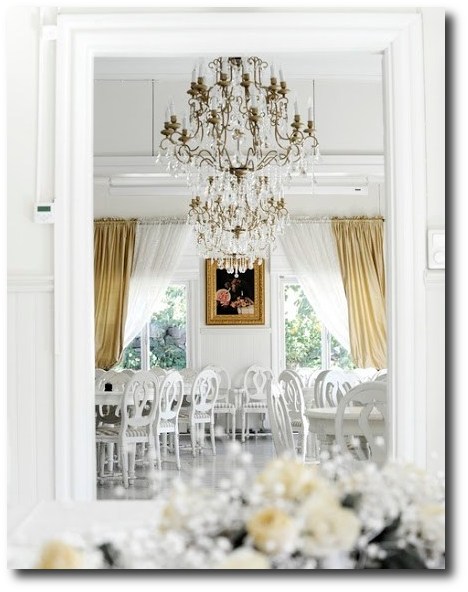
Onni Hotelli Kuvia Picture Credit Ranskalainenpatonki.blogspot
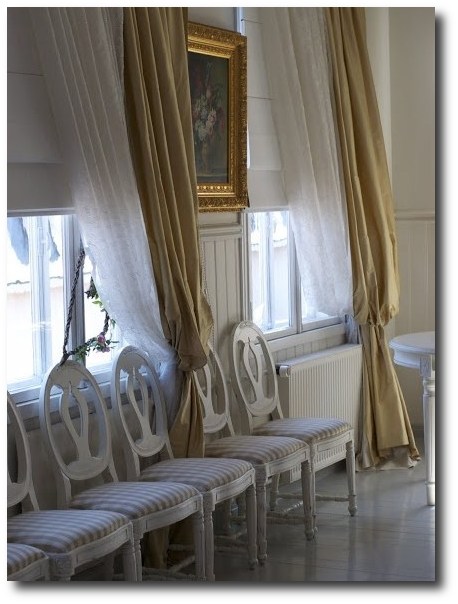
Onni Hotelli Kuvia Picture Credit Ranskalainenpatonki.blogspot
Belle Maison Corbeille Bed- Featured in Swedish Decorated Room With Painted Floors
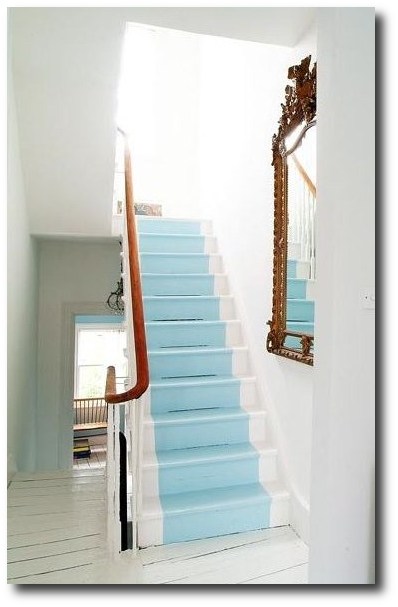
Blue Painted Wood Stairs
A Colonial Floor Makeover by Sara Kate
Sara Kate and her husband painted their summer house floors in an oil paint. Here are some of their remarks……..
“Moving the furniture was easy, the problem was working with the paint. I made a big mistake in laying the second coat on too thick and painting on a rainy day. The humidity and the thickness caused the paint to wrinkle, clot and appear dull and matted. I had to work hard to undo my mistake.”
They suggest using a Polyurethane based porch and floor enamel. After cutting the edges with a
brush, roll on a thin coat with a 1/4 inch roller. Keeping the heat on insures the paint will dry fast. He then suggests to roll at least two more thin layers and allow at least 24 hours between coats
Here are a couple of tips from the comment section of the article.
“Three simple lessons from eveyone’s paint woes: 1)PRIME- Frankly, no one wants to do this but priming is not a paint company scam – especially on a floor. Primer is NOT paint (anyone who’s had the lowly job of brush cleaner -such as I- can tell you that primer is much harder than paint to clean out of a brush. Pros, in my experience, will often designate some brushes for primer only). Think of it as glue that will hold the paint onto whatever’s beneath it. (and, yeah, tinting the primer is a nice trick and the paint store should do this). 2)PATIENCE. I assume you are all painting with a gloss finish. 24 hours minimum on this. 3) Relax with the dusting! Dust falls. Your sweet new floors are gonna trap some dust as they dry. “
“An alkyd paint dries overnight, but takes 28 days to cure to maximum hardness.”
“A response to a fainted floors in a rental apartment- I know you didn’t want to put down a rug to lighten the floor, but how about painting a floor cloth? You can get a large canvas drop cloth from a home improvement centre, Paint it with any kind of paint you want. After it is dry, put at least 2 coats of polyurethane sealer on, letting dry completely between coats. You are in control of the design, you don’t have to worry about putting the floor back to a rental state because you can lift the cloth and take it with you!”
“Katherine – A Painter – To those who asked about painting various surfaces, and those who asked about primer: Sanding and primer are twin keys to getting paint to adhere to almost any surface. Start with a clean surface — remove grease, wax, and anything chalky. If there’s any gloss or if you’re concerned about adhesion, do a light sanding with 150 0r 200 sandpaper. On a floor, you can use a floor sander with a screen… available at a rental shop. All you want to do is de-gloss so the primer has something to hold onto. (If you’re going over polyurethane, you have to scuff it up diligently, because poly doesn’t want to stick to anything.) Then prime with any of the primer-sealers that mention “excellent adhesion” on the label. Kilz, BIN, Bullseye… these are a few of the big names. A water-based primer-sealer is fine. If you’re making a drastic color change, look for a primer that is int0 tint-able, and tint it in the direction of your final color, but not necessarily matching the final color. The only time you will have a problem is when the surface is already painted and the existing paint isn’t adhering well. There isn’t much you can do about that, short of removing that old paint.”
“Red paint is difficult because red pigments are transparent therefore they need many more coats to give a good coverage – the purer and clearer the red the more transparent it is – burgundy reds and terracotta reds will cover better as they have other pigments in them which are not transparent”
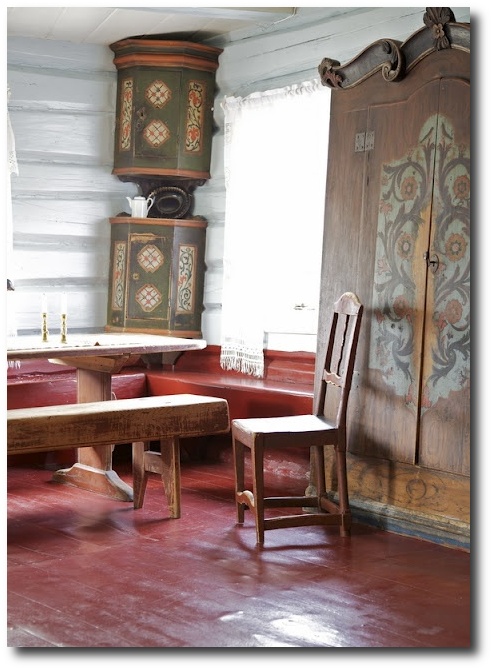
“When I stained my concrete, I got the acid at B. Moore. Instead of painting concrete, stain it instead. Staining is much prettier. B.Moore has many colors of concrete stains. Regarding the wood floors, they are worth so much more sanded and stained. To cut the cost, only hire out the sanding, and do the staining and sealing yourself. You will save at least half. I discovered this myself when some floor guys failed to return to finish my floors. I had only paid a small deposit, and they had finished the sanding. When I realized how easy and cheap it was going to be to finish the floor myself, I was thrilled they had deserted me.”
“All kinds of great coatings for all different applications (floors, countertops, faux stone/granite, etc.) are available at ArmorPoxy.com. I’ve used several of their products and all with great success. Particularly fabulous is the “For Dummies Bath Refinishing Kit”. You can use it on your tub, sink, tile, etc. and it makes everything look like brand new white porcelain. It’s truly amazing and easy to use. I did my bathroom more than 2 years ago and it still looks amazing….”
Another interesting comment-
“Concrete can be a tricky beast, especially in a basement or former garage that might have dampness or oily spills on the floor. You’ll have to clean and degrease the floor thoroughly, and if it has a very smooth, shiny surface you’ll need to etch it with muriatic acid to give it some tooth. There are special primers for concrete floors–use one. It really will make a difference. I painted the workroom floor in my basement without using a concrete primer, and the mineral salts in the concrete came up through the paint. I then had to strip away as much paint as I could, re-prime with concrete primer, and re-paint in order to fix the problem. Don’t be me. Use the primer the first time, and save yourself the headache.
Plywood, chipboard, and particle-board subfloors are easy to paint–sand the rough spots, prime, paint. Use an oil-based primer suitable for raw wood in order to keep stains from rising up through the paint.
If you think you might want to change the color every few years or so, don’t apply a water-based polyurethane, as it will keep future layers from sticking as well. Just paint the floor, touch it up as needed, and repaint as desired. The higher the paint gloss, the better it holds up, so use either high-gloss or semi-gloss, rather than urethane.
Use oil-based primers, yucky as they are. They block stains far better than latex primers, and provide better adhesion. Given how much wear a floor takes, and how much work it is to re-paint, do it right the first time. You can use latex paint over them, and subsequent paint jobs will not have to be re-primed (unless you’ve worn through to bare wood, but spot-priming will take care of that). If you have a really stubborn rust or dye stain that bleeds through oil-based primers, pigmented shellac will usually kill it (it’s the one thing that keeps the Calcimine often used as an interior finish in old houses at bay, and that stuff is pure evil).
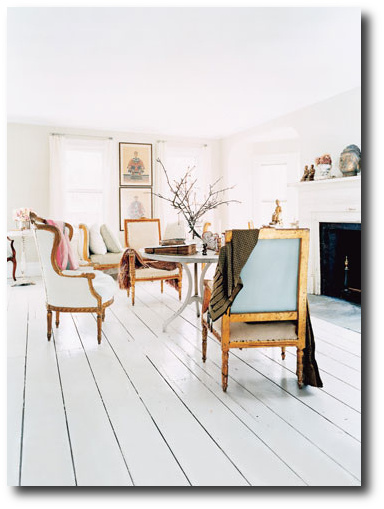 Swedish Flooring Looks From Domino Magazine
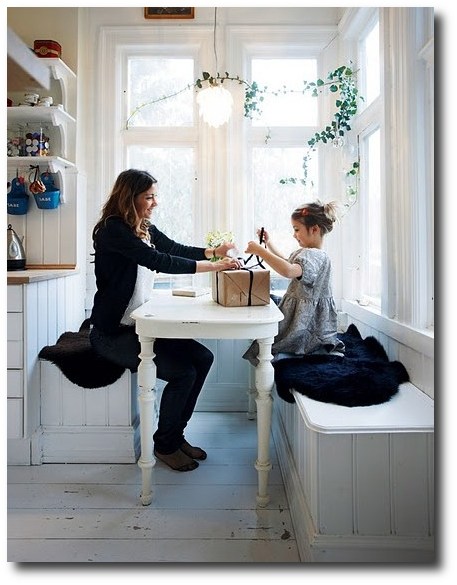
Swedish Interiors With White Painted Wood Floors
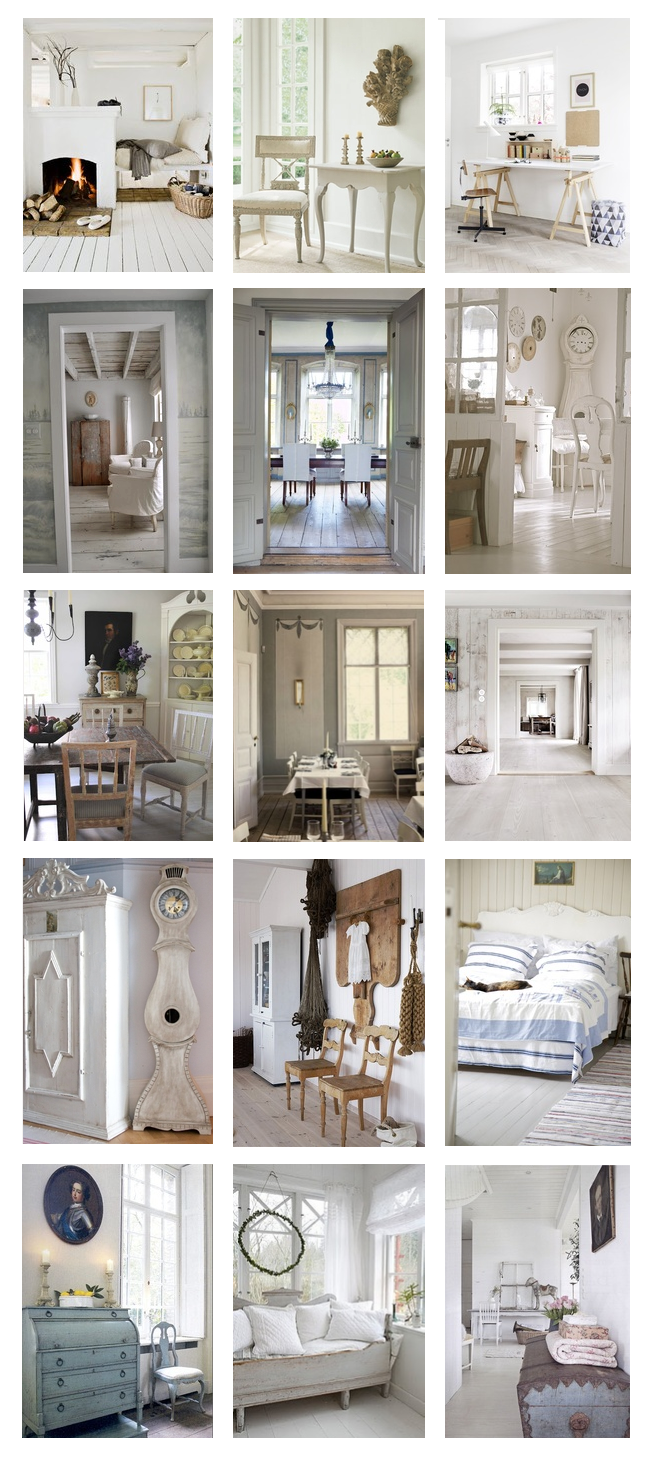 Swedish Interior With White Painted Floors


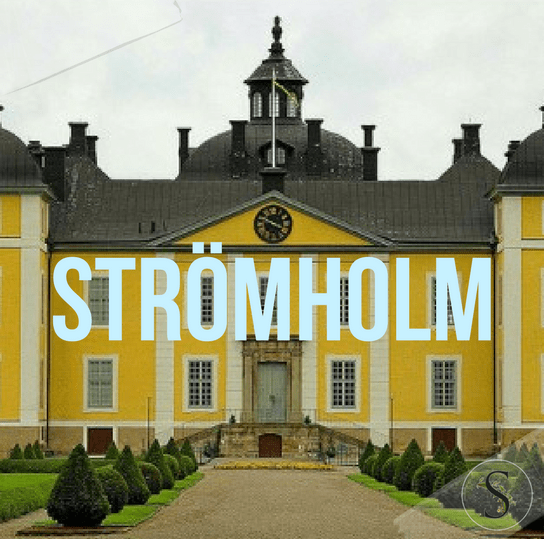
The Romantic Baroque Style: Part 1- Stromholm
If the Renaissance history is of interest to you, chances are you will love Baroque style. It is a design style isn’t that commonly seen in magazines, because the antiques are harder to find. If you are thinking about a design that is different and unique, this is certainly it! Baroque style originated in the 1600s in Italy before spreading throughout the rest of Europe. It originated in Rome, where the style was representative of the Catholic church, and was later adopted in the court of Louis XIV at Versailles. From there, the style spread to The Netherlands and Britain, and went on for almost two entire centuries, and became a less dramatic by the time the end of the 1700s.
Baroque didn’t go out of fashion suddenly. Rococo style was adopted, beginning in France in the late 1720s, especially for interiors, but the Baroque style continued to be used in architecture and interior design until the clean lines of Neoclassicism became the dominant style in the later 18th century.
Baroque style is a very ornamented style. Characteristics of this furniture are heavy, grand, theatrical, elaborate, and often rich in molding. The furniture is often very heavy detailed, did we say very heavy detailed? It is common to find baroque pieces which are intricately hand carved, such as turned legs and twisted columns. Louis XIV style is considered to the most identified example of Baroque style.
Baroque furniture is often larger in size. Canopy post beds are a good example of this. They were often grand with an excessive amount of carving. Cabinets, beds and chairs are all common pieces of furniture made in the Baroque style.
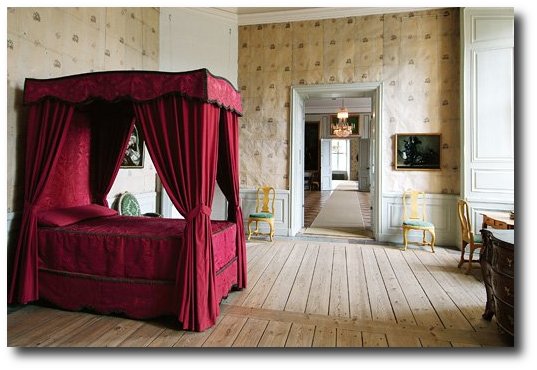
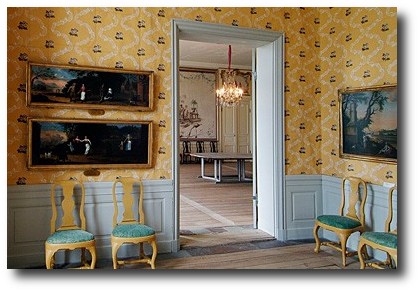
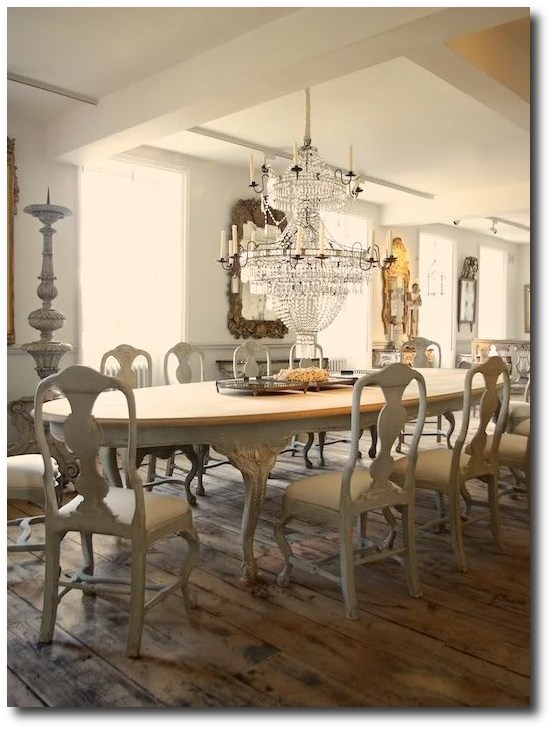
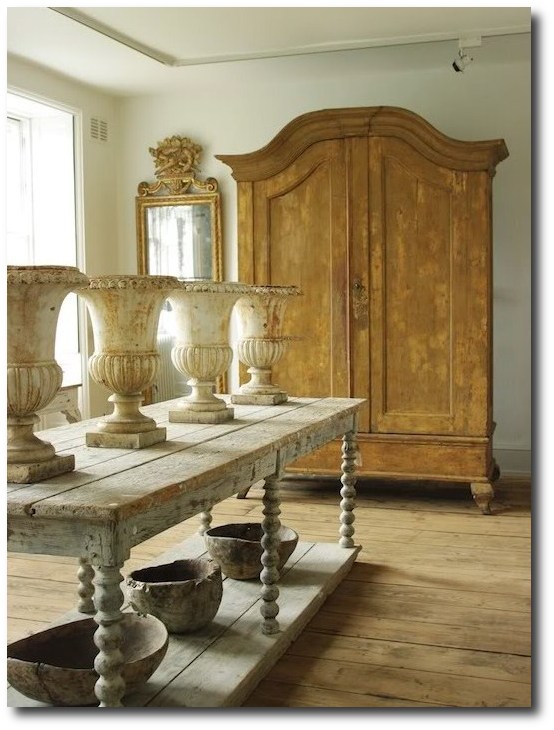
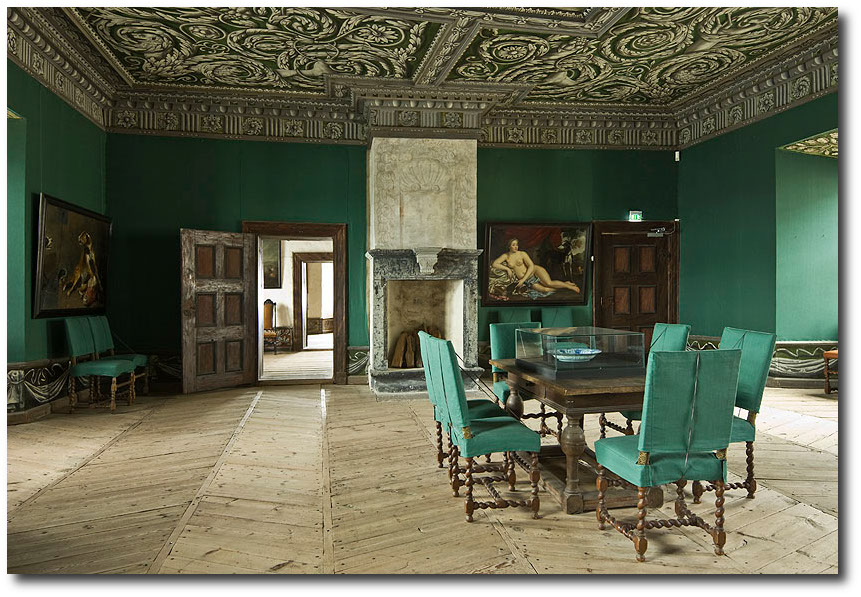
Sweden’s Strömholm’s yellow palace embraces the baroque style. This palace is a perfect mix between the baroque style with a Swedish flavor that is not at all Italian. Strömholm is located on the largest of three islands in the Kolbäckså river delta at Lake Mälaren. King Gustav Vasa had a farm on the property during the 1500’s. In 1560 the current castle was built between 1669 and 1681 for Queen Hedvig Eleonare. Strömsholm palace is one of the countries best examples of Baroque style. The Palace has royal interiors that are well preserved.
Additional Furniture To Admire
– A Swedish Baroque Table with Original Paintwork 1720s
-A mid 18th Century Swedish baroque drop-leaf table with its original blue paint
-A Swedish Baroque Centre Table circa 1750
-In Love With Swedish Baroque Mirrors
-Swedish Baroque drop-leaf table with original paint- Dienst + Dotter Antiques Picture 11
– Swedish Tray Topped Tea Table. Scraped to original blue paint. Beautifully shaped top with edge molding.Balustra shaped base on three legs.

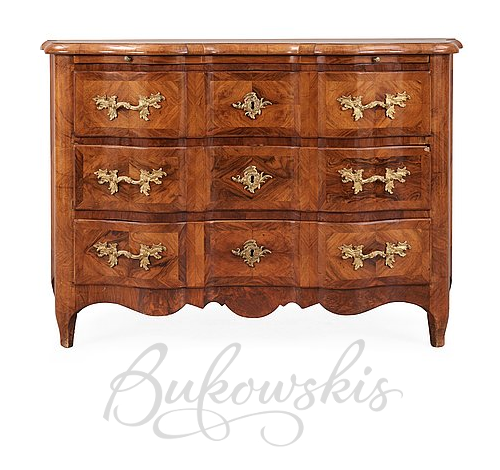
A Swedish late Baroque 18th Century commode, attributed to J. H. Fürloh.
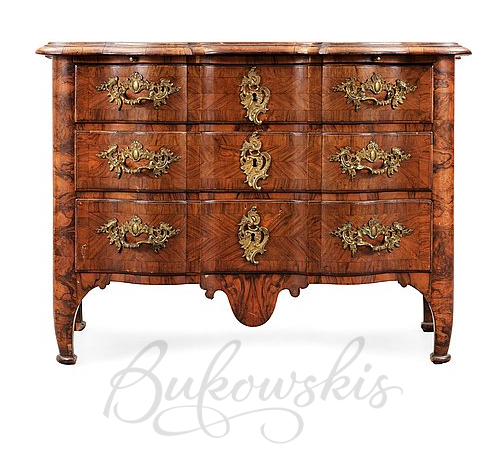
A Swedish late Baroque 18th Century Commode
Baroque Furniture From Augustus Brandt Antiques- Check out more pictures here
The Romantic Baroque Style: Part 2 King Gustav Vasa
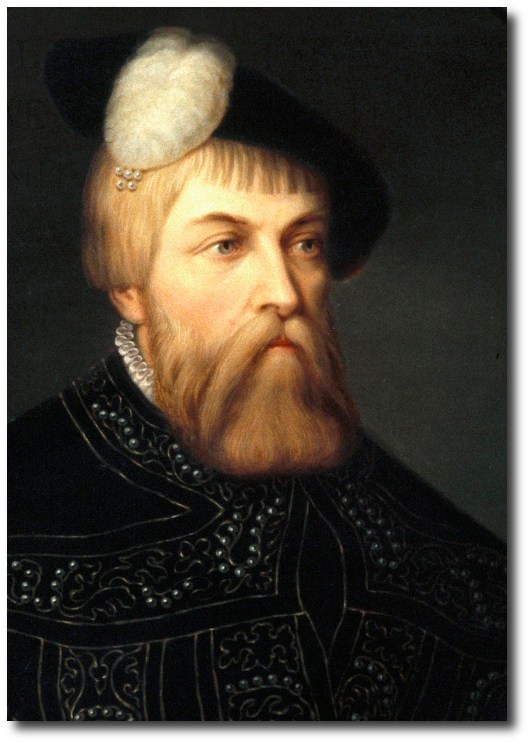
Gustav I of Sweden, born under the name Gustav Vasa (12 May 1496– 29 September 1560), was known one of the most powerful kings in Swedish history.
Gustav was the son of a Swedish senator and of a noble family whom played a prominent part in aristocratic politics of 15th-century Scandinavia. He was raised in the courts of Sweden, and participated in the fighting against Denmark. In fact, the connections his family had with the royalty at the time, supplied Sweden with three regents.
Gustav fought in the army of Sten Sture the Younger against Christian II of Denmark in 1517–18. Sweden at that time was a part of a union consisting of the Nordic countries (Denmark, Norway, Sweden and Finland), but the union was a mess in many ways. The Danish king, Christian II tried to dismantle the union by using brute force. King Christian attacked Sweden in 1520, and the Swedish Regent was killed. It was then that Gustav found himself held hostage in Denmark, but later returned to Sweden when the King promised to show leniency towards those nobles who wanted to fight back.
The Danish king, Christian II then called a “friendly” meeting with all of the officials, but Gustav chose to stay home. Gustav found himself spared because of that decision. Christian II rounded up the nobles, and bishops and had them beheaded in the Great Square in Stockholm. Gustav’s father, brother-in-law and uncles were murdered, together with about 75 other men in a mass execution known as “the Blood-bath of Stockholm”.
The Vasa family lands were confiscated, and most of Gustav’s family were imprisoned. Instead of hiding or running, he rose to the occasion and started fighting back by engaging the people of Sweden to rise up for their country. He started sowing the seeds of rebellion against Christian II . The army of Denmark pursued him, but he managed to escape which many tales of these adventures are told today. He managed to receive backing from the Hanseatic League, which also wanted the Danish king weakened. This union allowed him to gather together a sizeable army, and in 1521 he was elected Regent of Sweden. This army then attacked the Danes in several engagements, and step by step managed to oust the Danish king.
Gustav pushed through to establish Sweden’s independence, and his leadership through this time may have been what was responsible for his election as king. In 1523, at the age of 27, Gustavus was elected King of Sweden. He set about reforming the country, using methods inspired by rulers like Henry VII and Henry VIII of England.
Gustav made Sweden an independent state and gave his country, for the first time in a century, nearly 40 years of stable and intelligent government. Gustav managed to unite Sweden, and also laid the foundation for Sweden’s professional army that was to make Sweden into a regional superpower in the 17th century. He managed to shape the foundation for modern Sweden.
Beyond those great achievements, he ranks among the heroes of Swedish history because of his struggle to turn Sweden from a Catholic country to a Renaissance state with a Protestant church. This was by far some of the hardest wars many countries had to battle.
In the documentary A Lamp In The Dark: Untold History of the Bible, goes into great detail the tremendous struggle individuals had to endure throughout the Middle Ages. I highly recommend watching this documentary on You tube to gain a better appreciation for the battle against the Catholic church.
The Catholic church was against having the bible in the hands of the common man, and threatened imprisonment and death to any persons who disobeyed their rule. Valiant warriors of the faith in England such as John Wycliffe, William Tyndale, Martin Luther, considered the cost for the sake of sharing the Gospel that salvation IS through Jesus ALONE, not through works, or anything else. They rejected the notion that the Catholic church set forth such as “sacrament” which individuals had to confess their sins to a priest instead of through prayer to our heavenly father to forgive our sins. (1 John 2:1-2)
The Catholic church positioned itself in control of individuals souls (salvation), and even went as far to ask money from people whose loved ones had died whom could be removed from “Purgatory” (Hell), which they taught every believer goes first, which was contrary to scripture. The Catholic church’s sheer dominance made them extremely wealthy because of the vast amount of people willing to paying money to remove their loved ones from the “Purgatory”, and this allowed the Catholic empire to throw their weight around in many countries. Believers also fought ideas brought by the Catholic church that the Pope was Yahweh himself on earth, stated by Pope Leo XIII, Pope Innocent III, and Pope Boniface VIII, which contradicted scripture. Once the common people were able to read the Bible, through the Protestant Reformation, they could hold the Catholic church accountable by the scriptures themselves.
Gustav fought hard to ensure the triumph of Lutheranism (named after Martin Luther), and the suppression of Roman Catholic customs. Gustav Vasa has been known as the founder of modern Sweden, and the “father of the nation”. Gustav looked up to Moses, whom he believed to have also liberated his people and established a sovereign state. Gustav I’s breaking with the Catholic Church is virtually simultaneous with Henry VIII doing the same in England; both kings acted following a similar pattern.
To understand the Baroque period, a person must take into account the religious and political tensions at the time. The Catholic church during this time was a very powerful entity and one of the biggest customers of of art. During the seventeenth century artists were being asked by the Catholic Church to create pieces of art which then could transend a message through which could be then understood by the uneducated common people.
The Catholic Church through this time was going through some major changes known as the period of ‘Counter – Reformation’ which began with institutional changes within the Catholic church as we discussed earlier. The clergy recognized that they could communicate through art by using the more theatrical ‘Baroque’ interpretation of religious themes. The Church buildings were designed and decorated in such a way which the Catholic church itself was trying to build it’s own empire kingdom apart from the Kingdom of God which we are told through the bible was the bodies of his people, not buildings and objects.
The mass amount of wealth church accumulated through using the very word of God in deceptive ways allowed them to buy thousands of paintings, thousands of statues, and buildings that were the best of the best through this time period. They owned the nicest buildings, and the most beautiful art across Europe, so it was no wonder why their style at the time became the design that many copied in architecture, interior design and so forth.
The upper classes ALSO loved to show off their wealth and saw this new style as rich, and unreachable for the common folks, so they embraced it, hoping to stand out. Wood carvings appeared lavish, and obviously was a style that many of the peasants could not afford. Baroque art and architecture was one approch they used to wave their money for the world to see.
From Italy, Baroque quickly spread to essentially every country in Europe. Each country incorporated its own customs and heritage with Baroque. Some were more extravagant and others more conservative with the design style. In Italy we saw tremendous detail in the furniture, where as in Sweden we saw more of a refinement with the style. The overblown carved details were softened, and mimimized. During the middle of the 16th century the Baroque Era gradually gave way to the Rococo, and this wave of style change hit each country at a different time in history.
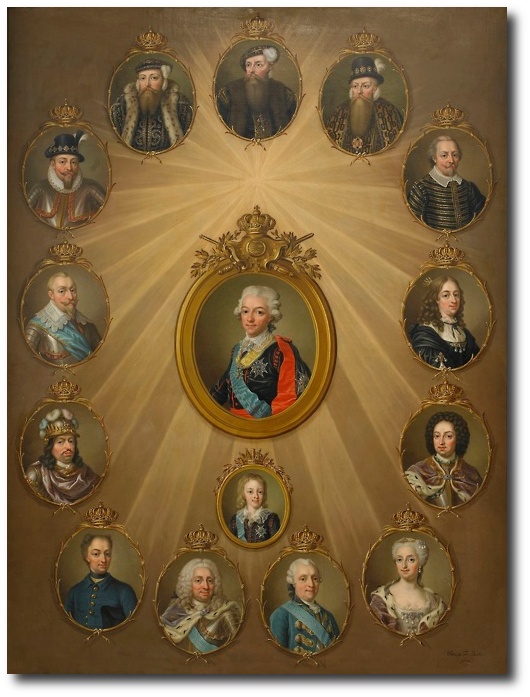
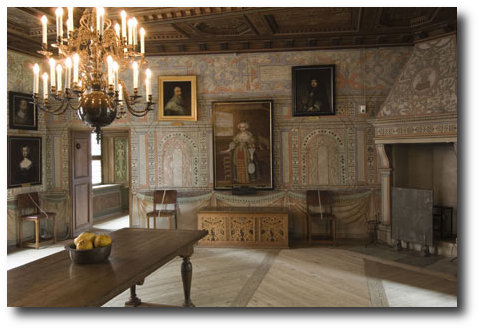
Gripsholm Castle belongs to the famous castles in Sweden.
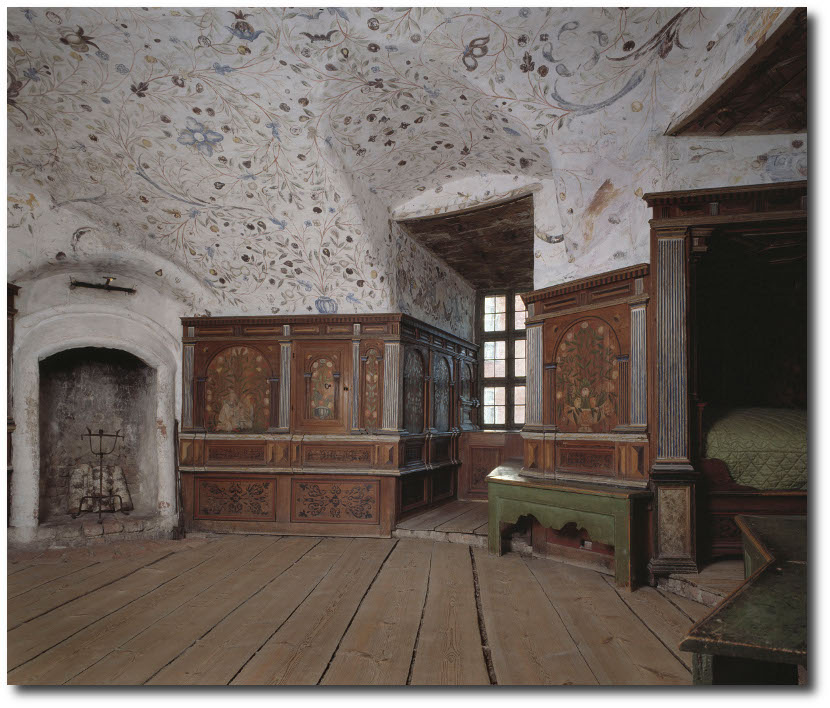
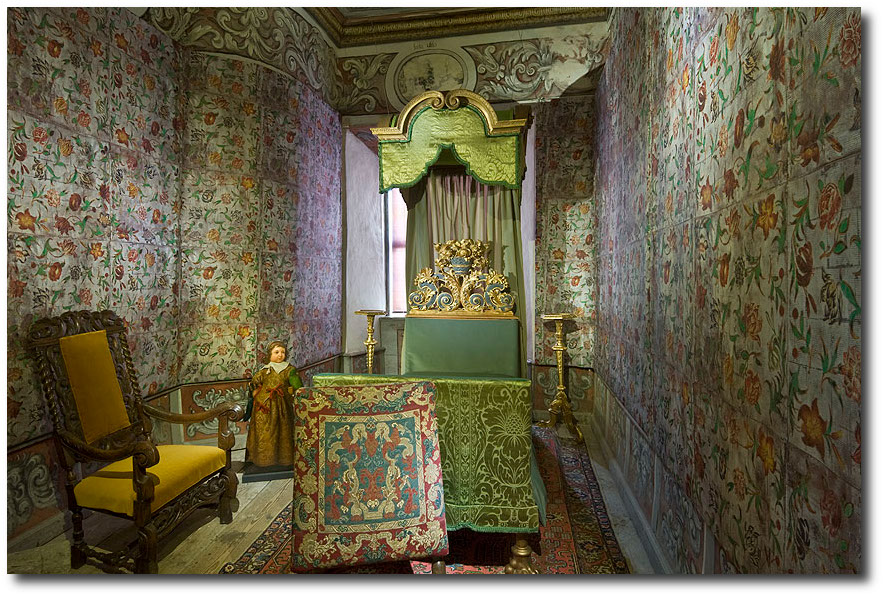
This view shows how kings slept in the chamber of Charles IX.
Gripsholm Castle, Stockholm – Home of King Vasa And The Royal Family
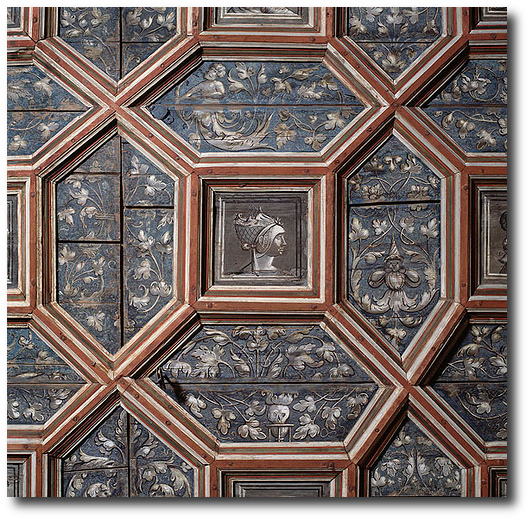
Gripsholm interiors – Roof decorations National Museum Stockholm’s Flicker
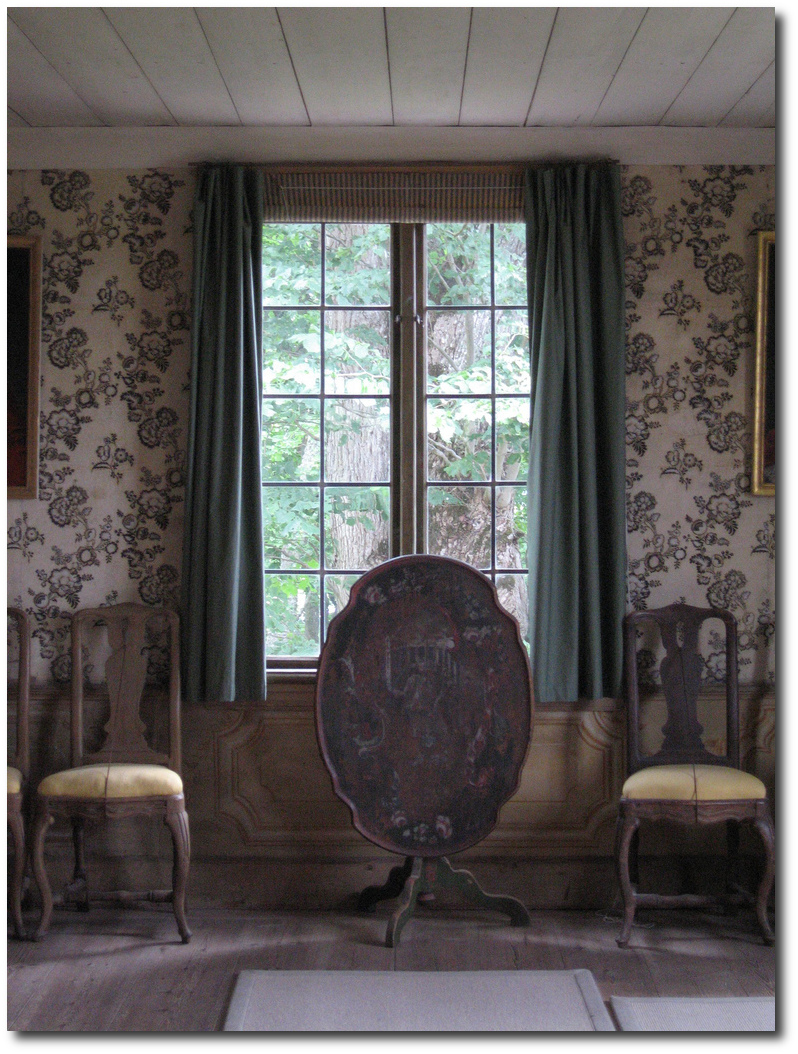
Swedish Baroque Style Seen in The Linnaeus House -Elmar Eye’s photostream
National Museum Stockholm’s Flicker
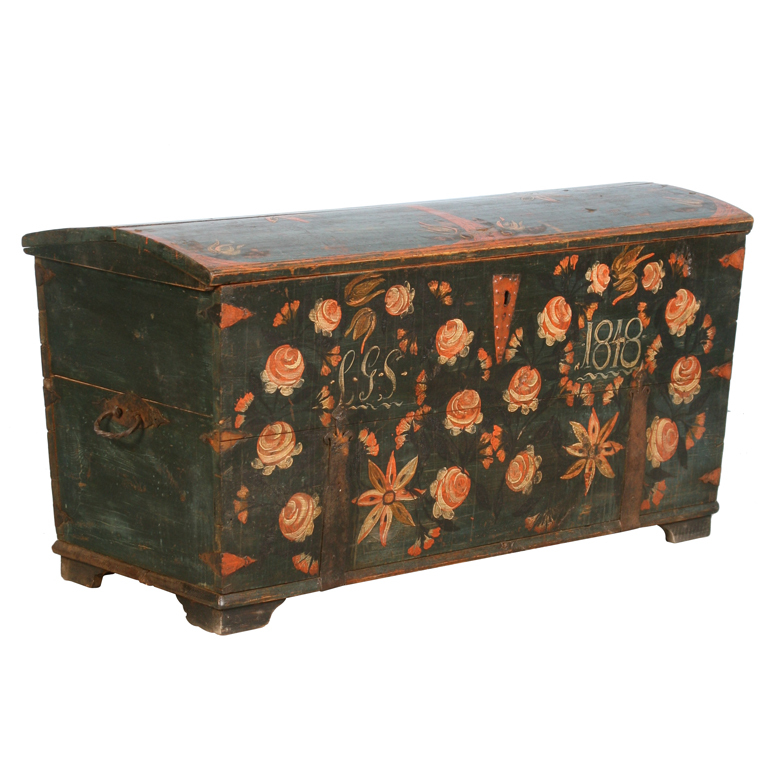
Antique Original Painted Swedish Trunk, dated 1848 From Scandinavian Antiques
The reign of continued with Gustav’s sons Eric XIV, John III, John’s son Sigismund, and finally Gustav’s youngest son Charles IX.
Under Eric XIV the Reformation in Sweden proceeded on the same lines as during the reign of his Gustav Vasa, retaining all the old Catholic customs not considered contrary to Scripture.
After 1544, when the Council of Trent had formally been declared, the new teachings set forth by the Catholic church became obvious to that the Christian Bible, and the Catholic church were quite different. In fact, The Catholic Church created horrible laws at the Council of Trent that made it a death sentence for anyone who said the bread and wine used in Holy Communion were only symbolic. Sadly this entire history of the Catholic church has been covered up. Today the laws set forth in the Council of Trent still stand, and are upheld by the current Pope. The Popes during Vatican II Council have accepted the entire ratification of the entire council on this decree (Council of Trent, Session 13 Chapter VIII, Contradicting Hebrew 9:27-28; 10:11,12, 15)
King Gustav Vasa went on to publish a bible in Swedish for the people of his country. If he attended the “the Blood-bath of Stockholm” perhaps Sweden wouldn’t have Yahweh’s holy word, and perhaps never knew what Yeshua (Jesus) did on the cross for them. The Swedish Bible was published in 1540-41. The men behind the translation were Laurentius Andreae and the Petri brothers Olaus and Laurentius. Of them, Archbishop Laurentius is regarded as the main person. However, had the work not been commissioned by the Swedish King Gustav Vasa, who had in effect broken with the Pope in Rome in the 1520s, the work would not have been possible. The Bible follows the German version by Martin Luther from 1526 closely, not only in language, but in the fonts used and the typography as a whole. The Danish version, printed a few years earlier, also did this.
Charles Spada’s Normandy Home- See Part 1 and Part 2
The Romantic Baroque Style: Part 3 Skokloster & Steninge Palace
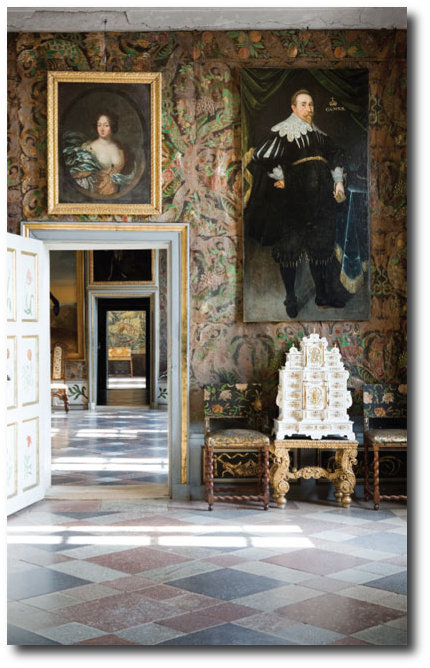
Swedish Skokloster Castle In the Baroque Style
King’s Hall in Skokloster Castle, Sweden
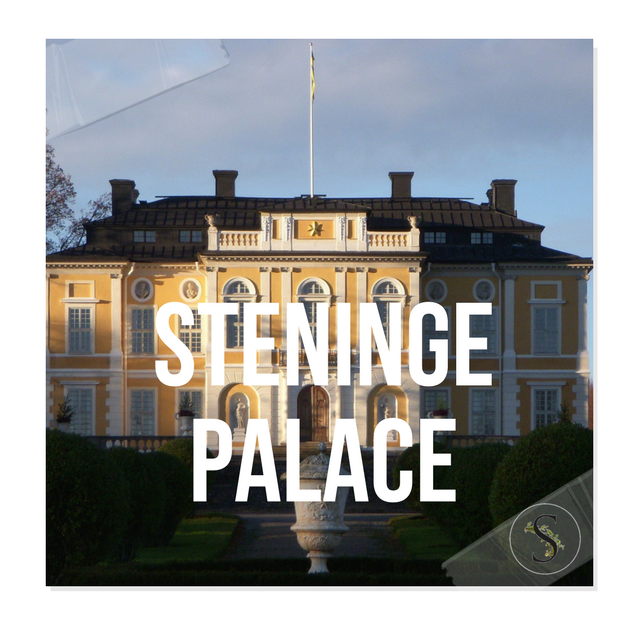
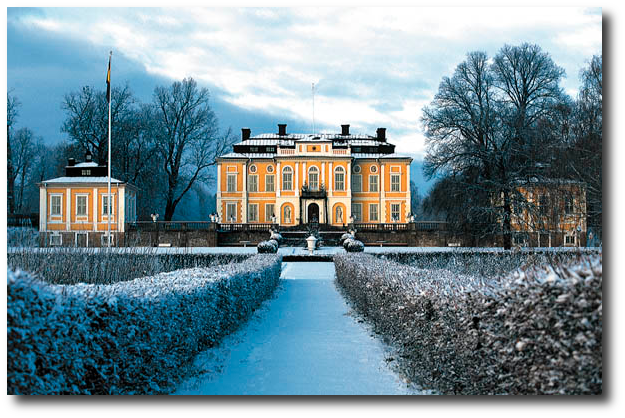
Steninge Palace, is called “Sweden’s most beautiful and perfect baroque building” Steninge, another palace located in Sweden stretches back to the 13th century. The palace has had countless owners; the Gyllenstierna (1649-1735) and von Fersen (1736-1839). In 1667, Carl Gyllenstierna 1649-1723, inherited the Steninge estate from his mother. His close relationship with the queen allowed him to develop the Steninge estate and the beautiful areas around Mälaren.
In 1680 the well-known architect Nicodemus Tessin the Younger was asked to design the Palace which were completed in 1705. Tessin was strongly inspired by the Baroque architectural style of Italian and French castles. This castle has only a few very small pictures of the interior, so sadly the interior isn’t photographed at large and available to the public. Nicodemus Tessin designed Steninge Palace with a blend of the Italian and French Baroque style with Swedish taste. It is said later that Tessin the Younger regarded Steninge Palace as his masterpiece.
Skokloster Castle is another castle in Sweden decorated in the Baroque styles, and is said to be one of the most important Baroque castles in Europe. Skokloster Castle was built as a residence between 1654 and 1676, when Sweden was a great power. Even to 17th century people, the imposing white building with its corner towers made a fairytale, ancient impression.
Steninge Palace Photographed By Keith Samuelson.com
See Information on Steninge Palace Here
Skokloster Castle From Adventures of A Far Traveler Blog
Skokloster Hallway – Photo Credit Richard Aufreiter
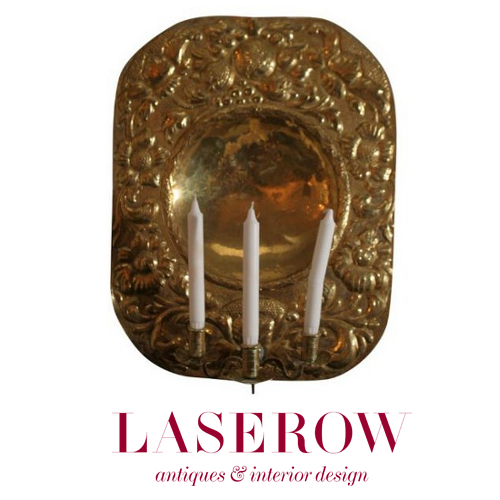
Large Swedish Baroque Brass Wall Sconce
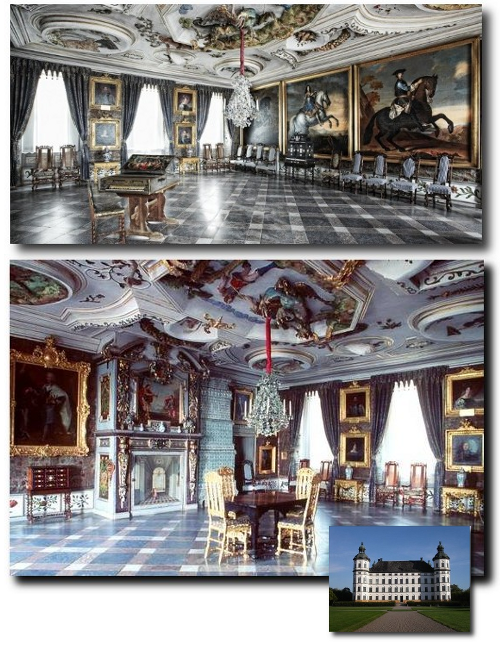
Skokloster Castle
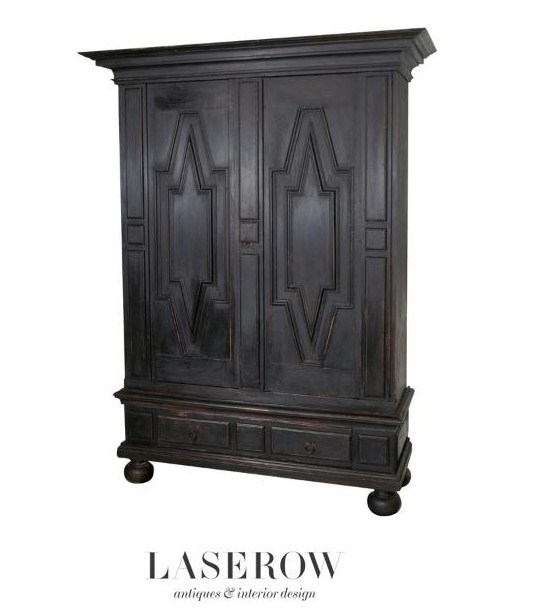
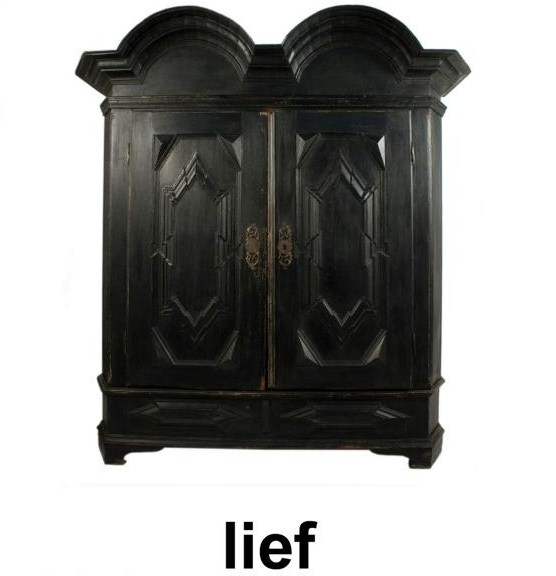
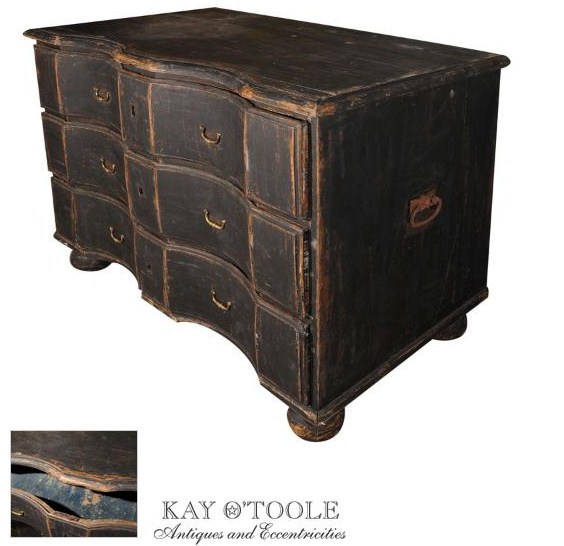
Two Door Black Swedish Baroque Cabinet 1770
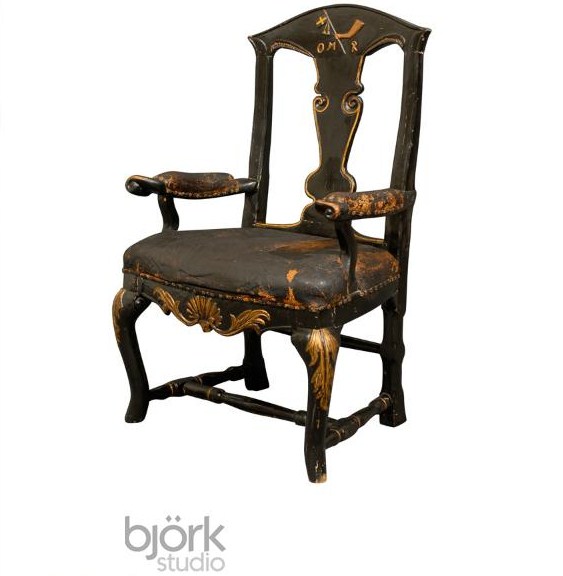
Swedish Baroque Captain’s Arm Chair c. 1750
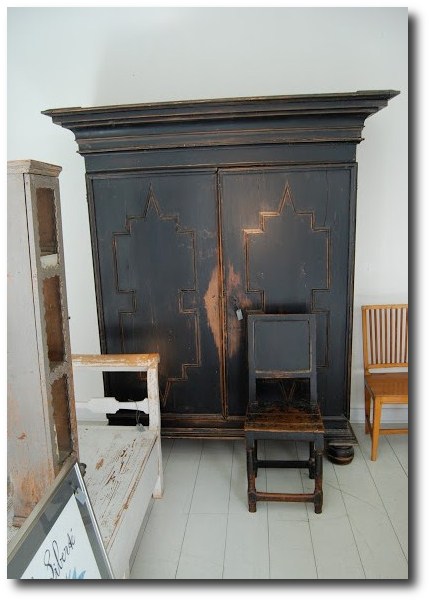
Swedish Baroque Cabinet and Chairs From romantiskahem.blog
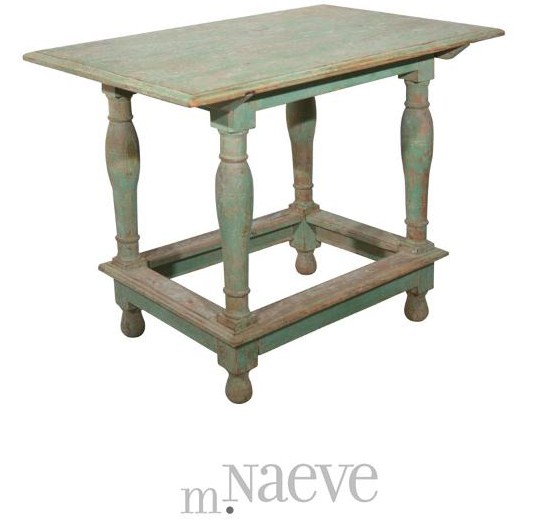
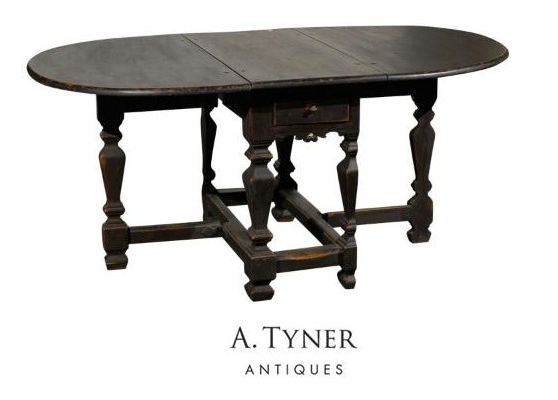
18th Century, A Swedish Baroque Drop Leaf Table.
Drawers on each end of the center section. Split-leg support on each side.
The Romantic Baroque Style: Part 4 – A Collectors Home

The Dienst’s Home
A Baroque Wing Chair Upholstered In Gray Linen, sits beside a Baroque Chest
In Sweden, the Middle Ages lasted for approximately 500 years, until Gustav I of Sweden seized power in 1523. Most all of the buildings were constructed out of timer, until the 12th century, where stone became the predominant building material for the construction of the churches. Lund Cathedral, and Husaby Church are excellent examples of this style. The Gothic style brought brick to Sweden as a new fashionable building material, and many of the cathedrals were fashioned out of brick, while others were made of limestone. 1,500 of Sweden’s 4,000 churches from the Middle Ages survive from this period. The 13th century city walls around Visby are some of the best-preserved medieval city walls in Europe, and in fact, the street layout of Stockholm’s Old City still can be seen designed with a medieval flavor.
Sweden rose to a great Power in the 17th century, the privileged class and government began to build again. The idea of the architect and designer was established and the profession developed. During this time works of Simon De la Vallée and Nicodemus Tessin the Elder became well known in Sweden. The work of Nicodemus Tessin the Younger moved the architectural development in Sweden during this time into High Baroque, such as Stockholm Palace.
As we discussed in Part 1, a notable example of the Baroque style in Sweden was seen in Strömholm. In part 2, we discussed King Gustav Vasa, whom was the ruling power at the time, and how the Catholic church dominated the design circles which influenced art across Europe and abroad. In Part 3, we discussed both Skokloster & Steninge Palace as striking examples of the Baroque style, which architect Nicodemus Tessin the Younger was responsible for. In part 4 and 5 we hope to inspire you to achieve this look in your own home looking at an example of a collector of Swedish antiques and what they did for their own home working with Baroque Swedish antiques in particular.
Jill Dienst’s owner of Dicost + Doner specializes in Scandinavian antiques from the 17th century to the mid-20th century. Jill Dienst’s passion for collecting for her own home over the years paved the way for her success as an antique dealer. Before opening up her own business, Jill Dienst spent decades at some of the finest institutions in the art, which allowed her to gain an appreciation for antiques and design world.
All images and information from Martha Stewart.
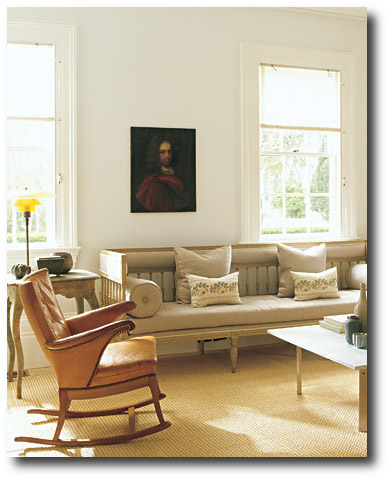
The centerpiece of the living room is a Gustavian sofa, which has been
upholstered in plain linen.
Mid-twentieth-century pieces by Danish designer Poul
Henningsen are mixed into the room
The simple, roll-up window shades are the same kind used in Swedish manor
houses, but these are made from a sheer fabric.
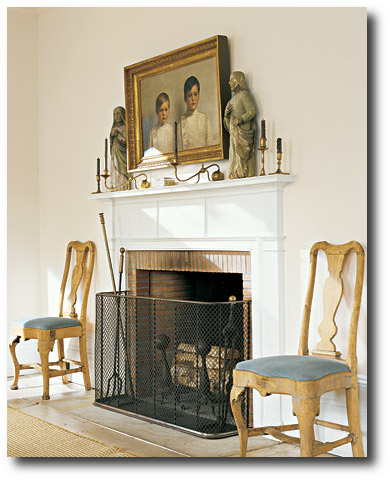 The living room walls and mantel were painted slightly different variations of
the same color.
The painting is a 1911 portrait of Swedish boys in school uniforms sit above the mantel.
The statues came from a rustic church in southern Sweden.
The candlesticks work beautifully with the gilt portrait of the Swedish boys
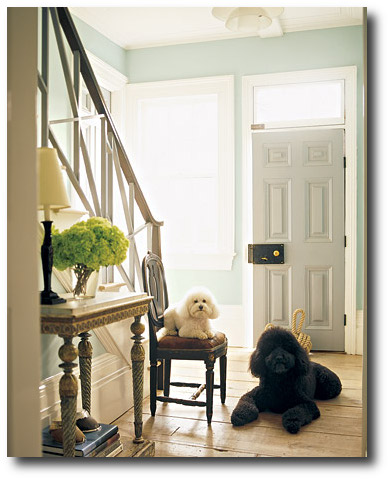 A black painted Gustavian chair and Gustavian giltwood console sit in the entryway
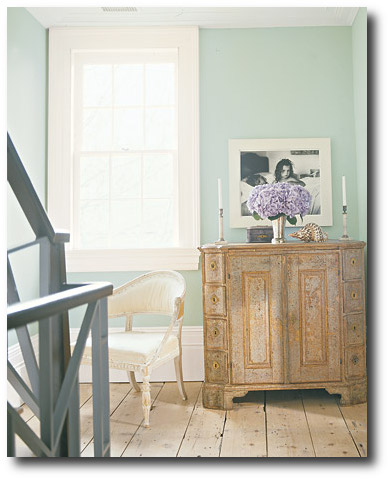
The second-floor landing features a large baroque cabinet from Sweden, which
retains its original paint.
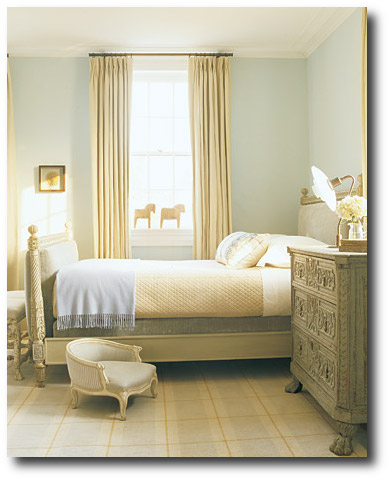
In their daughter’s room, a nineteenth-century bed has been reupholstered in a
heavy velvet.
French nineteenth-century chair by the bed. Dala horses, a traditional motif of Dalarna, Sweden sit in the window. The carved chest is German.
The Romantic Baroque Style: Part 5 Add Color
 The Dienst’s home is an excellent example of a home decorated around the Baroque themes with a distinct Scandinavian design. The Baroque styles originate in Italy so most commonly we see examples of this style from that region, but rarely from the north or the south or any other region for that matter. In addition, the Dienst’s home is designed around some of the very best Swedish antiques making their home inspirational to all who are hoping to project this style for their own homes.
With so many modern variations of this style, there is no right or wrong when it comes to decorating and color. In fact, you may find that many top designers tend to embrace color to an extreme when working with the Gothic / Renaissance interiors. Many modern professional styled homes set around the Baroque period style tend to favor brighter colored interiors which do give the really primitive styled furniture a modern, updated look. Hot pinks, cobalt blues, reds and bright yellows mixed with the Baroque antiques give rooms a very premium designer feel.
You’ll also find that Baroque furniture is also painted in a plethora of colors. Painted furniture in hues of purples, blues, greens, reds, yellows, oranges can then be matched up with paint colors that work with the original paint on the antiques.
Fresco wall painting can also capture the picturesque look into a room. Stuccoing it can add that castle appeal that are seen in the ancient stone buildings. Many of the Swedish Baroque castles featured elaboate walls covered in wallpaper. Choose wallpaper with a colorful, detailed, motif pattern can still fit into the Baroque schemes.
While many people like to keep the windows rather minimal, study the designs to see what appeals to you best. Windows have been known to be one of the main characteristics of Baroque designs. Consider buying heavier draperies made from velvet, damask or silk which can be hung in a modern way. With this approch, your home can look updated using the right styles of fabrics without it looking like a museum.
Flooring, can truly make a break a room all on its own. Paint can transform a room without much cost, so I always suggest that any budget should be spent on flooring, and a few carefully chosen period antiques. Sweden has been known for its vast forests, so it made sense that flooring was made from wood. You simply cannot go wrong with pine flooring. Pine flooring also allows you to get away with vibrant paint shades on the wall, and almost any wallpaper pattern.
Baroque styled interiors rarely used rugs or carpeting. Rooms in the Baroque era usually used geometrical-patterned wood flooring. Besides parquet flooring, you can also use marble and stone floor tiles that were also used during that period. Make your own stone for the floor or walls using concrete molds. There are a variety of shapes and styles making period stone features inexpensive to produce at home.
Baroque furniture is typically large and heavy. With the modern bedrooms being much smaller in size, plan the furniture out before purchasing to make sure everything will fit to the bedroom. Consider investing your bedroom budget on a bed. A canopy bed with ornate carving and tall posts from which you can hang drapery would be an ideal choice.
Upholstered chairs are an easy way to match up patterns that match the drapery, bed canopy and the color of the wall. The bedding should match the theme of the drapery, wallpaper, upholstery, and the bed canopy. Ikat patterns have become tremendously popular in the last several years. There are so many different versions of this ethnic, bold weaving style that is likely one of the oldest patterns in existence. Get some examples from Kelli Ford & Kristen Fitzgibbons. Look for combinations of colors paired with white. Indigo and ocher and vibrant contrasting colors would be a great choice for a Baroque interior.
Period styled decor will also strengthen the overall design. Consider a combination of candlesticks and lamps. Choose a heavy crystal chandelier with both brass and glass to enhance the Baroque feeling. Add ceramic vases and bowls with floral oriental patterns to enhance a room that has color, or lack of color. Invest in large scale paintings or very heavy mirrors with ornate gilded frames.
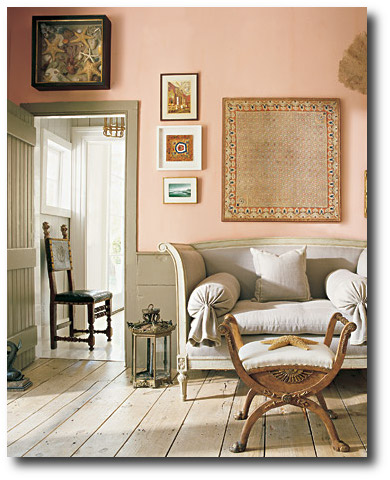
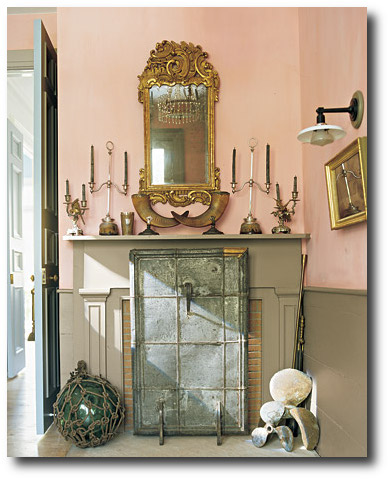
In the two pink rooms, Dienst’s small parlor off the entry features an early-baroque spark screen. The mirror is Danish rococo, and the crystal chandelier it reflects is Gustavian. Brass propellers complete the look. Gray wainscoting and bare floors soften the vivid color of the walls, which are adorned with an array of small paintings, sea fans, and a framed collection of starfish. The Gustavian settee is upholstered in linen, the stool is from the mid-nineteenth century, and the side chair is baroque. A mid-twentieth-century Danish lamp stands on the floor by the settee.
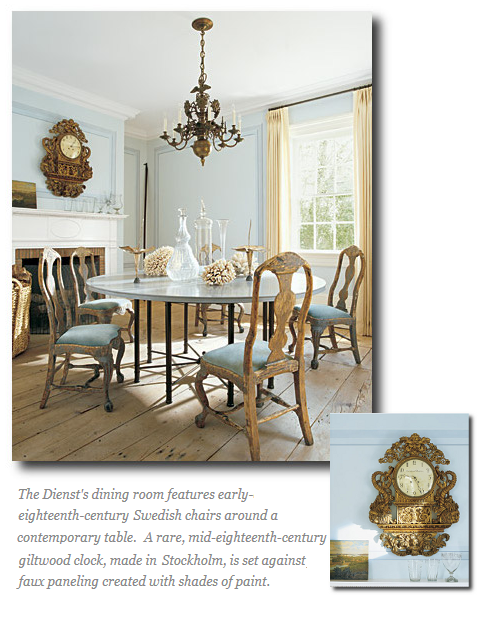
Reclaimed Wood Dining Table From A Tyner Antiques
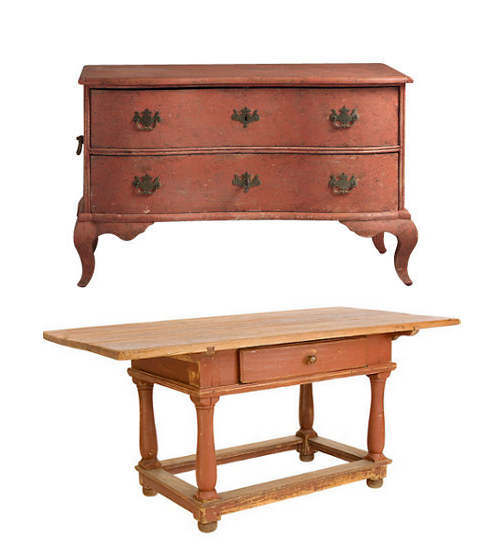
A.Pair of Swedish Baroque Commodes
B. A late-18th-century Baroque Swedish table with center drawer. Original red paint.
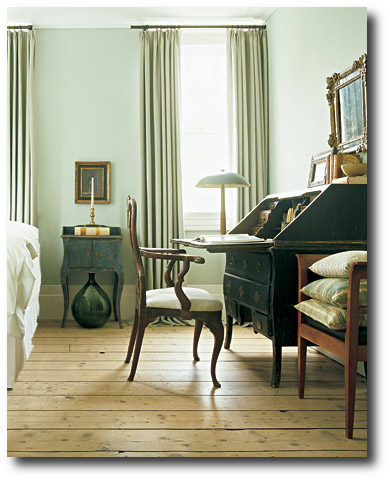 A black painted baroque Swedish desk sits in a guest bedroom.
The small side cabinet is rococo, and
the lamp is Danish.
Swedish Baroque Table From the 18th Century
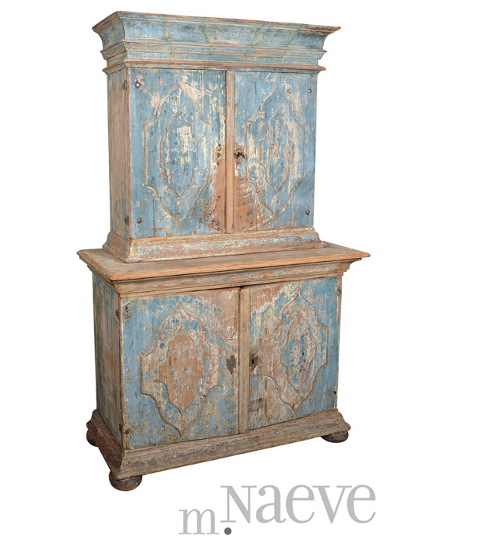
Beautiful Swedish Baroque cabinet in original blue paint
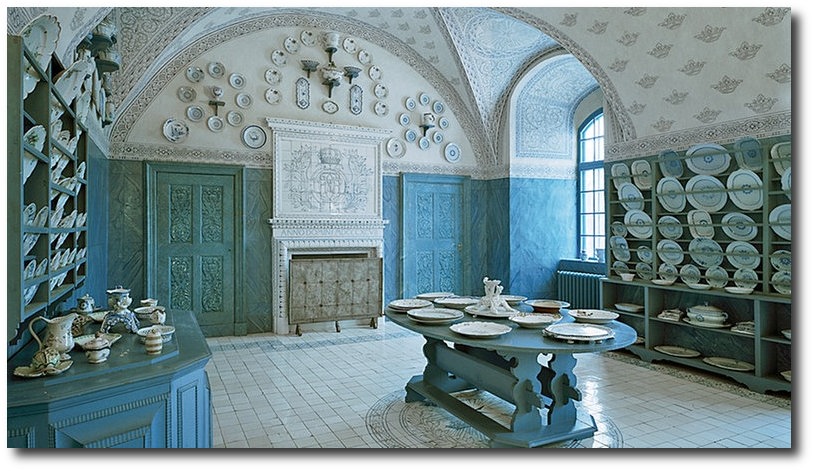
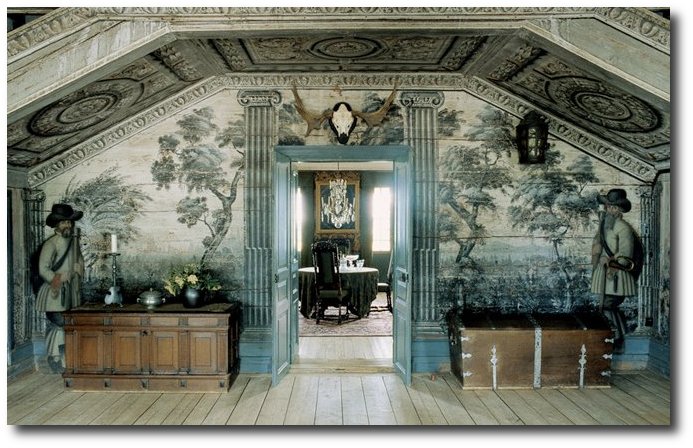
Landscapes on wood panel decorate the entry at Sandemar Manor in Sweden.
National Museum Stockholm’s Flicker
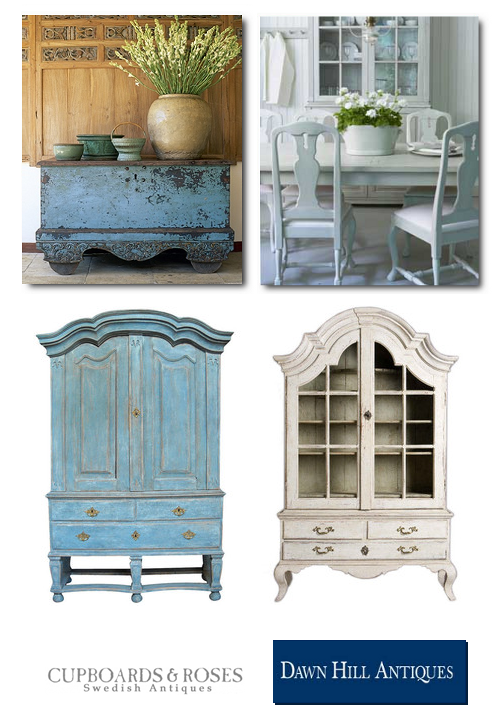
Picture Credit Home Beautiful Magazine , A. Tyner Antiques
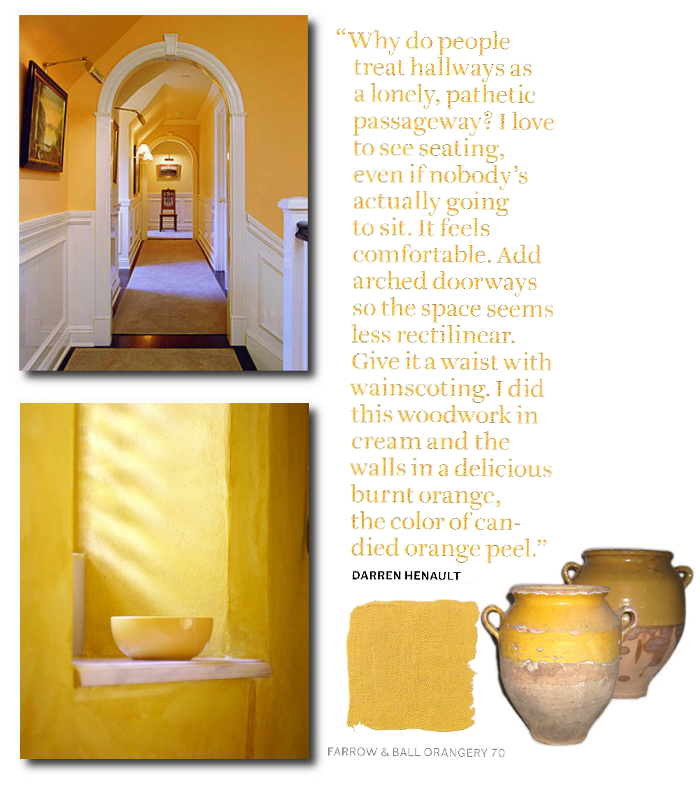
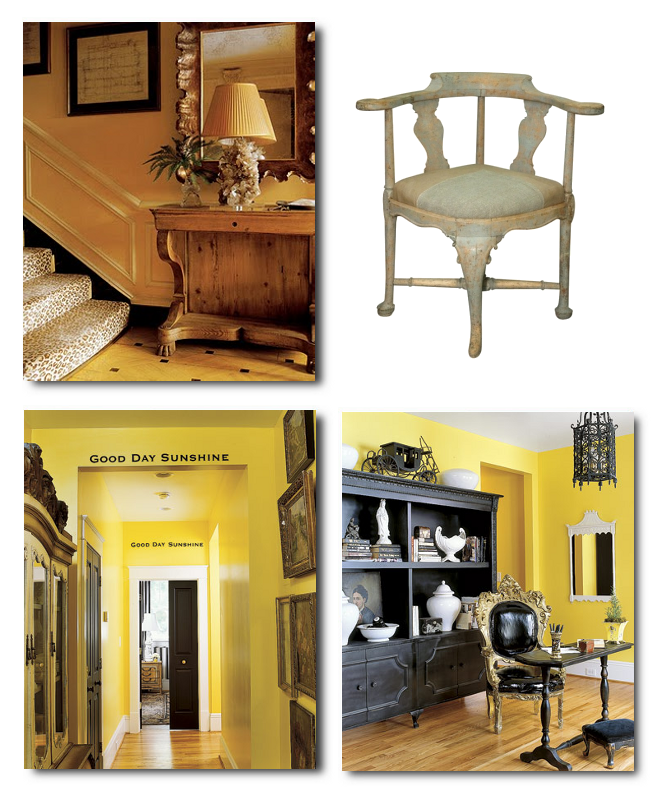
Designer Miles Redd, Using Yellow In A Baroque Styled Room
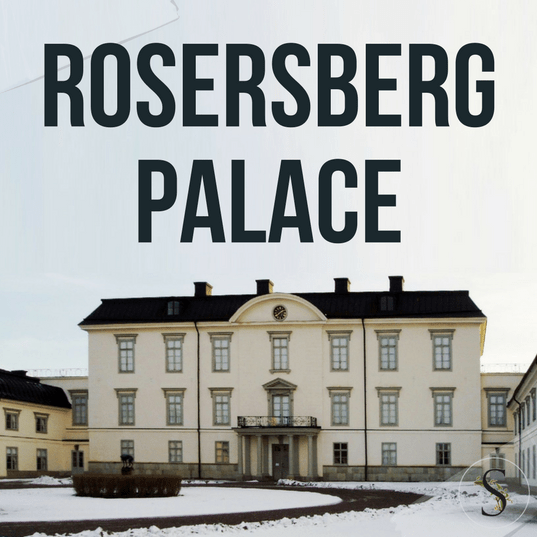
Sweden’s Empire Decorated Rosersberg Palace
Rosersberg Palace (Swedish: Rosersbergs slott) is one of the Royal Palaces of Sweden. Situated on the shores of Lake Mälaren, on the outskirts of Stockholm, it was built in the 1630s by the Oxenstierna family and became a royal palace in 1762. It was then that the state gave it to Duke Karl (later Karl XIII), the younger brother of Gustav III of Sweden.
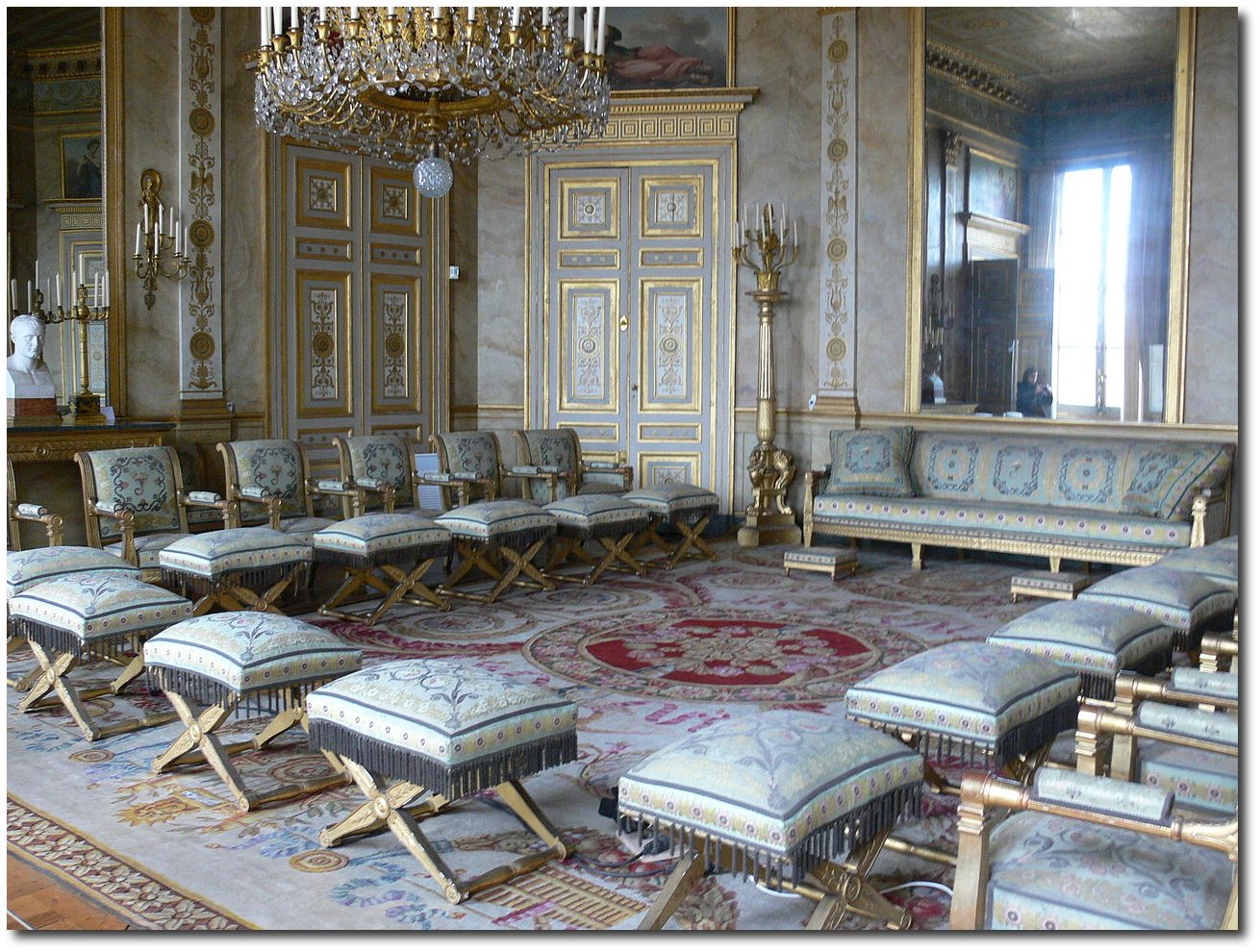
Today at Rosersberg the rooms remain almost untouched from the 1795-1825 period. The interior takes you back in time to the authentic royal interior from the turn of the 19th century.
The second half of the 17th century, the Renaissance Palace became to be dated. Chancery President Bengt Oxenstierna acquired the estate, and renovated the home in the Baroque style that was fashionable at the time. He sought out the country’s leading architect, Nicodemus Tessin the Younger, and new wings were added to the building. The tall Renaissance gables were taken down and the exterior of the building was updated with a new hipped roof.
Then in 1747, Rosersberg was acquired by Baron Erland Broman. More alterations to the buildings were directed by one of the country’s most prominent 18th century architects, Jean Eric Rehn. On Broman’s death in 1757, the property was acquired by the State.
The property was then placed at the disposal of the young Duke Karl (later King Karl XIII) of Södermanland.
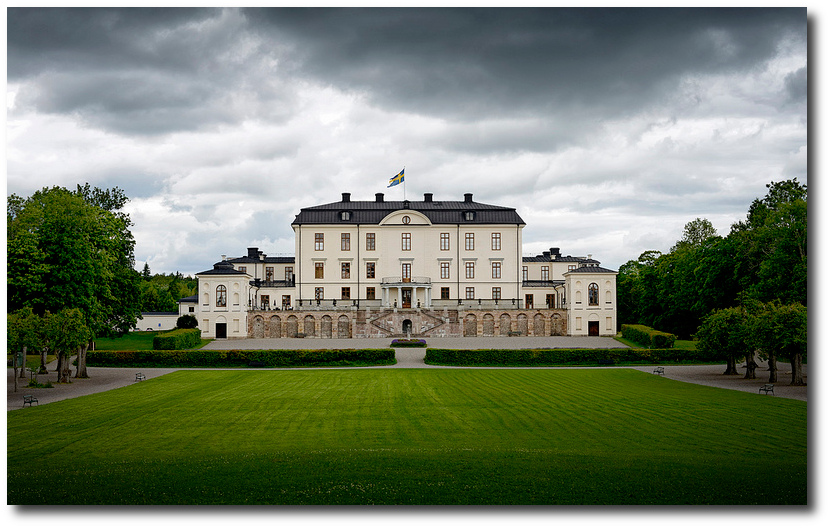
When Duke Karl (XIII) moved in around the 1760s, he modernized the palace in late Gustavian style. The interiors at Rosersberg Palace differ from the Gustavian style interiors of other royal palaces in Sweden. At Rosersberg the style has been known to trend after the Empire style. The palace combines the two styles: Neo-Classicism and the “Empire style”. Get some ideas from this beautiful castle for your own home.
- Sweden’s Rosersberg PalaceFrom Flicker
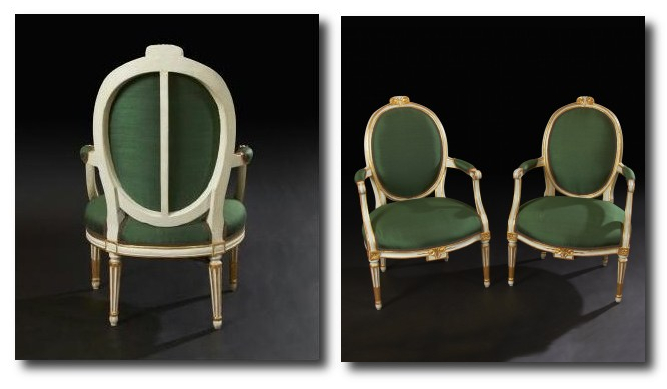
- Pair of Louis XVI carved and painted Fauteuils. Having oval backs, carved flower crest and apron on stop fluted legs.
- Photo Taken From Sw-Zamki.Narod.ru
- On the wall is a picture depicts the coronation of Karl XIV Johan. Photo Taken From Sw-Zamki.Narod.ru
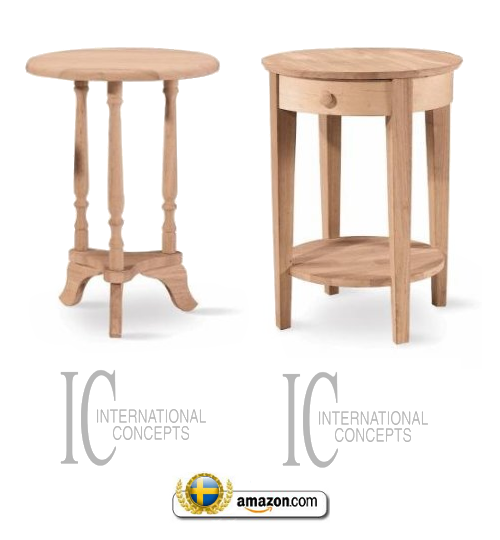
Turn this unfinished international concepts table, sold for $42 dollars into a thousand dollar table with an additional marble top and some paint. Consider white paint with gold accents for a classic Swedish style.
International Concepts Accent Round Table with Drawer- $104
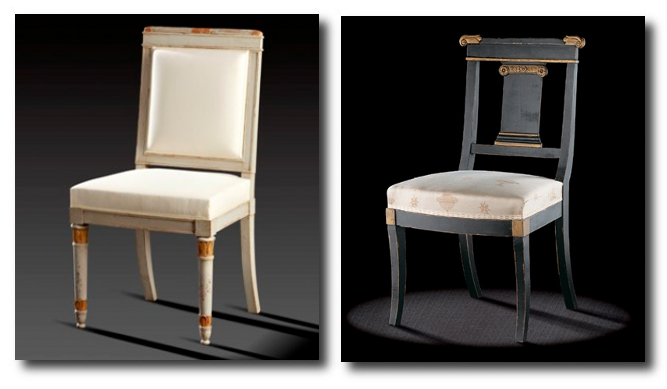
In this photo, you can see a neoclassical chair painted with a gray paint, outlined in a dark gray with white upholstery. Use the same color combinations with your painted furniture

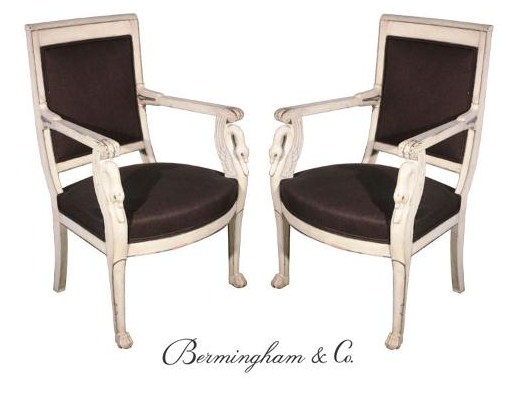
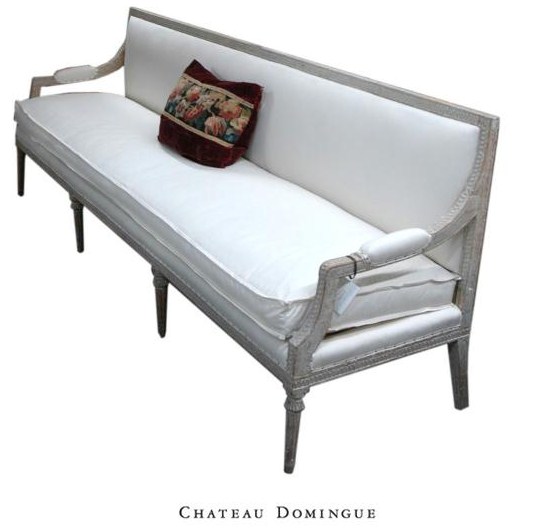
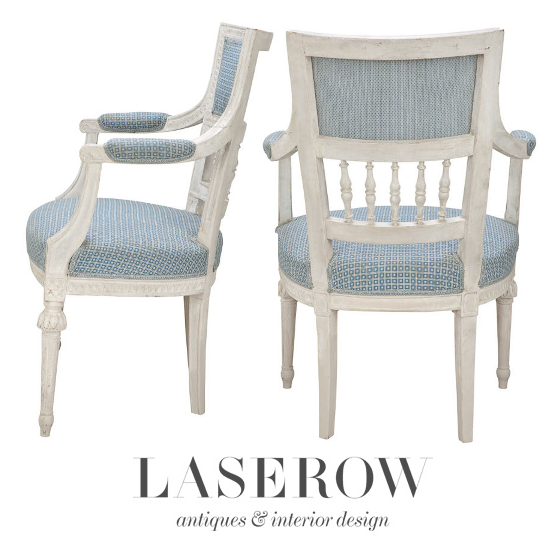

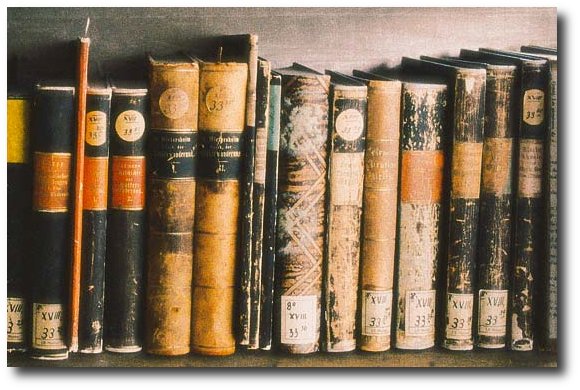
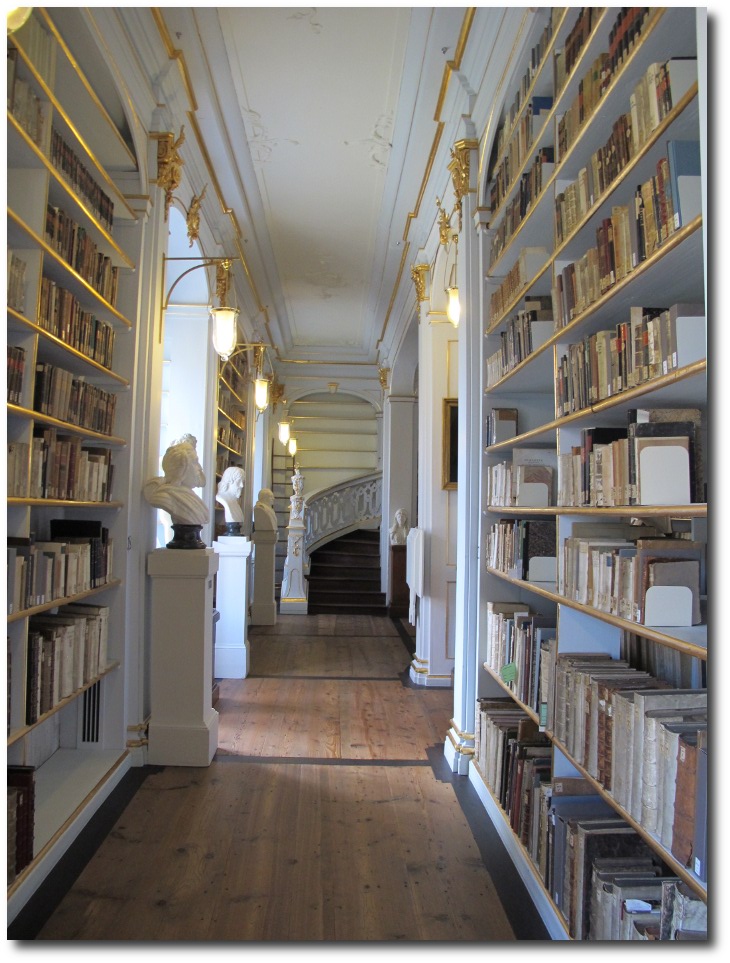
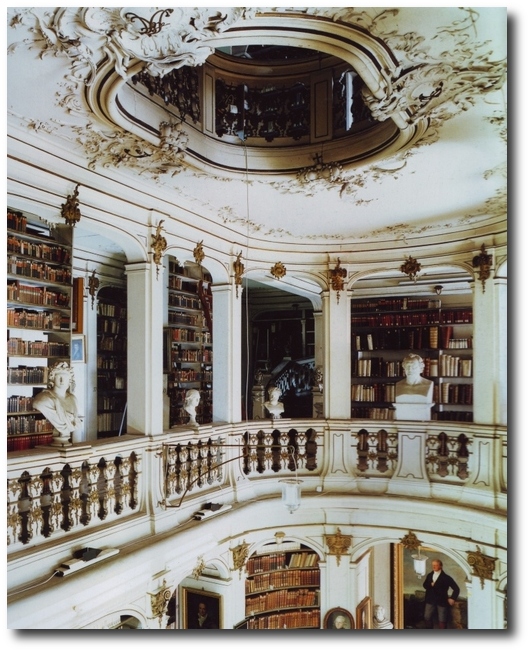
The Most Beautiful Rococo Library In The World:The Anna Amalia Library
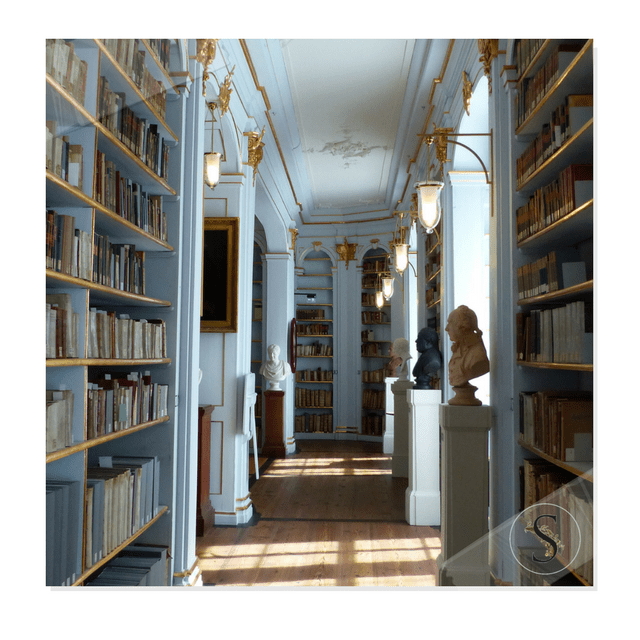
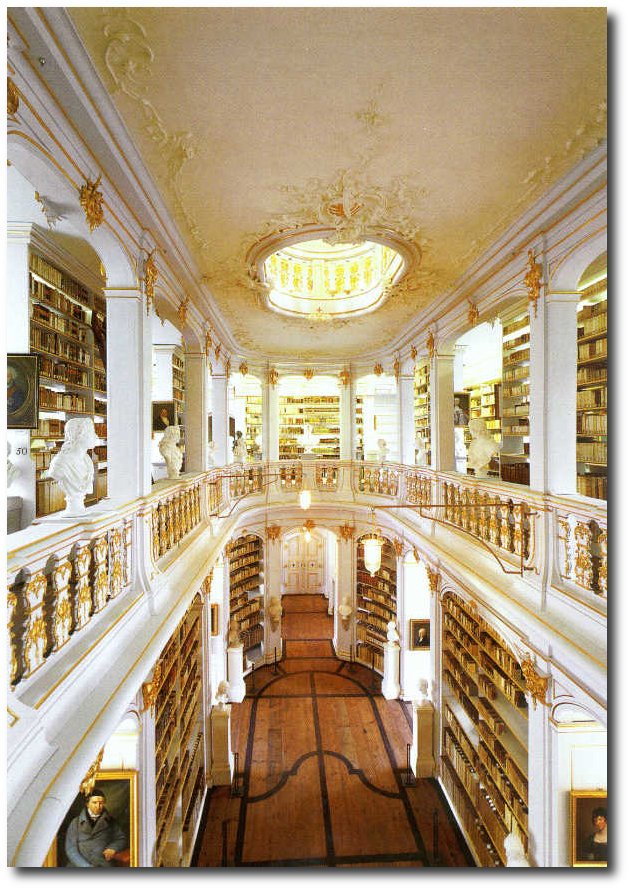
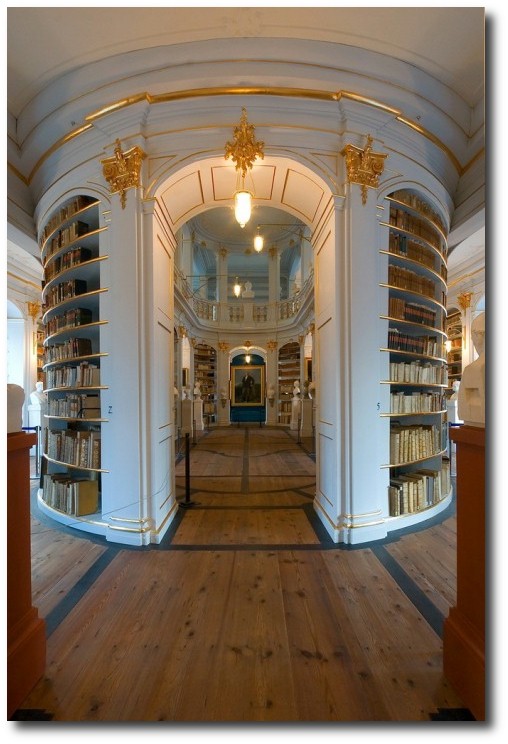
The Duchess Anna Amalia Library located in Weimar, Thuringia, Germany, is world famous for its oval Rococo architecture. The library one of the most breathtaking examples of Rococo design. The Rococo library houses a major collection of German literature and historical documents. The Duchess Anna Amalia Library is named for Anna Amalia, Duchess of Saxe-Weimar-Eisenach, who arranged in 1766 for the courtly book collection to be moved into the library.
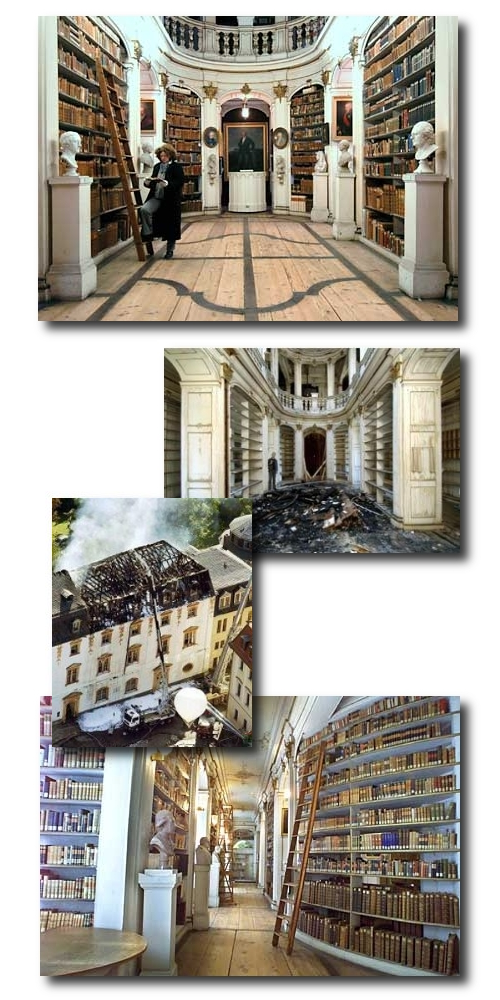
In the picture above, a photographer takes a picture of the in the middle of the room with a view of the front door. Three weeks after Candida Höfer had made their shots, a fire caught in the library, and burned about one million volumes. 50,000 volumes were saved, but many were irreplaceable, and of the 62,000 volumes that were damaged by fire or water, at least 36,000 were restored. Even though, a substantial amount of books were lost in the fire, there has been no loss of interest in the library.
The sad part of the account was the library was scheduled for the overdue renovation when an electrical fire struck the library in September, 2004, JUST weeks before the collection was to be moved for the renovation.
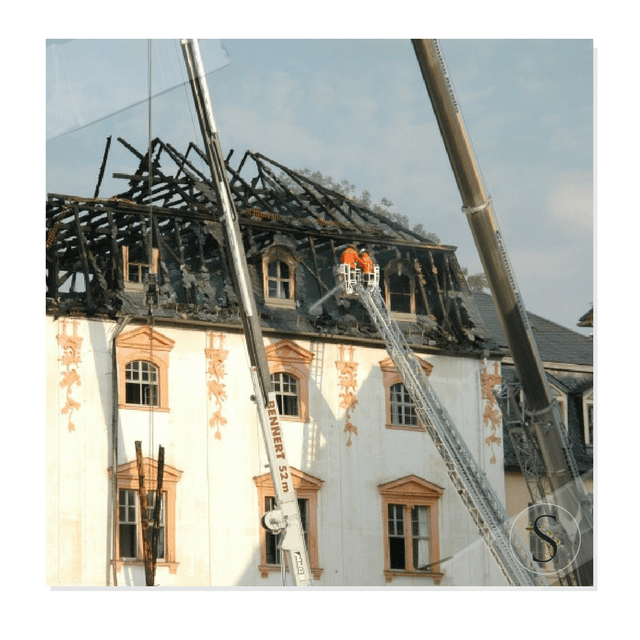
Thousands of precious books which had been preserved for two centuries, were destroyed by fire by a damaged electrical cable. The interest in preserving the library drew in almost 14 million dollars for the restoration and repurchasing of the books.
Check out this bm-online.de, link for some of the pictures of the restoration. The library was reopened in December 2007.
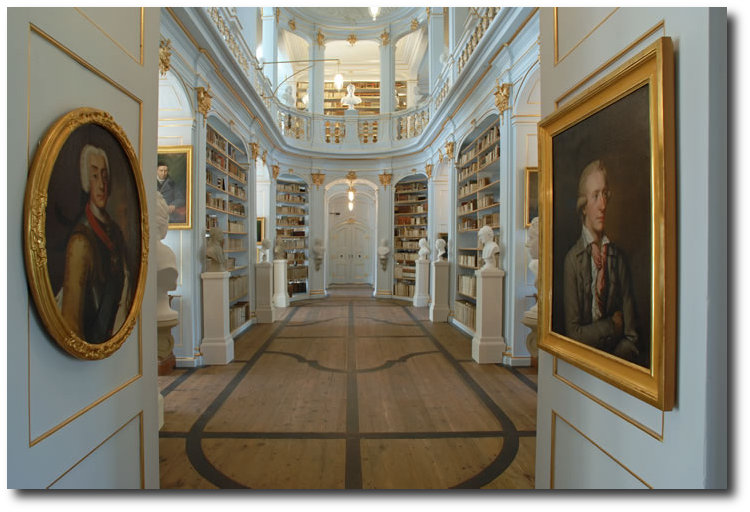
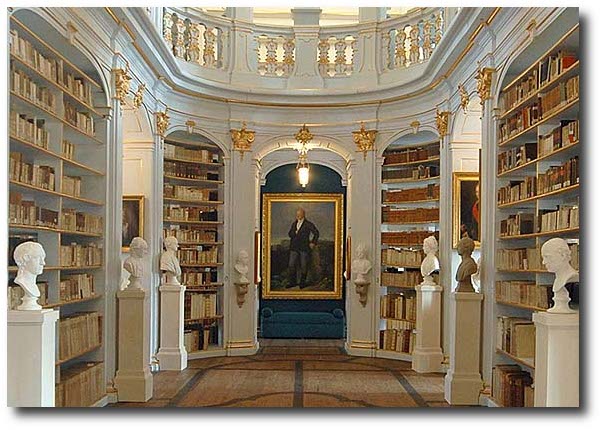
The Rococo hall continues to be one of the most beautiful libraries in the world. The hall has a narrow floor plan and an astounding ceiling height which leads the eye upward. The reading room is a lofty gilded gallery with busts of poets, paintings and bookcases set against white and blue walls. A light parquet floor and minimal furnishings create a dramatic contrast to the Rococo Hall which can be seen through the oval opening in the ceiling.
In The Most Beautiful Libraries in the World, writer Jacques Bosser provides a vivid description of the library’s interior: “The heart of the building was open, thus creating a vast central room for reading and preservation. It was surmounted by a sizable gallery replete with bookshelves. Encircling the hall, between
it and the castle, is a wide corridor with bookshelves on both sides. Its late-Rococo décor is sober, simple, charming, and functional. The floor is a parquet decorated in dark slats shaped like a carpet. Everywhere are paintings, framed drawings, and white marble busts of the celebrated visitors to this site, which had long been renowned through-out Europe” (Laubier and Bosser, 2003, p. 54).
See additional photos at Baulinks Website, Epoch Times
- holidaycheck.de
- Candida Höfer
- commons.wikimedia.org
- vebidoo.de
- gaab-weimar.de
- kastl.de
- germany.travel



4 Resources For Swedish Decorating
Swedish furniture has been sensationally popular the last 10 years as a style that is fresh for decorating the upscale home. Gustavian style has appeared in some of the more prominent decorating magazines in the US such as Veranda, Architectural Digest, World of Interiors and even more frequent in European magazines such as Campagne Decoration.
The casual appearance of lighter colored painted furniture has been popular for centuries. France was credited with the influence of the Swedish furniture in the 17th and 18th century. Many of the formal pieces found in the palace of Versailles were made over in the same shape and form, but painted instead of stained wood. The decadence of the French furniture couldn’t be copied because it was too costly for Sweden at the time, as well as Sweden has their own taste in mind.
In France, side tables were constructed from the most costliest woods, with decoration that took hours if not weeks to complete. French cabinet makers through the 17th century used techniques such as inlay, (pictures cut from ivory or wood, and set into wood), or marquetry, ( veneer composed of numerous woods, and stained which produced a pictorial mosaic), lacquering and japanning, (the application of numerous layers of varnish) were all costly, and time consuming.
While France had the best of the best, some say Sweden did a better job of re-interpreting the design elements seen in France such as the furniture by scaling down the formality. Linen was used instead of silk, paint was used instead of the stained wood, and faux painting replaced marble walls.
Borrow Interior Design Elements From Sweden For Your Own Home
Marks Of The Swedish Style
1. The Use of Paneled Walls (But In A Different Way)
The French were known for their paneled walls. Paneled walls are well known to be the most expensive and rich form of all wall treatments. Originally they were hand carved out of wood, as labor was inexpensive in the 1700′s. Today much of the decorative baroque looking ornaments are made from plaster. Wood panels once served to insulate a room from the cold stone frame of a building. It is also quite apparent that paneling was installed for decorative purposes as well.
Boiserie is the term used to define ornate and intricately carved wood panelling seen in some of the well-to-do French estates. The earliest known examples of boiseries were unpainted, but later the raised mouldings were often painted or gilded. For a great example of painted paneled walls, look at Charles Spada’s Country Home, which gives some great examples of 18th century color combinations. Martha Stewart shows a wonderful example in a green palette. A very formal dining room is done up in blue, and arches painted in oranges and pastel blush tones.
Boiseries were popular in seventeenth and eighteenth century French interior design and the Palace of Versailles. The panels not only appeared on the walls, but were also used to decorate doors, frames, cupboards and armoires as well. Often pictures would be set into the boiseries, the carving framing the picture rather like a conventional frame.
Decorating With Paint -Get This Look For Less….
Many of the wealthier Swedish people borrowed this look for their estate homes. Costly wood paneled walls were a far stretch for many of the Swedish people in that day, as it is for many people today. Paneled walls can cost thousands, and be tremendously time consuming.
Why not fake it with paint?
The Belvedere in the park of the Petit Trianon shows a fine example of what a person could do with paint to simulate the heavy ornamented look of the French style.
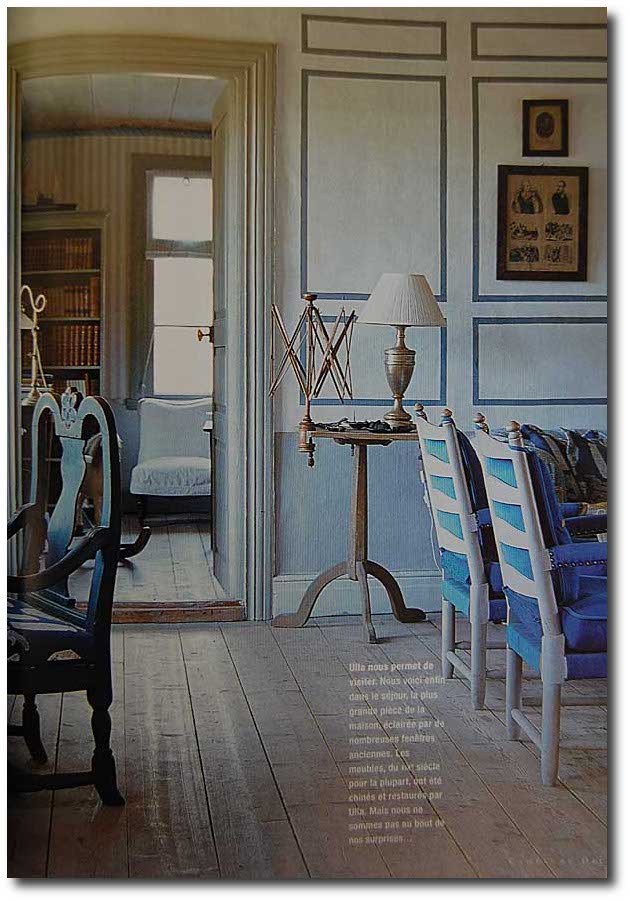
In Lars Sjoberg’s house featured in Country Style by Judith and Martin Miller featured walls with blue frames around them. Using two painted frames simulates the look of framed walls. Further in the post, you can see many more frames painted on the wall which do a beautiful job of showcasing furniture placed in front of it.
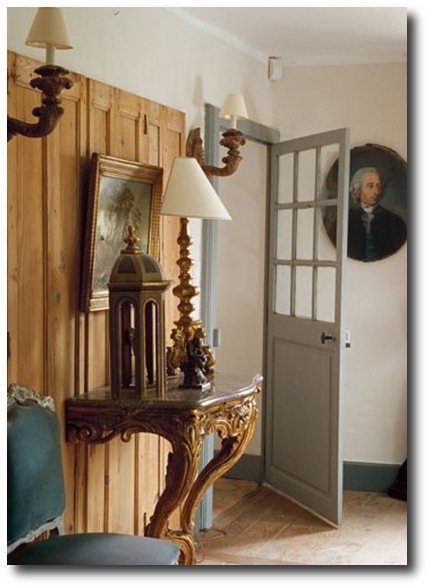
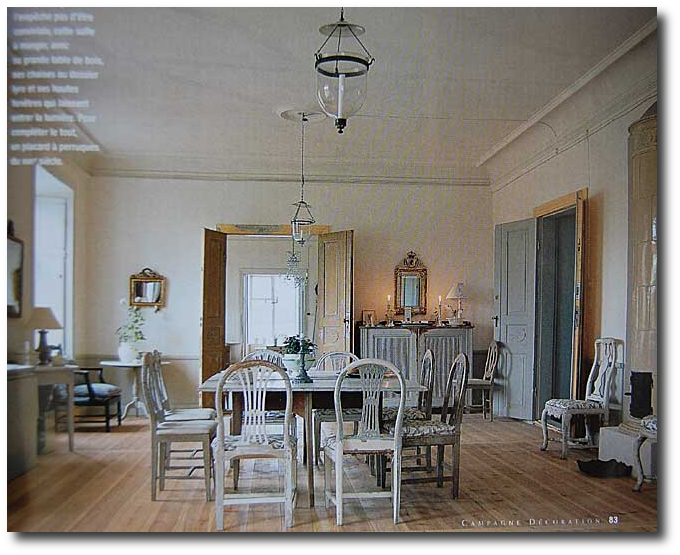
Picture Featured in Campagne Décoration
In the USA we have a chain of stores called Habitat For Humanity – Re-stores which carry all sorts of architectural elements from wood screens, to paint, sinks, and so forth, which are heavily discounted.
Here we see the paneled wall idea made from doors which are positioned side buy side. Consider purchasing similar styled doors in sets of 3, 5, or 7 which can be linked together using door hinges. As you can see here, it works!
Picture Credits– A Special Thanks to Aged And Gilded Blog, TweedlandThe Gentlemans Club, And
Lars Sjoberg’s Book- Classic Swedish Interiors
Here are some companies to keep in mind:
1. Decorators Supply– They have over 13,000 designs in their carving library. For over 100 years they have specialized in creating finely detailed composite replicas of the hand carved wood ornaments found in the most extravagant homes.
2. Bailey Interiors.com – Decorative Plaster Ornaments and Claws
3. Beaux-Artes offer decorative wall panels which can be used on walls and ceilings. Their products are cast from historic ornamentation and are available in over 20 different Finishes.
4. Victoria Larsen offers a number of ornamental frame molds which allow you to make dozens of your own molds in the privacy of your home. She also offers raised plaster stencils for the wall in a variety of patterns.
Consider a yearly subscription to Veranda, Architectural Digest, World of Interiors and Campagne Decoration.
We will be discussing accent furniture in Part 2, and Swedish painting techniques in Part 3
Check out Classic Swedish Interiors for more photos to get a better view of the far room
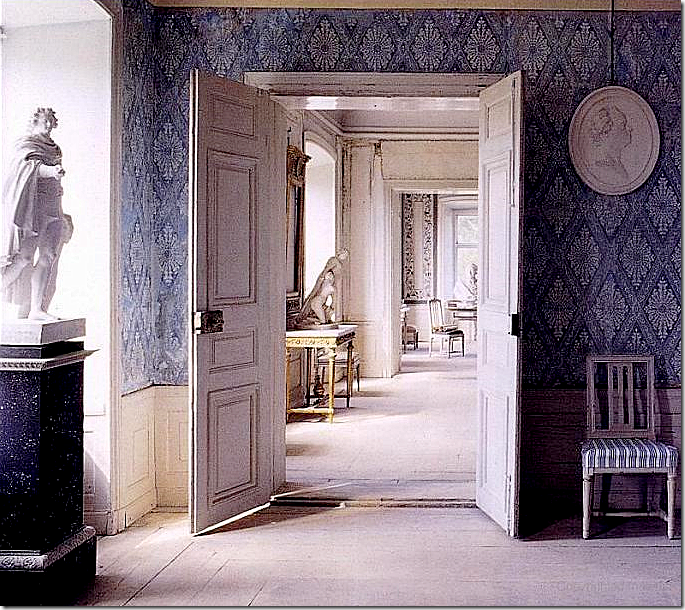
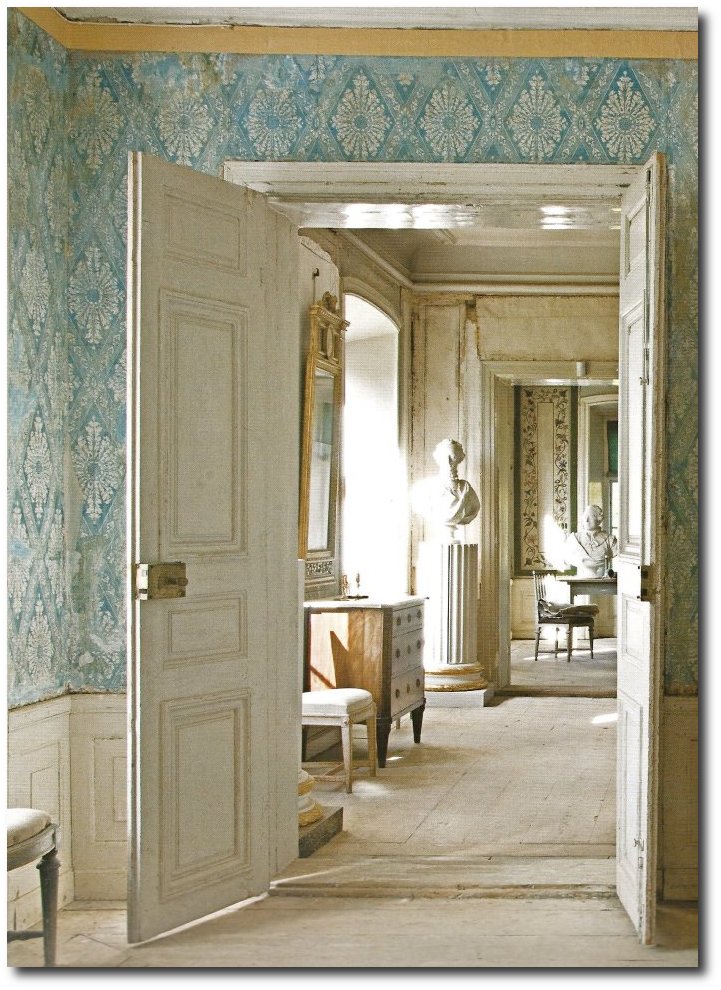
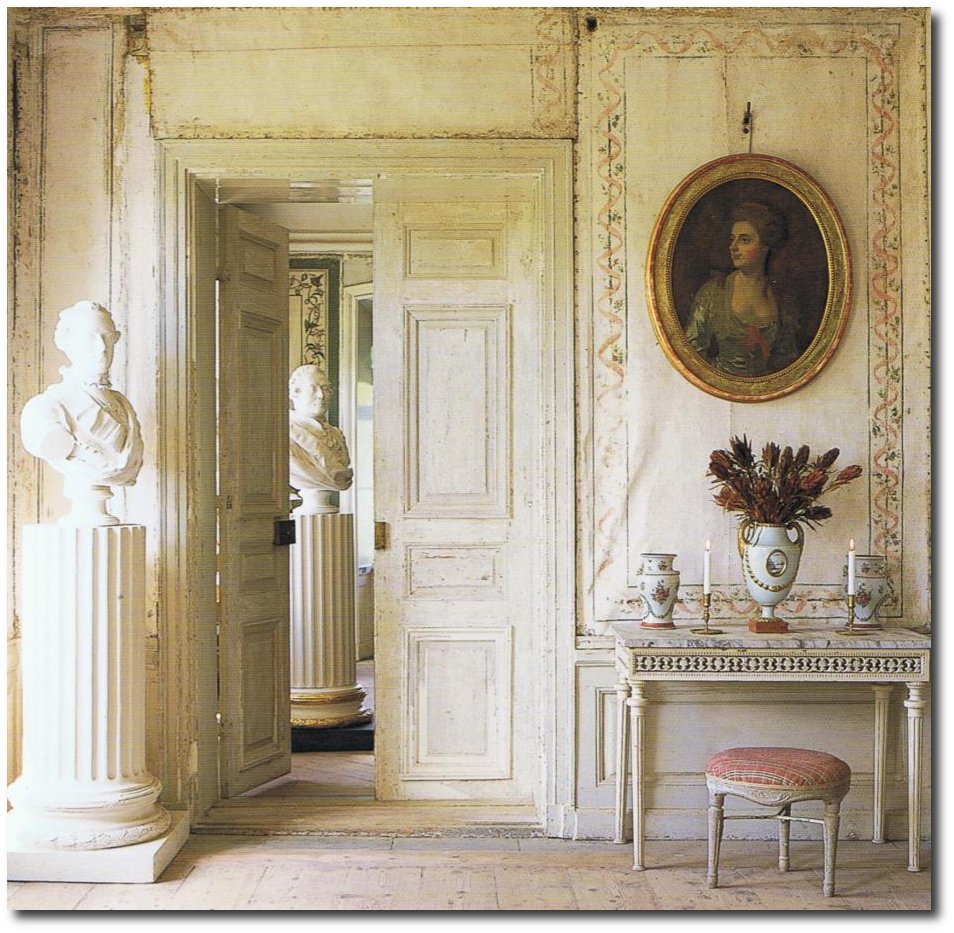

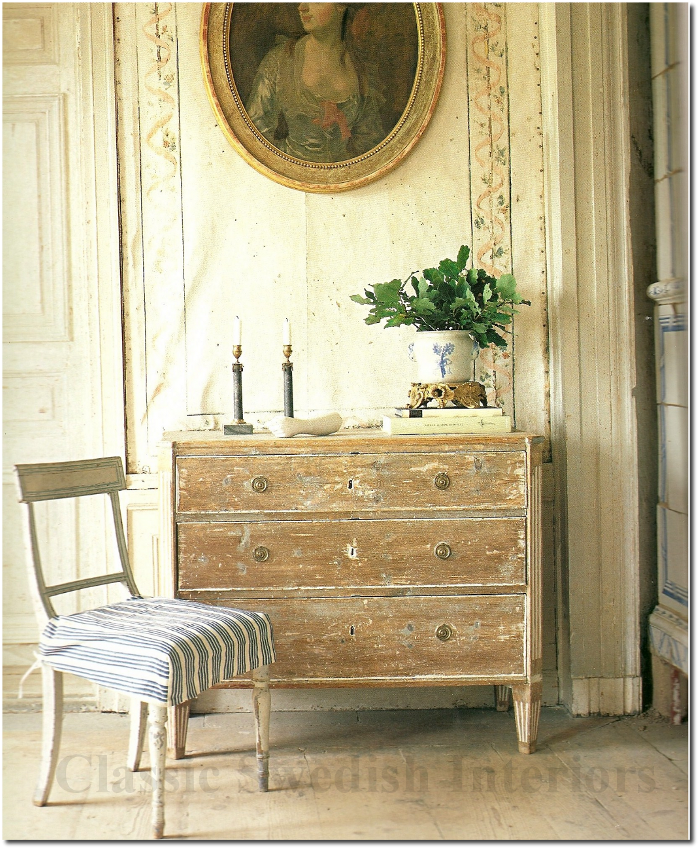
How Important Are Accent Pieces In A Swedish Home?
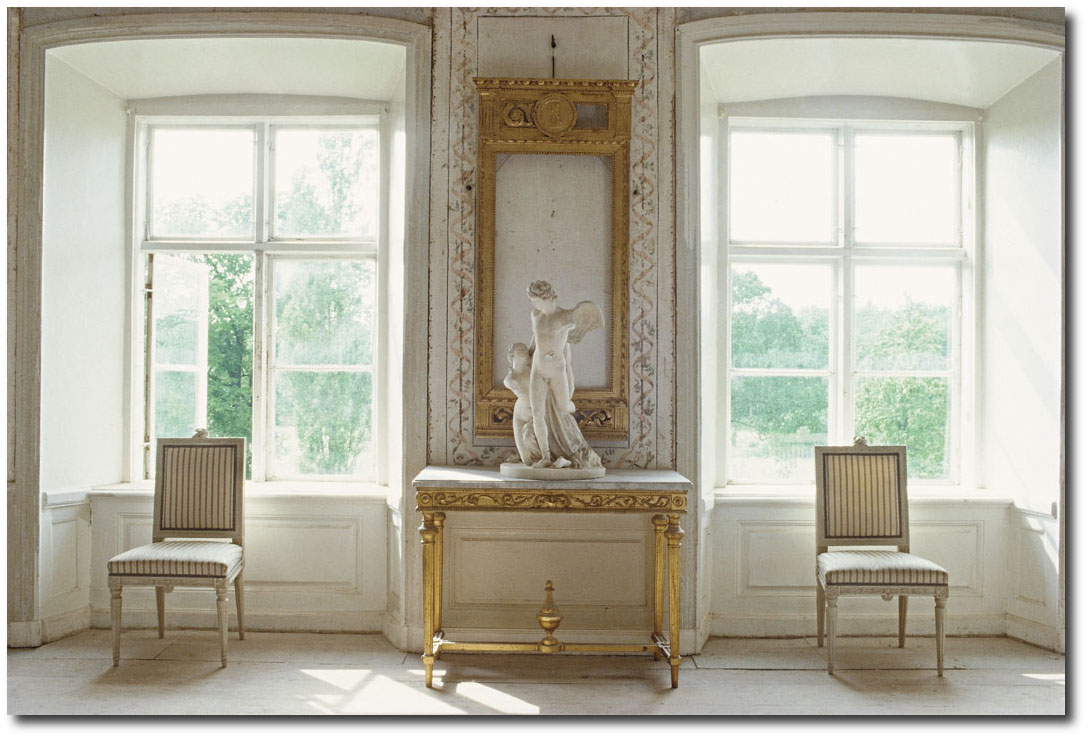
As we discussed in Part 1, Paneled walls can bring the Swedish flavor into your home and give you the Gustavian appeal you are after.
Another element that we see in Swedish historical homes are sitting areas using what we call today as “accent furniture”. It was common to find a number of sitting areas around the home using accent chairs, and tea tables.
2. Accent Furniture
Today accent furniture has become more popular again. We have been used to over-sized sofas, and forgotten what side chairs and tables can do for a room.
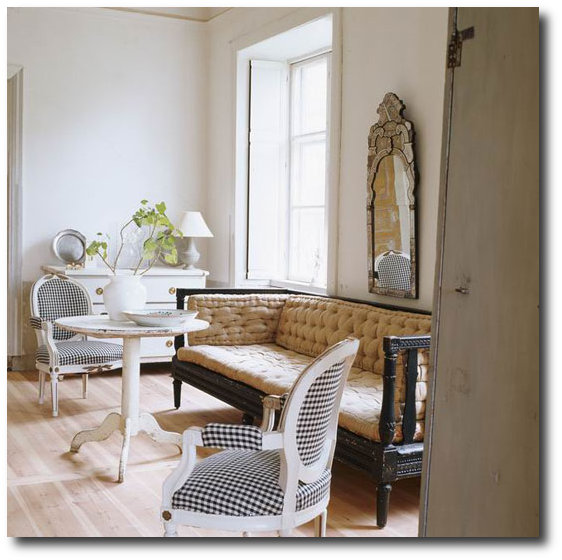
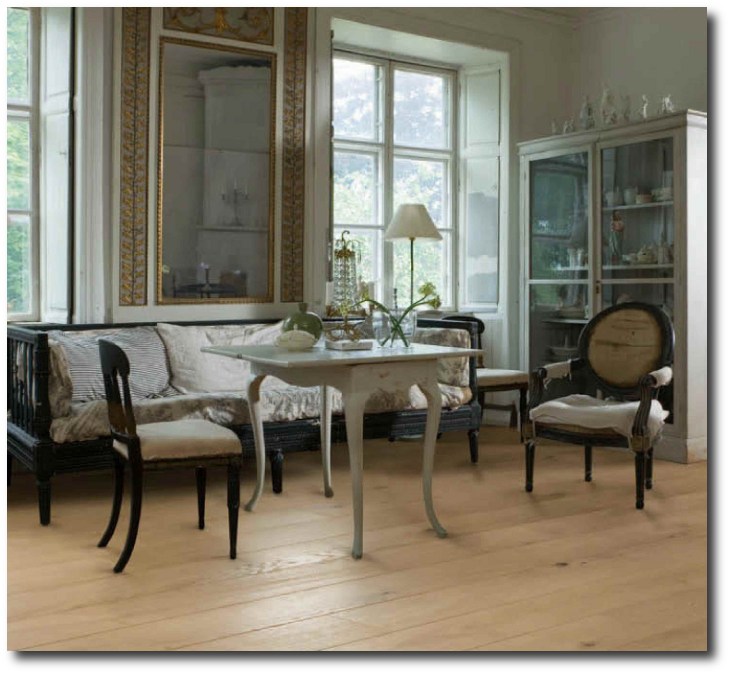
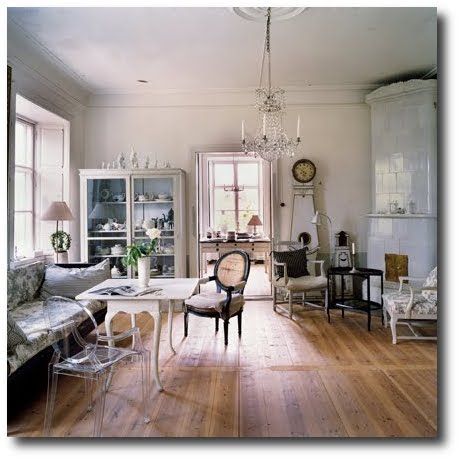
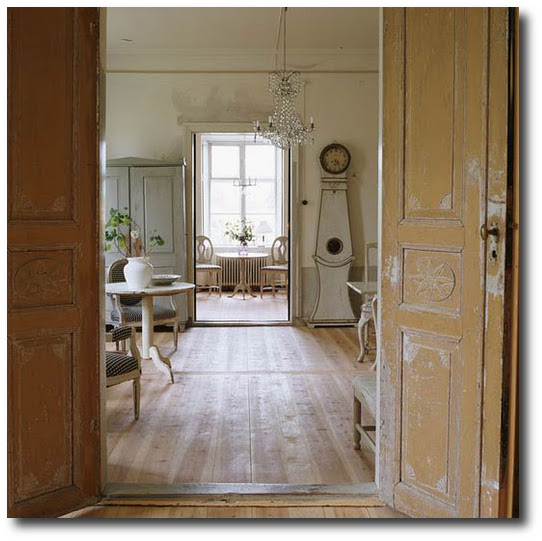
Swedish design is based around symmetrical looks. In the living room above, we see two white painted chairs in a Gustavian buffalo check paired with a black painted Swedish bench. In other photos of this room the black bench is paired with a Rococo table and the furniture seen in the rest of the home is moved around. Here we see a round white painted tripod tea table. Using accent furniture allows you to move the furniture around the house like they have done with Barbro’s home.
Smaller accent furniture became popular in France in the 17th & 18th centuries, and caught on in Sweden. The Accordion Side Table is one example of smaller scale furniture that existed in France. The accordion table itself wasn’t something seen in Sweden, but the idea of smaller tables became popular, or functional at the time.
Tables didn’t just look pretty, they served a purpose in the home. Side tables were practical for playing cards, having tea, and doing fine needlework. Writing tables were one of the most common uses for tables in this time. Tables with folding leaves were extremely popular in Sweden. Tables were pushed against the wall, and were then brought out for dinners, crafts, and schooling.
Sofa tables were designed to appear before sofas. These tables were long and narrow, and often had folding leaves which enabled the person to sit at the sofa and use the surface of the table without having to move the table closer to them. Consider adding a table paired with a sofa instead of a modern day lower “coffee table” that is seen in most homes. Or add a set of upholstered benches in front of your sofa to tie in matching upholstery.
Picture Credits– A Special Thanks to Campagne Decoration Magazine, Photos featured on Aged And Gilded Blog & Master Henry Blog