$100+ Solid Braided Rugs
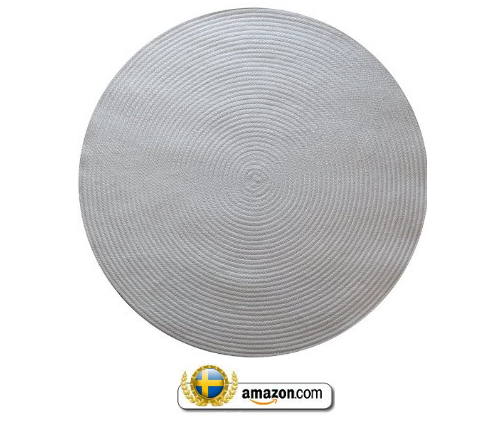 Braided Rug 80″ Round Off-White $109
The careful selection of your homes rugs can really bring alive that Swedish look you are after. Last month, I found myself spending hours trying to select a rug that would work perfectly for our outside covered patio. After browsing endless patterned rugs, I found myself drawn to plain, simple braided rugs.
Living in Seattle for a short period of time, I left several large sisal rugs outside under a lofted outdoor barn, only to find later they were molded, so much so, that I had to pour bleach to remove the dark black spots that were left on the rug. So after that experience, I didn’t want to chance getting the wrong rug for my outdoor patio.
Super Area Rugs on Ebay, had a large selection of rugs that work for indoors and outdoors. The intricate braided detail was enough pattern, and also gave my space that simple look I was after. These rugs can work for the indoors, as well as the outdoors. I ordered an Oval version of the “Reversible Braided Rug in Blue Ice Color” When they arrived at my door, they were rather light, made of a synthetic material, which enables them to be washed and used outside throughout the winter.
In this post Swedish Decorating MUST Haves – Natural-Fiber Rugs I show pictures of jute rugs, sisal rugs, and hemp, all great choices when selecting a rug for a Swedish home. If you want something different, consider a braided rug. I have found they come in very pretty light colors such as blue, ice blue, and white, amongst so many other colors.
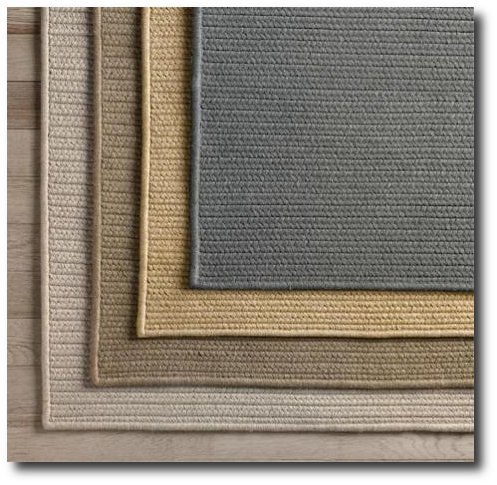
Sunbrella Solid Braided Outdoor Rugs- Find Them On Amazon
Here are some selections that would work with a Swedish style home:
– Rhody Rug Braided Rugs In French Blue– Amazon
– Rhody Rug Braided Rugs In SOLID Navy– Amazon
– Rhody Rug Braided Rugs In SOLID Key Lime– Amazon
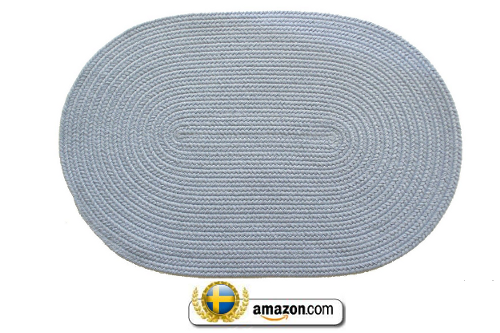
Solid Braided Rugs By Rhody Rugs- In Hydrangea Color
ITM Indoor/Outdoor Braided Rug, Green, 8-Feet, Round- $199
ITM Indoor or Outdoor in Periwinkle Blue – 8 Feet Round $199
ITM Indoor/Outdoor Braided Rug, Blue, 6-Feet, Round $144
ITM Nautical Braided Reversible Rug, 5-Feet by 7-Feet, Grey $116
ITM Indoor/Outdoor Braided Rug, Dark Blue, 6-Feet, Round $165
Solid Braided Rugs By Rhody Rugs- You choose the color and size!
60 Scandinavian Country Folk Art Books On Amazon

Scandinavia – made up of Denmark, Finland, Sweden, Iceland and Norway -has always had a unique mark on the arts through history. Whether it be needlepoint, embroidery, wood carving, furniture painting, knitting or any other local arts, they inspired each other in these regions, often drawing on the same color tones, motifs, and decorations.
The Nordic style craftsmanship and decorative themes can be seen unique to this northern area of Europe. Chances are if you love Scandinavian furniture, you will fall in love with so many of the different arts that are also found in this region.
Folk art, is celebrated in the international galleries around the world, but it also can be found in people’s homes, garages, and attics around Scandinavia. With access to to the internet, you don’t even have to know the back streets of Sweden, or speak the language to invest in high quality antique folk art. With esty and ebay within reach, you can pull together a collection for your interior without leaving your home.
“Folk art” is the most common term to describe the every day craftsmanship of people from one region or another, which depicted the artistic talent of life and times in art. Almost everyone has a hobby today, and it was more so, 100 to 300 years ago, when the family didn’t gather around the television for three hours each night. People had so much more time that could be devoted to the arts when the children were home schooled, and mom and dad worked off the land. Life was so much better back then, and you could have a little piece of that history.
The art was influenced by the culture, which is why German, Italian, and even American folk art each has their own style and flavor. Many of the popular collectible folk art pieces include handcrafted toys, quilting, wood carvings, and basket weaving. Folk oil paintings can be some of the most expensive range of collectibles within Folk art. Oil paintings emerged in the late 1700’s but only until the 1800’s did it really begin to flourish. Folk artists were often self-taught, and considered amateur artists due to the fact that they were not academically trained in the fine arts. These paintings are some of the most collectible of the wall art, and surprise, surprise,….sometimes they are inexpensive! It is amazing what you can find on ebay, if you are willing to wait.
Here is a collection of 60 books that focus their attention on Folk art, or the Scandinavian region in general.
Don’t judge a book by it’s price, as I have bought some books for less than $5 dollars and they happen to be higher quality than the more current books you can easily spend $40 dollars on today.
While I haven’t read all of these books, many of these books listed cost than $10 dollars….! If you are interested in learning how to knit, or work embroidery, you can create your own art with designs from the past. Check out my unique list below:
Books On Amazon:
1-Swedish Folk Art: All Tradition Is Change– Used On Amazon From $8.93
Book Review From Lauren- “I have a huge interest in this subject and so I was pretty excited when I found it in my university’s library. I didn’t finish it since it’s a pretty thick book. Since I enjoyed it, wanted to reference back, and read further, I bought here on Amazon. Not only are the pictures nice, the information is pretty solid. The information probably won’t really be considered outdated, so it’s a nice addition to my own personal book collection.”
2-Swedish Folk Art: Floral and Kurbits Designs – This wonderful book of Swedish Folkart is 88 pages, 62 color with coverage of all the major styles of Swedish Folk Art from 1750 to 1900. Included are 32 projects with photos of antique pieces and pages of basic kurbits and floral forms with strokework by author- Used From $15 On Amazon
3-Our Nordic Heritage Ingalill Snitt-Our Nordic Heritage presents the 18 sites in the Nordic countries which have been inscribed on UNESCO’s World Heritage List – the cultural and natural heritage of mankind. Areas with this status represent outstanding and irreplaceable cultural and natural treasures. They are important to us as sources of experience and understanding of our manifold historical, cultural and natural background. Buy It Used From Amazon $18
4-Masterpieces of Dala Peasant Paintings by Svante Svardstom- Buy it On Amazon $26
5-Design Basics for Swedish Folk Art by Diane Edwards- This is a beginner book for learning the basics of Swedish Folk Art, a beautiful painted art that was done in Sweden in the 1700, 1800’s and early 1900s. There are several different styles which are described in this book and there are patterns of each with complete instructions. There are several pages with illustrated strokes to show the novice painter how to approach and decorate wooden pieces with this ethnic art form. Diane Edwards has done much research into Scandinavian folk art and she has simplified the approach to this art form using acrylics and easily available brushes for today’s artist.– Buy Used From $9.
6-Scandinavian Folk Designs (Dover Pictorial Archive) by Lis Bartholm-With 155 traditional motifs to choose from — all adapted by noted Danish designer Lis Bartholm — today’s artists and craftspeople can re-create many of the lovely patterns that ornamented domestic furnishings generations ago. The eye-catching elements have been adapted from designs that decorated china or were painted or carved on furniture, walls, and wooden dinnerware.- Used from $2
7-Scandinavian Cross Stitch Designs by Jana Hauschild Lindberg- Add a touch of simple Scandinavian charm to your home with these dozens of elegant cross-stitch patterns. Designs range from fifth-century woven textiles to original paper cuts made by the famous Danish fairy-story teller, Hans Christian Andersen. Projects draw upon traditional Scandinavian symbols and motifs that have been handed down from generation to generation and upon the beautiful natural environment and wildlife of the region. Used From $4
8-Swedish Folk Painting of Dalarna: Wall Kurbits and Furniture Rosepainting by Patricia J Virch (1981) Used From $78, New From $144
9-To Amerika: Dala paintings by Bengt Engman – Locate It on Amazon, Or Ebay
10-“DALMALNING” Central Sweden’s Peasant Painting by Lois Bostrom Nuermberger- Used from $5
11-Scandinavian Folk Patterns for Counted Thread Embroidery by Claudia Riiff Finseth- Scandinavian Folk Patterns for Counted Thread Embroidery draws needleworkers into the world of Nordic folklore and tradition. In addition to presenting a comprehensice discussion of mythology and the folk history of narrative textiles in Scandinavia, Claudia Finseth creates fifty-eight striking original counted thread designs. Nordic history, culture and tradition come to life for modern embroiderers through the imaginative adaptation of traditional themes. Many of the projects feature the classic decorations that once adorned Norwegian, Swedish and Danish homes: bellpulls, table runners, wall hangings, samplers and Christmas decorations. The designs fall into five categories, each containing numerous spin-off projects for varying skill levels and imaginations. Used From $1
12-Folk Art Designs: From Polish Wycinanki and Swiss and German Scherenschnitte (International Design Library) by Ramona Jablonski- Used From $2
13- European Folk Art Designs (Dover Pictorial Archive) by Marty Noble-Traditional motifs from Austria, Poland, Hungary, Russia, Switzerland, and other European countries include scores of charming designs incorporating florals, wildlife, and human figures in folk costumes. Ideal for adding a touch of Old World flavor to a variety of print and craft projects. 265 black-and-white designs.- Used From $4
14- Folk Art Needlecraft by Clare Youngs Expert crafter Clare Youngs has long been influenced by the folk art of cultures from around the world. Here she uses some of her favourite motifs to create 35 gorgeous projects to make. Clare uses traditional imagery as well as a more modern take on classic folk art – with beautiful results. The designs use a range of different embroidery stitches – including seed stitch, French knots, satin stitch and cross stitch – to create striking arrangements.- Used from $10
15- Russian Folk Motifs (Dover Pictorial Archive)This treasury of 226 designs for royalty-free use, all meticulously rendered from authentic Russian art and artifacts, include motifs from Moldovian carpets, stove tiles, gingerbread molds, architectural carvings, ancient metalwork, and much more. Depictions of Matryoshka dolls, ceramic toys, and woodcuts of characters from folklore appear as well. Used From $2
16- Folk Art: Imaginative Works from American Hands (American Country) by Time LIFE – This volume explores an aspect of the country lifestyle featuring folk art in 175 pages filled with ideas, information and hundreds of brilliant full color photographs. Buy it used from $1
17-Punchneedle Embroidery: 40 Folk Art Designs by Barbara Kemp and Margaret Shaw- Punchneedle embroidery is back! It still features the same quick and simple technique as before, but now with increasingly appealing designs that result in charming works of miniature art. This beautiful volume explains all the basic techniques, so even beginners will soon be able to create the 40 exquisite folk-style projects. Buy it used from $4
18- Folk Art by Robert Young and Robert Liebe- The vitality and simplicity of folk art makes it accessible and rewarding for collectors and a diverse source of inspiration for interior designers. Folk Art is the first book to draw together the wealth of folk art from across Europe, including textiles, toys and games, naive paintings, pottery, and furniture. It explores the origins and attributes of each piece, with guidance on identifying the most collectable artefacts. Buy this used from $8
20- Folk Art Style: Traditional and Contemporary Painting for Everyday Objects by Sybil Edwards The author explores three distinct genres of decorative folk painting – traditional strokework, bold painting and blending – demonstrating the brush strokes and illustrating the huge variety of finished styles which can be achieved with them. Traditional folk motifs, fine art themes, Art Deco designs, contemporary minimalism – all these and more are used as the inspiration for 20 handpainting projects. Buy this used from $1
21-Folk Art Needlepoint: 20 Projects Adapted from Objects in the American Folk Art Museum by Ruth Peltason We are drawn to American folk art for many reasons—its history, its humanity, and, perhaps most of all, its unaffected beauty. With elements both whimsical and practical, this enduring and beloved art form has become a rich source of inspiration for today’s craftspeople. For needleworkers in particular, folk art is among the most popular styles to stitch. Organized thematically by types of folk art motifs—among them, hearts, flowers, and daily life—Folk Art Needlepoint offers twenty projects and variations, from pillows and paperweights to a door stop and scissors case, that celebrate the best of American folk art. Buy this used from $1
22- Folk Art of Rural Pennsylvania by Frances Lichten Hardcover: 276 pages Buy this used from $7
23-Textiles: Collection of the Museum of International Folk Art by Bobbie Sumberg Textiles explores the cultural meaning and exquisite workmanship found in the Museum of International Folk Art’s vast collection that spans centuries and includes pieces from seventy countries around the world. Handcrafted work in beautiful, vivid colors typifies the clothing, hats, robes, bedding, and shoes that represent the lives and passions of the people who created and used them. Buy this used from $22
24- Folk Quilt Applique by Clare Kingslake -Folk style quilts add charm and comfort to any homes. Here, simple yet effective quiltmaking and appliqué techniques for hand and machine work are combined with a quirky folk style. Drawing on a palette of soft country colors, author Clare Kingslake has created a project collection to brighten up your home all through the year. Discover 20 irresistible projects from small and quick table mats, bags and purses, to attention-grabbing hangings and quilts. Buy Used from $11
25– Folk Art Murals of the Rufus Porter School: New England Landscapes: 1825- 1845 by Linda Carter Lefko- Here is the long awaited update of research on the Rufus Porter Landscape Mural School, greatly expanding the knowledge and understanding of this uniquely American folk art field of the 1820s to 1840s. The text provides detailed documentation never seen before in print. The book takes the reader on a virtual tour of Porter School murals in the New England states, presenting and analyzing more than 400 colorful images, which will provide inspiration for historians, researchers, designers, and painters alike. Buy this used from $60
26- Quilts: Masterworks from the American Folk Art Museum by Elizabeth Warren, Maria Conelli, Stacy Hollander and Martha Stewart- From America’s preeminent museum collection, this definitive volume places the quilt firmly in the realm of art. Combining economy with artistry and everyday craftsmanship with extraordinary beauty, quilts hold a unique place in American culture. Each quilt tells a story about its maker and her community; seen together, these monumental textiles paint a broad picture of the development of a national character and uncover the hidden history of women’s contribution to art. Buy Used from $37
27- Glorious American Quilts: The Quilt Collection of the Museum of American Folk Art by Elizabeth Warren and Sharon L. Eisenstat Used from $5
28- Living with Folk Art by Editors of Country Living and The Editors of Country Living (Jan 2001)- Patchwork quilts, woven coverlets, hooked rugs, painted furniture, carved decoys—these are among the most popular styles of folk art. If you’ve fallen in love with their old-fashioned charm, find out how to show them off effectively. Here are great display ideas for entryways, halls, living rooms, dining rooms, and kitchens—along with tips for mounting textiles and protecting baskets, china, and utensils. Buy this used from $5
29- Folk Art Primer by Jo Sonja Jansen and Edna Snyder – Buy Used from $9
30- Painting Folk Art Flowers with Enid Hoessinger (Decorative Painting) by Enid Hoessinger Demonstrates how to paint folk art flowers using ten acrylic colors and thirteen basic brushstrokes, and includes eight step-by-step projects – Used from $16
31- Folk Art of Europe by Helmut Theodor Bossert- Used from $5
32-Folk Art Friends: Hooked Rugs and Coordinating Quilts (That Patchwork Place) by Polly Minick and Laurie Simpson (Jun 2003) More than 20 quilt and rug designs showcase the authors’ distinctive style- Motifs include simple stars, hearts, flags, houses, and dogs- Photos shot in Polly Minick’s home show her creative ideas for displaying rugs and quilts- Used from $3
33- Treasures of Folk Art: Museum of American Folk Art (Tiny Folio) by Barbara Cate, Lee Kogan and Museum of American Folk Art (Oct 27, 1995) Celebrating the exuberance and variety of folk art, this Tiny Folio presents the museum’s finest examples from colonial times to the present. Created by self-taught artists, the works in this book include paintings, sculpture, weather vanes, decoys, painted furniture, quilts, and more. 340 full-color illustrations.- Buy used from $2
34-Painted Wood Projects in the Pennsylvania Folk Art Style by Alan Bridgewater and Gill Bridgewater – his book shows how to achieve 20 painted wood projects to brighten the home, using a palette with rich reds, yellows, greens, browns and black and white. The designs in the book are based on those of the Dutch communities of Pennsylvania who transformed ordinary objects into exquisite works of folk art. Buy used from $1
35- Color Your Own American Folk Art Paintings (Dover Art Coloring Book) by Marty Noble (Jul 19, 2011) Thirty meticulously rendered versions of well-known American folk art paintings include Edward Hicks’ The Peaceable Kingdom, Eunice Pinney’s The Courtship, and other beloved portraits, still lifes, and landscapes. Colorists of all ages, including would-be artists and Americana enthusiasts, will find this collection an engaging combination of art history and activity. Buy Used From $2
36- Color Your Own Famous American Paintings (Dover Art Coloring Book) -Line drawings of 30 American masterpieces invite colorists to add their own hues to famous paintings — from the quiet charm of Mary Cassatt’s Mother and Child to Edward Hopper’s starkly realistic Hotel Room. Additional works by Albert Bierstadt, Childe Hassam, Edward Hicks, Winslow Homer, Grandma Moses, and 23 other masters- Buy Used From $1
37- Color Your Own Impressionist Paintings (Dover Art Coloring Book) by Marty Noble Use colors of your choice, or recreate the original hues, for 30 great paintings, among them Mary Cassatt’s Mother Combing Her Child’s Hair, Renoir’s At the Concert, and 28 other reproductions of works by Monet, van Gogh, Gauguin, Manet, Pissarro, Morisot, Cézanne, and 4 other great artists. Buy Used From $1
38-Hungarian Folk Designs for Embroiderers and Craftsmen (Dover Pictorial Archive Series) by Anne Szalavary Used From $29
39- Norwegian Handknits: Heirloom Designs from Vesterheim Museum by Janine Kosel, Sue Flanders and Laurann Gilbertson (Sep 6, 2009) Vesterheim Museum in Decorah, Iowa, is one of the premiere centers for Norwegian-American heritage in the United States. As such, it houses one of the country’s most extensive collections of the textiles and handknits that have woven ties between Norwegian communities in America and the Old World, between today’s culture and a rich past. This book collects thirty patterns for handknits from Vesterheim—folk mittens, socks, scarves, hats, wristers, handbags, knapsacks, and sweaters—all inspired by traditional knits housed in the museum. With an introduction reflecting on the history of Norwegian-style knitting and the stories behind the handknits that inspired the patterns, the book is at once a practical guide, a repository of cultural history, and a lovely look at one of the rich traditions knit into the American fabric.– Buy Used from $6
40-Norwegian Tapestry Weaving by Maria Brekke Koppen -The classic book on Norwegian tapestry. Profusely illustrated with over 220 black and white drawings, photographs and 4 color plates. The translation combines the 1978 and 1988 editions. It includes: history, joining techniques (especially the Norwegian dovetail),looms, designing, weaving methods and finishing. Buy Used From $34
41-Norwegian Rose Painting in America: What the Immigrants Brought by Nils Ellingsgard Buy It Used From $31
42- Ornamental Woodcarving in the Norwegian Tradition by Johan Amrud Buy Used From $285
43-Woodcarving In The Scandinavian Style by Harley Refsal -Carve and bring to life wonderful, old-world people in the Scandinavian “flat plane” style of carving. Clear directions and step-by-step photographs show you exactly how to make a few simple, well-placed cuts, leaving large, flat planes intact on the wood-carved figure, for an effect rich with folk-art charm. Plus, you’ll get a history of Scandinavian woodcarving and photographs and drawings of decorative pieces. 132 pages (4 in color), 225 b/w- Used From $2
44-Scandinavian Country A noted interior design editor joins House Beautiful in showcasing the purest, most appealing expressions of this classic yet understated style. ;iiScandinavian Country marries the most exciting elements of contemporary style with an appreciation of the pristine, inviting land that gave them birth. 290 full-color illustrations Buy Used From $1
45- Scandinavian Country (Architecture & Design Library) Buy Used From $5
Review 1- This book makes you wich a small house by the fjords! The photos are superbe! To welcome you in the north Europe, that’s a very good book. You have the right colors, as much light as you needed and the nature all over the pictures. Flowers everywhere. A small walk through History. All in a very simple way. When you know this countrys, you know everything’s writh about this book. Yet,some things are missing. If you buy this book to have information, don’t expect to find many details about how to decorate a house in the scandinavian style. Not really! After this first book, you will surelly want to find other ones about the subject! Because, you’re just beginning to know what north european houses are about! Not a bad beguinning! Not at all! If I were you, I’d start right here.
Review 2 -I really loved this book. As one reviewer commented, the pictures definitely make you wish for a home by a fjord. They alone are well worth the price of the book. Every so often,I page through the book again and enjoy it as much as the first time I looked through it.
I disagree with the reviewer who complained about the quality of the writing. The text explained the photographs, which made them so much more meaningful. For example, Scandinavian countries have a very short summer. Because of this people spend every moment of the long summer days they can out of doors. They don’t need fancy outdoor furniture for tea or meals. A couple of chairs and a small table will do nicely. Also, because of the long dark winters, Scandinavians love to paint and deteriorate their homes in bright colors. They almost always have natural pine or hardwood floors and wood furnishings. Because of it’s simple and oh so appealing decorating style, this book has influenced the way I decorate.
46- Country Living The Scandinavian Look -Inspired by the storybook home of the beloved Scandinavian artist Carl Larsson, Wisconsin native Loran Nordgren realized a dream of twenty years: the building of a magnificent home in an idyllic, rural corner of the state. It is a glorious place – of soaring ceilings and intimate rooms, of open views from room to room, of viewing lofts and internal balconies – where a family can gather, share good times, and also find solace and solitude. A virtual village, the Nordgren compound includes a main house, family cottage, and a storehouse clustered around a central courtyard. Buy Used From $1
47-Painted Rooms: Scandinavian Interiors by Sigmund Aarseth – Traditional decorative arts meet contemporary living in the Scandinavian interiors of Sigmund Aarseth.
‘Painted Rooms’ presents an impressive variety of beautifully painted interiors, from colorful traditional Norwegian farmhouses to exciting commercial interiors. The book shows the innovation, experimentation and individuality which has always been an important part of the Norwegian psyche. It also documents a renewed demand for colorful, decorated rooms in Norway.
The broad range of styles and techniques featured in this book makes it a valuable resource for anyone with an interest in interiors, decorative arts or Scandinavian lifestyles and traditions. It is also an indispensable reference book for decorative artists, interior designers and crafts people of any discipline. Contains more than 200 color photographs by Gudmund Aarseth Buy it Used From $21
48- Norwegian Rosemaling: Decorative Painting on Wood– Rosemaling-rose painting- is the art of applying traditional rose designs to wooden surfaces that begun in Norway centuries ago. Buy it used From $12
49- Aarseth’s Rosemaling Design- The beautiful art of Norwegian Rosemaling with step-by-step instructions by world renowned Norwegian Rosemaler, Sigmund Aarseth. The book covers classic design characteristics of Norwegian Rosemaling, traditional color use and placement, how to background wooden pieces so they are historically accurate, information about brushes and stroke work and Sigmund’s painting methods. There are 64 color pages of illustrations of Sigmund’s paintings and color examples of historical Rosemaling. This book is a great reference for Folk Art painters and teachers. It is an indispensable guide for students and admirers of Norwegian Rosemaling, Telemark Style. Buy It New from $21
50– Design Basics for Telemark Rosemaling –Basic information on designing Telemark rosemaling for beginners and intermediate painters of rosemaling. Strokes, color mixing, designing and basic backgrounding information included with designs for 19 rosemaled pieces.- Buy New From $11
51- Telemark Rosemaling: Design Basics for Telemark Rosemaling, Volume 2 – This book follows Design Basics in Telemark Rosemaling Volume 1 in continuing to discuss painting and design in the Telemark style of Norwegian Rosemaling. This book moves beyond the basics of strokework and teaches the new rosemaler how to paint on many different types of surfaces. The book has 12 pages of color photos of the different pieces which have patterns and instructions in the book. Both oil and acrylic media are used in the paintings in this book.- Buy this new from $9
52- Rosemaling the Beautiful Norwegian Art -Two books in one! Rosemaling flourished in Norway from 1700 to 1850, and the designs are still around, gracing old wooden trunks, furniture, bowls, plates, and many other wooden surfaces. This gorgeous, classic art form is still being practiced today. Penfield’s latest rosemaling title combines two previous books by renowned artist/instructor Helen Elizabeth Blanck. It shows how to perform rosemaling in simple, step-by-step instructions helpful to the novice or expert alike. Topics covered include bands or borders, scrolls, getting started, materials, color harmony, accents, and quick tips. Dozens of designs allow readers to create their own works of art. Buy it new from $14
53- Collection of Norwegian Rosemaling in America– Buy it used from $20
54- Scandinavian Painted Furniture: A Step-By-Step Workbook by Jocasta Innes Provides more than 20 examples of Scandinavian furniture painting, and shows, with step-by-step photographs, how these designs and effects can be achieved. The book offers the key to painted finishes and design motifs such as: marbled and distressed colour; layered, glazed colour; rustic grained finishes; and a range of applied decoration, from Rocco arabesques and floral pieces to the stylized brushwork used to build up traditional motifs.- Buy it used from $5
55- Scandinavian Painted Decor – With the help of internationally renowned artisan Jocasta Innes, anyone can create the beautiful and diverse decorative styles found in Norway, Sweden, Finland, and Denmark. Stunning full-color photographs enable you to explore the delights of Scandinavian interiors and painted wood architecture, from the cheerful charm of rural farmhouses and country manors to the rich splendor of palaces and churches. Learn to use traditional painting techniques, including splatter painting, marbling, and stenciling, to transform walls, floors, ceilings, furniture, and other home accessories. With this inspiring source of decorating ideas and how-to instructions, you can bring a touch of Scandinavia to any place in the world.– Buy used from $5
56- Simply Scandinavian: Painted Furniture Patterns to Pull Out and Trace-Simply Scandinavian is a workbook, with pull out and trace pattern sheets and blue chalked transfer paper for tracing the patterns onto furniture pieces. The blue may be washed off with water after painting is complete. Teaches beginners to paint in the Scandinavian tradition, suggesting types of paint, colors, tips for steadying the brush for large swirls, producing dry brush highlights, and personalizing your creation with initials and date. Jocasta Innes’ simplified process of painting allows you to follow the steps of itinerant Scandiavian painters who were self taught and repeated the same simple designs in different combinations and colors to enliven winter interiors. Buy it used from $1
57- Simply French: Painted Furniture Patterns to Pull Out and Trace – Buy it used from $6
58- Painted Furniture Patterns: 34 Elegant Designs to Pull Out, Paint, and Trace – The author of Paint Magic offers a new book on the latest decorating craze: painted furniture. In this simple and practical book, she groups 34 handsome, unique patterns according to theme, each set containing ready-to-use motifs that range from wild roses to bows to lyres to laurel wreaths. Detailed instructions. 168 color plates. Buy it used for $1
59- The Woven Coverlets of Norway by Katherine Larson -The Woven Coverlets of Norway showcases one of Norway’s most beautiful and enduring folk arts. A warm, thick cover has always been important during Norway’s long winter nights, but coverlets also decorated the family bedsteads in one-room farmhouses, affording housewives an opportunity to display their talents. Coverlets were a central feature in the important ceremonies of a person’s life as well, wrapping an infant at christening, providing a cover for the marriage bed, and draping the coffin as a last offering of comfort to a loved one. To explain the coverlet’s importance as the pinnacle of the Norwegian weaver’s art, Katherine Larson looks at the role textiles played in the lives of women prior to the twentieth century. Buy it used from $24
60-Paper Cutting Book: Contemporary Artists, Timeless Craft by Laura Heyenga, Rob Ryan and Natalie Avella (May 11, 2011) There’s a renaissance underway in the art form of cut paper, with an explosion of raw talent and an abundance of amazing work produced in the medium in recent years. This gorgeous volume features work from 26 contemporary international artists who are creating images of astonishing intricacy, using little more than paper and blade.- Used from $10
One of my favorite AUTHORS, check out my review:
Jocasta Innes Scandinavian Painted Furniture – The Swedish Furniture
Jocasta Innes, cookery and interior design writer: born Nanjing, China 21 May 1934; married 1960 Richard Goodwin (divorced 1967; one daughter), one son (by John Michell, adopted by Goodwin), 1967 Joe Potts (divorced 1979; two daughters), partner to Sir Richard MacCormac; died London 20 April 2013.
Swedish folk art cabinets were quite popular between 1770 and 1850, and were present in most country homes.
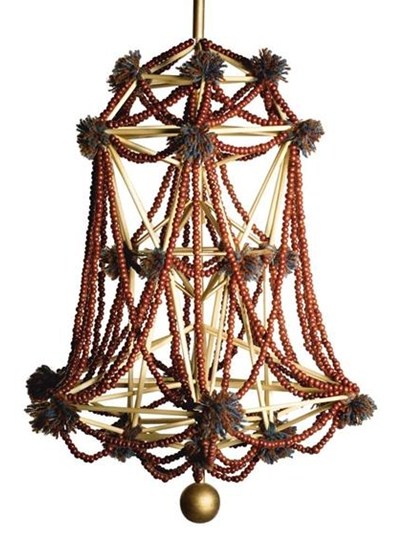
Chandelier in the grass and bearberry by Gustaf Åhman from Järvsöbacken.
PHOTO: Robert Blombäck
Self-made chandeliers became a common household decor item in the Swedish peasant home in the 1800s. These beautiful crowns were seen hung over the dining table. Many of the chandliers took on designs similar to what was created locally.
In Dalarna, the hand made chandeliers consisted of straw, yarn and björktickor which was sawn into thin slices and täljdes in heart and star shapes.
Many of Härjedalsvägen crowns were made of reeds, where the straw was threaded into diamonds adorned with thick yarn tassels.
On Gotland were chandeliers made of pig bristles bent and then the ends were joined together with beeswax and then was wrapped with colored wool.
Info From Skona Hem
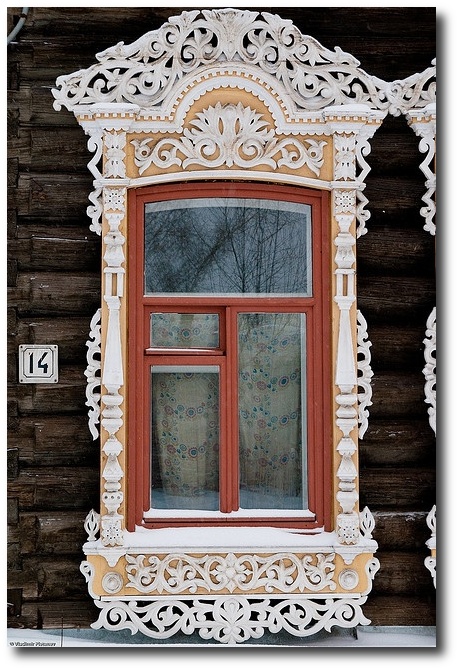
Czech Republic Tschechien Prague Prag Praha on Flicker
The Norwegian blog Ernashus cookbook author Hannu Sarenstrom.
Swedish Jugend House- Originally Seen on Sköna Hem
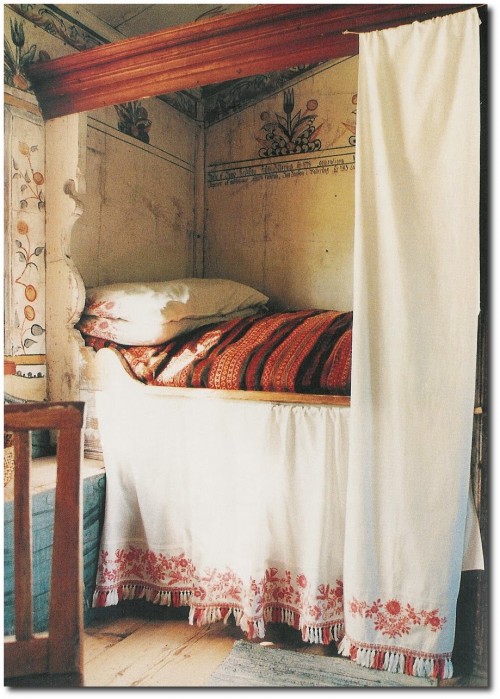
Swedish Cupboard Bed
Red Swedish Country Style Bench- Lindas Lantliga Blog
Red Scandinavian Tea Cup- emmelines.blogspot.com
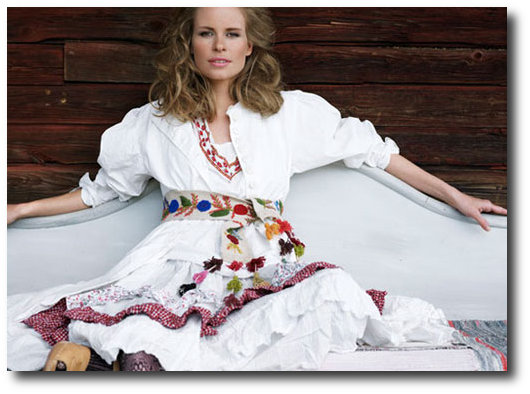
Swedish Folk Art Costume-Visit kurbits.nu
Floral Swedish Folk Art Texiles- Visit borntoknitblog.blogspot.com.au
Red Scandinavian Interiors Seen in Katrin Cargill Interiors
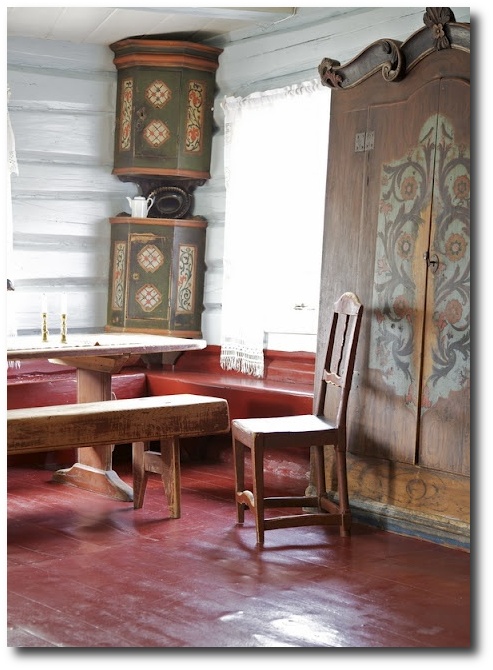
Swedish Folk Art Style- Seen On Livs Lyst Blog
“Living in Norway” is a pictorial tour throughout Norway of days gone by in quiet solitude between the grand fjords with the majestic mountains on all sides. The book is divided into the four seasons: fall, winter, spring and summer. You can experience the beauty of Norway through all seasons. Winter time in Norway is long, and the daylight hours few, but the homes are gaily decorated throughout the dark winter days.
When it comes to antiques, here you can see them in their natural surroundings. This book offers hundreds of color photographs, but don’t forget to read the text, it is a fantastic tour of Norway.
The “hytta” or cabins the norwegians used in the summer days are featured, many of the old hytta still exist and open their doors to guests as do American bed and breakfasts. Some of the hytta remain with the original families, others have been purchased for private use or for overnight stays. Traditional rosmalling on the walls and the “box beds” will guide you through times gone by.
An intimate tour through the summer home of Edvard Grieg and his wife will delight you and amaze you to discover that this is also the final resting place of the Greig’s. But more awaits.
The modern Norwegian homes are smartly represented also, from a simple concrete structure in Oslo decorated to please someone with an eye for new-age artwork, these glimpses inside the homes of Norway and excellent stories about their histories may leave you wondering how to find these places. No fear, among the last pages of the book are addresses for each of these homes if you would like to include one of these homes on your next trip to Norway.
No matter if you wish to visit a Nordland harbor with it’s peaceful calm fjord, or a Gudbrandsdalen farm which is linked to the 3 series trilogy written by Nobel prizewinner Sigrid Undset (The Bridal Wreath, The Mistress of Husaby, The Cross), you will find a rich selection of Norwegian homes, interior and exterior, modern or antique. As you read the book, it will look handsome on your coffee table. It makes an excellent gift for a family member who would enjoy reading about days gone by in Norway and living in modern Norway.
If you desire to decorate your home norwegian style, ideas abound in the book. How about a stroll along Karl Johan street in Oslo to find a excellent restaurant with a historical past? A great book for Norwegian genealogists interested in farm life also. This book is rich in text and photographs, and the book is so inexpensive
- Lars Bolander’s Scandinavian Design
- Seen On The Essence Of The Good Life
- Heritage Of Europe- Studio Dreyer Hensley, Kisten Visdale
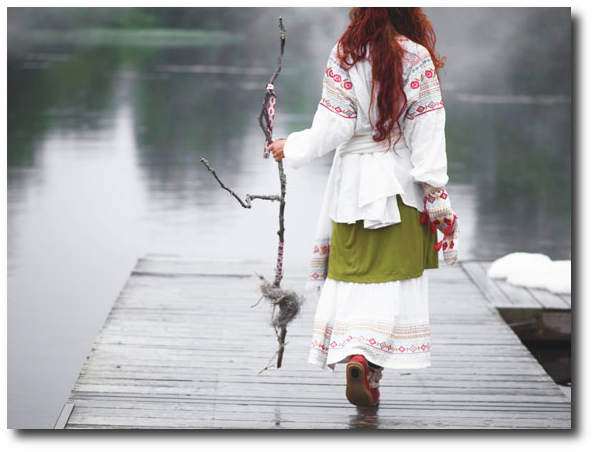
- A Swedish girl wearing traditional costume, Dalarna, Sweden by Bjö© on Flickr
- The Swedish House- Review
- Swedish Folk Art Style- Seen On Livs Lyst Blog
- Norwegian-American Homes at the Vesterheim Museum
- Carved Norwegian Spoons-Visit plumo.com
- Norwegian Folk-Vibrant colors My North.com
- Russian motifs painted on a wooden shelf- Marieclaireidees.com
- Råbystugan (old farm house from 1776-1777) by Vilseskogen on Flickr
- Book- Country Style by Judith and Martin Miller Seen on The Paper Mulberry
- Swedish Folk Art Style- Seen In The Swedish Room
- Seen On Kevin Sharkey’s Blog
- Review Of Living In Norway By Debbie Cole
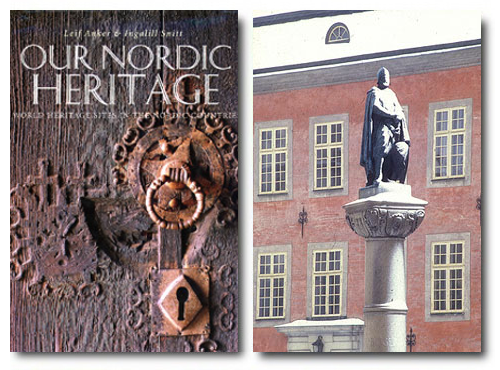
Book- Our Nordic Heritage Ingalill Snitt- Buy It Used From Amazon $18
Book – The Soul of Stockholm From Ingalill Snitt- Amazon From $2


50 Examples Of Swedish Folk Country Interiors
Interior archive is one of those sites where you can spend hours on. Looking through their dozens of pictures, there are a number of beautiful pictures that present a country look from Sweden. Here are my favorites:
A Swedish Interior Design Country Folk Art Home Photographed By Tim Clinch
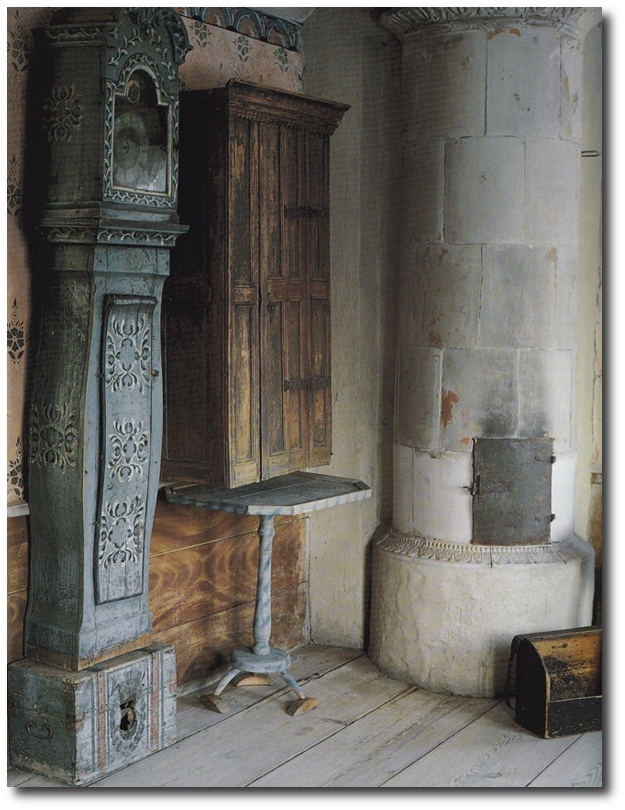
The Interior Archive showed some beautiful pictures of a country house in the folk art Swedish style. A simple kitchen is furnished with antique wooden furniture. A hand-painted Swedish Mora clock stands against a distressed orange wall in the kitchen. Here, we see the detail of the hand-painted decoration on the chair that sits in the kitchen. A wall-mounted corner cupboard provides ample storage in the kitchen.
Swedish Country Home Designed By Van Breem
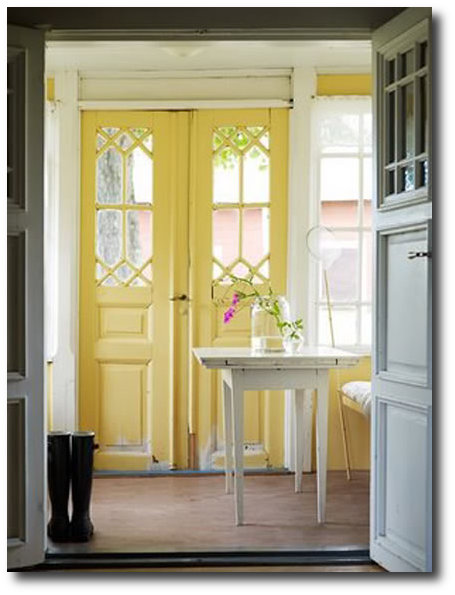
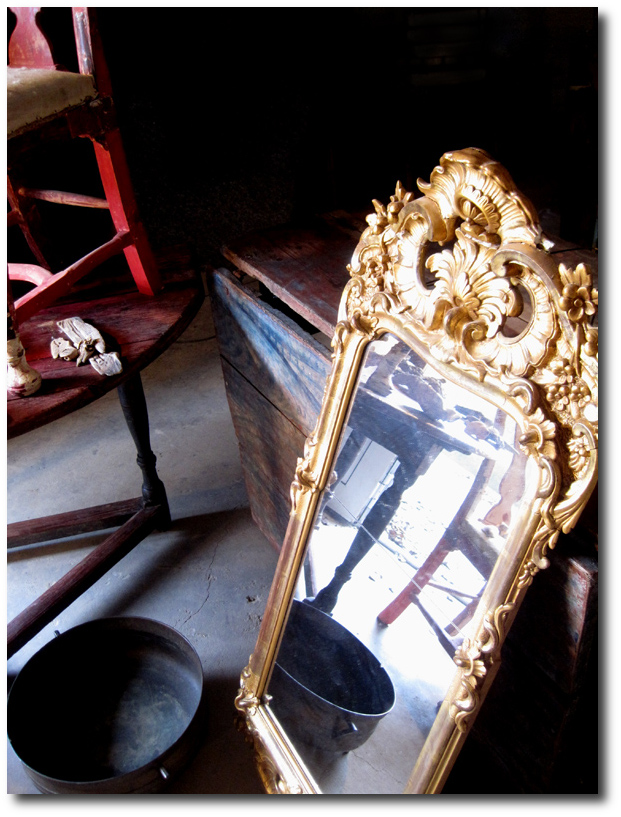
Photographer Simon Upton captures a guest bedroom is painted a pale grey and the bed is from van Breem’s line of reproduction Swedish furniture. A pair of rustic wooden chairs flank a console table and a Swedish Baroque mirror in the yellow painted hallway. The dining area in the kitchen has a wooden trestle table and Swedish grandfather clock and is full of spring flowering bulbs. The large range in the kitchen displays a collection of Swedish copper pots. A painted yellow Swedish sofa from 1760 and a dresser in the living room. Outside we see a Swedish bench and lantern infront of a shed with a blue door.
A Swedish Home Designed By Lena Renkel-Eriksson
-Lena Renkel-Eriksson has used shades of white, blue and dove grey to recreate the classic style of her native Sweden in her Surrey home Here she creates a unique space around the color blue. A blue-painted cabinet in the kitchen was custom made by Swedish carpenters and the swedish country chair was painted in a richer more saturated blue and distressed. In this photo, we see a yellow painted doll’s house flanked by tiers of battered leather suitcases in a nursery. This spectacular photo shows off a dining area designed around the Swedish styles. A Swedish bench is paired with white painted Swedish gateleg table, and two classic swedish side chairs. The wooden floor of this hallway has been hand- painted in a yellow and white harlequin pattern. In the attic bedroom, white is the dominant color. A white wooden desk and Gustavian-style chair are placed infront of the window. A country styled white painted chair sits in the corner of the living room, where beautiful painted walls steal the attention. An oval Gustavian bow mirror is painted in white on the wall shows this room is decorated around the classic Swedish styles.
Noteworthy Beauties:
-A Rustic Lars Sjoberg Home shows a Swedish mora clock which stands on the stone staircase.
-Designer Lena Proudlock shows a solid blue-painted Swedish mora clock which stands on a blue-painted wooden floor.
-Mish Tworkowski designs this rustic styled living room that sits an antique spoolwork armchair
and a re-upholstered French chair in an orange velvet. In the room sits a cream painted 19th century Swedish cabinet. White washed wood walls give plenty of light to this sitting area.
-Miguel Flores Vianna shows a spectacular Swedish kitchen with a wood burning stove, with country Swedish chairs. This kitchen has many rustic elements to it. A light blue is painted on the walls breaking up
– Christian Kain positions two pairs of boots on either side of a carved painted console table in green the hallway.
Picture Credits:
Jeff R Bridgman American Antiques
Swedish Interior With Slat Wood Walls- Tumblr
Swedish photographer Anna Kern.
Norrlands Chairs Lucas Antiques Blog
Swedish photographer Anna Kern
Swedish photographer Anna G. Tufvesson ,
Swedish antiques from Gudrun Ödmann Antikhandel gudrunodmann.com
Picture Credit-masterhenriks.blogspot.com
Swedish photographer Anna Kern
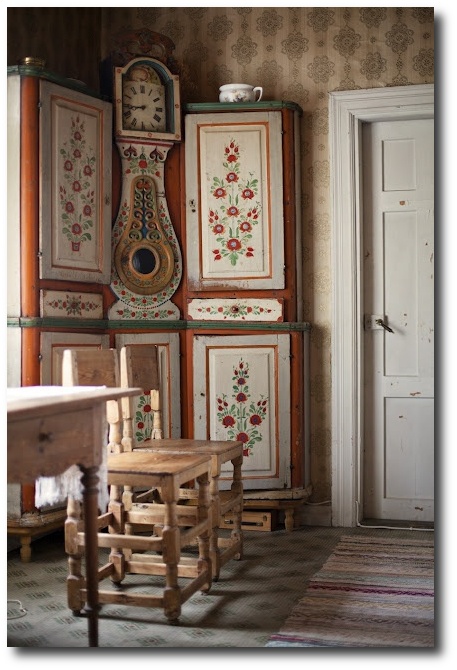
Corner cabinet in red, white and green with a built in Mora style clock. Tumblr
Swedish Bench- Live Auctioneers
Sandemar, Sweden, 17th Century
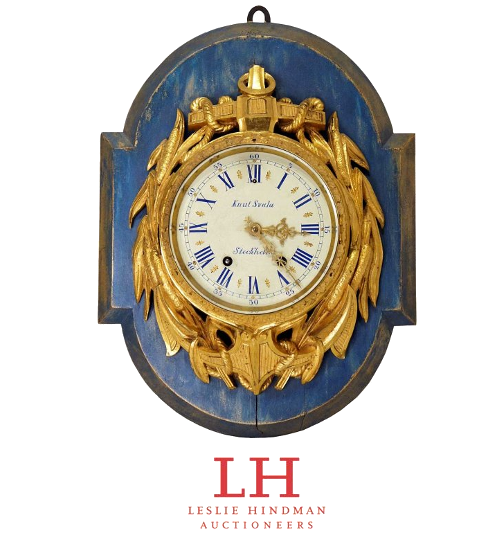
Swedish Gustavian Style Gilt Bronze Cartel Wall Clock,circa
1860, having a heavy bronze case in the form of an anchor draped with a
laurel wreath mounted on a blue painted wooden plaque; the white
porcelain dial has a blue Roman numeral chapter ring encircled by an
Arabic numeral minute ring, marked Knut Svala / Stockholm
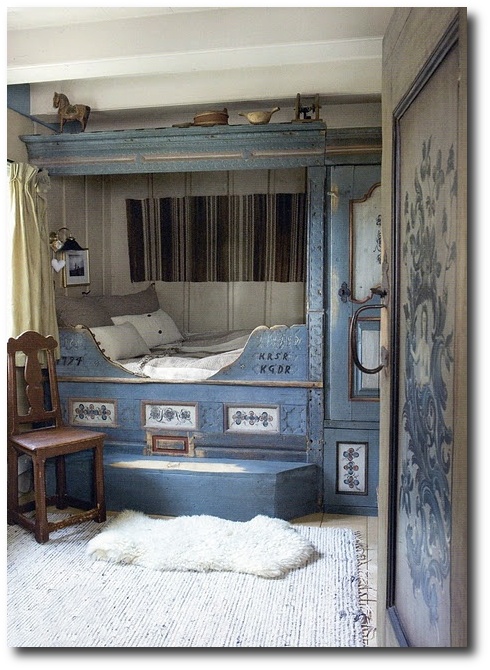
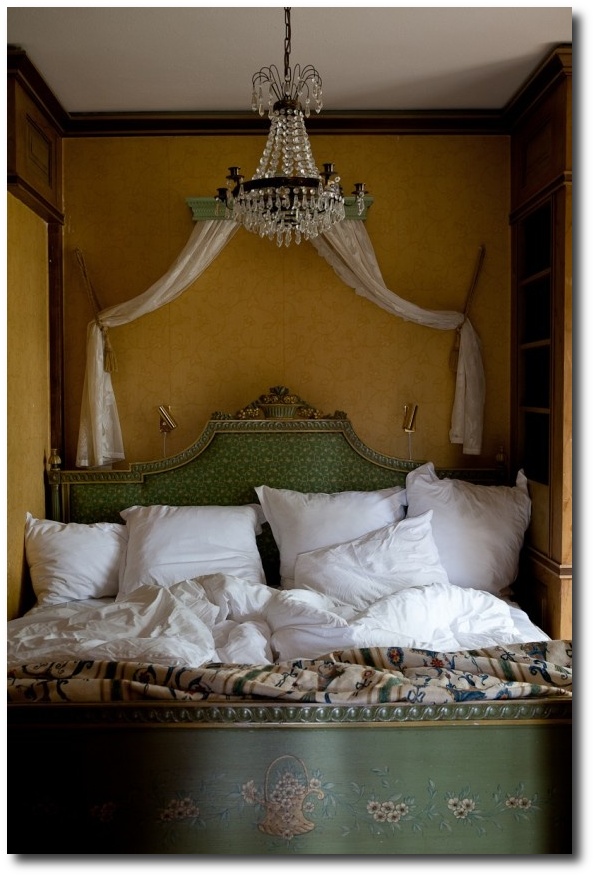
Scandinavian Bed
Folk art painted step back hutch with adjustable shelves, two drawers and two doors.
Scandinavian room scanned from BOOK: The Perfect Country Cottage by Bill Laws
Featured on Glenda’s Blog The Paper Mulberry
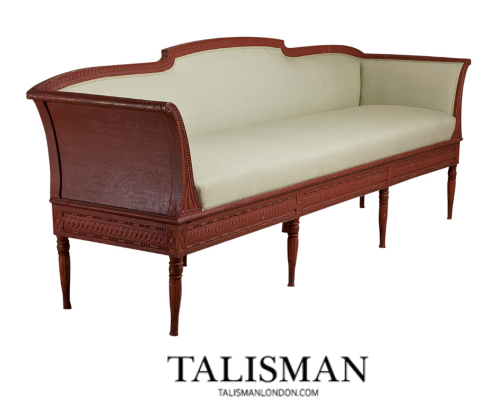
A Rare Swedish Gustavian Red Painted Sofa circa 1790 Reupholstered by Talisman
The Swedish Country House By Susanna Scherman- Buy It On Amazon
Original Pictures Seen On Martha Stewart
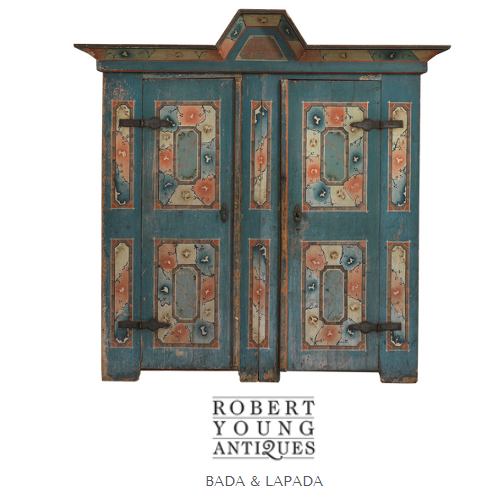
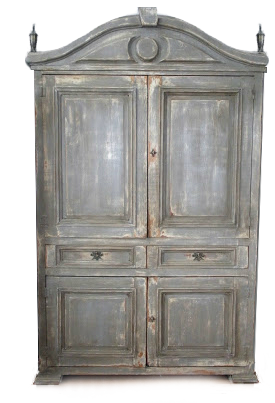
A remarkable late 18th Century Marriage Cupboard, in the Folk Art tradition, made in two vertical sections and surmounted by an arched molded cornice, all retaining the original painted decoration and hand wrought iron hinges. The original painted surface shows some appealing evidence of wear and age and the subtle original polychrome colours have softened and patinated to a delightful chalky dry surface.
Marriage Cupboards of this scale and importance were generally made to special commission for young married couples and were frequently offered by their families, containing woven, homespun and embroidered fabrics. They are also known as “Dowry”, “Brides” or “Wedding” Cupboards and are often associated with the Scandinavian Countries, where there was a strong tradition of Paint Decorated Furniture of this type as in other European alpine regions. The reason they are made in separate sections is so they could easily be de-assembled and transported up to the mountains in summer months, when the agricultural folk would take their livestock up to new pastures.
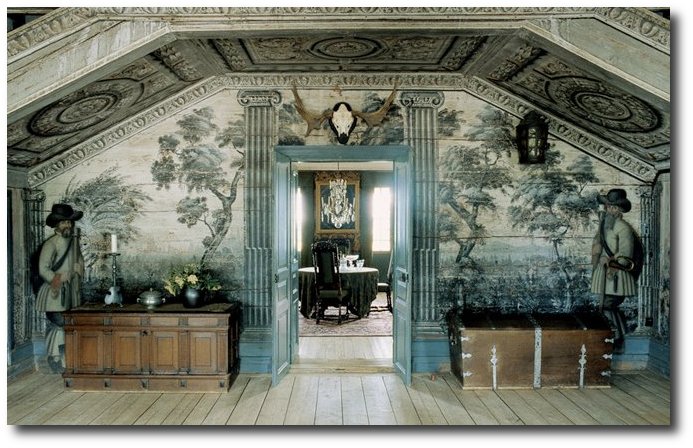
The extraordinary artwork seen in this social gathering space was painted by Jonas Hertman in the 1770s. The subjects of the murals depict cherished images and events in Swedish culture.
Original Pictures Seen On Martha Stewart
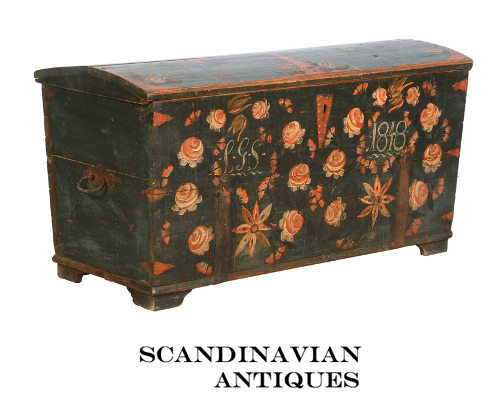 The colorful original paint has been well preserved on this lovely chest. The monogram and date of 1848 indicate it was likely a wedding or anniversary gift.
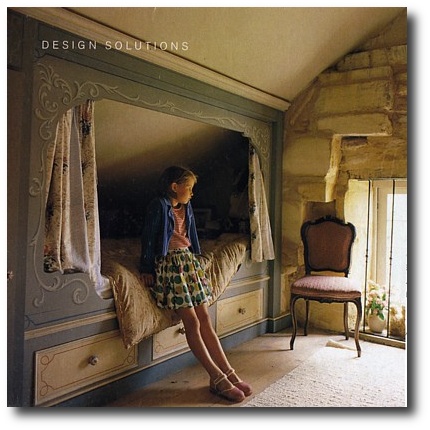
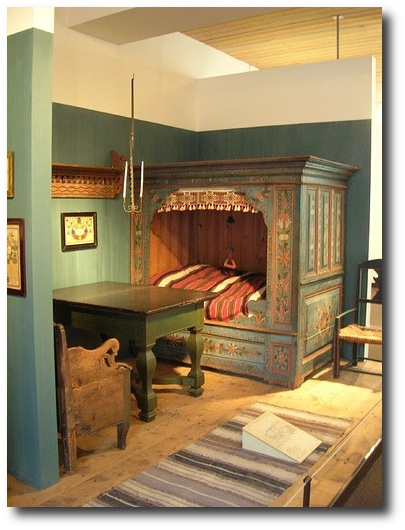
Scandinavian style bed stuffed with charm –Flicker
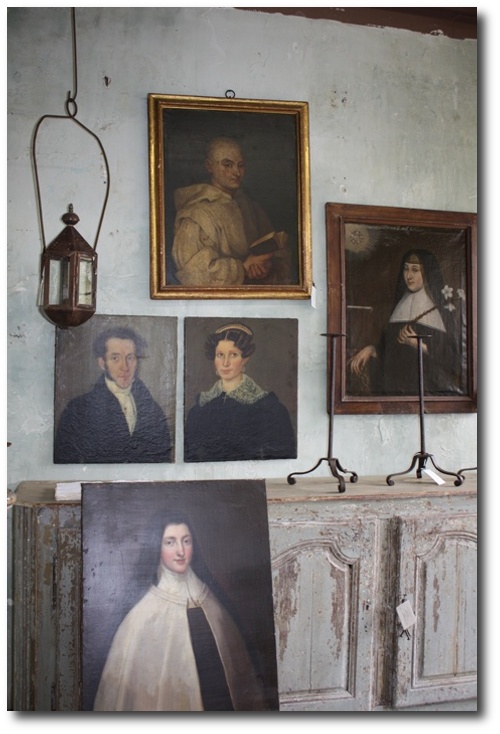
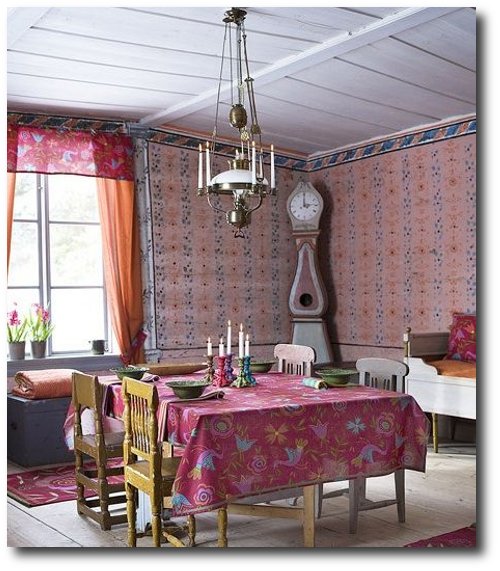
Swedish Folk Art Style- Space For Inspiration
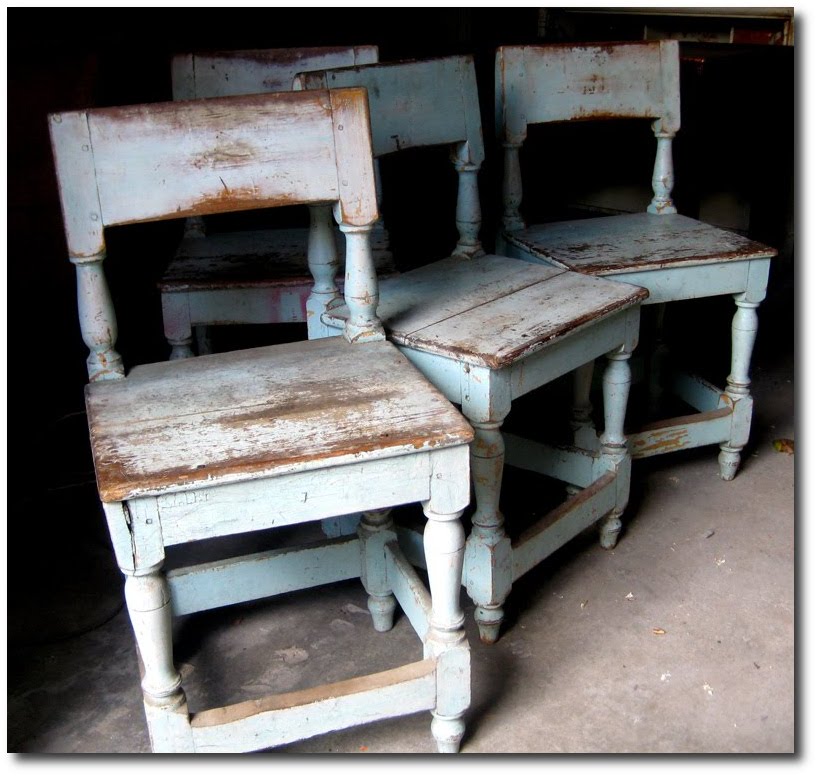
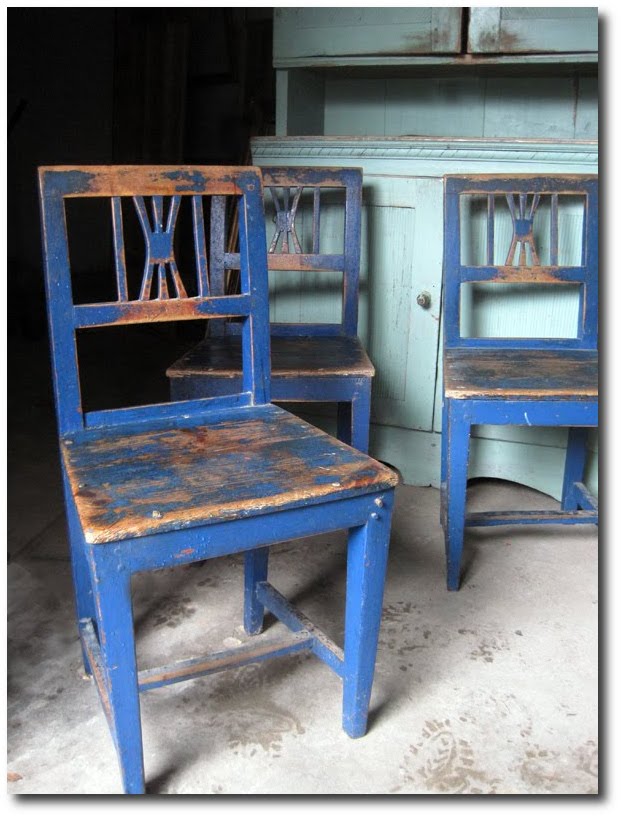
Primitive Corner Cabinet With Astonishing Blue Paint, 3 Beautiful Country Chairs,
Red Antique Chest, -Swedish Wedding Chest Lucas Antiques Blog,
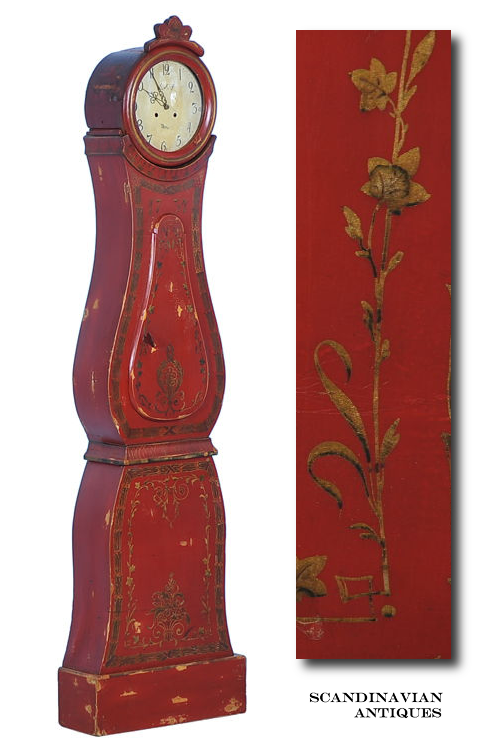
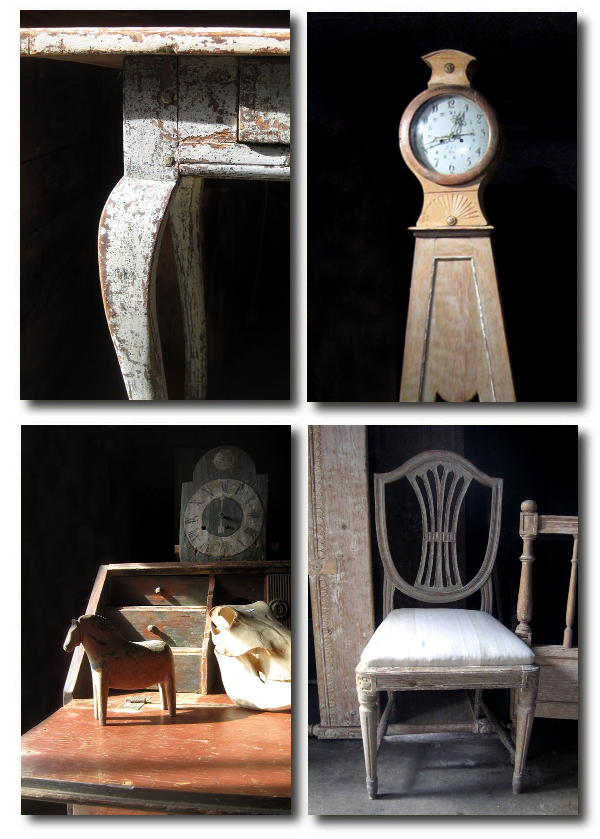
The beauty of a Swedish Mora clock such as this is found in the lovely
curves of the piece itself. In addition, this one had been painted a
deep shade of red and has intricate floral and leaf flourishes in gold
and green (note, paint is newer than the clock case, painted
approximately 100 year ago).
Swedish Mora Clock In Red From Scandinavian Antiques




Designers Pick Their Favorite Gray Paints
Picture Credit –Scandinavian Antiques Co On Ebay
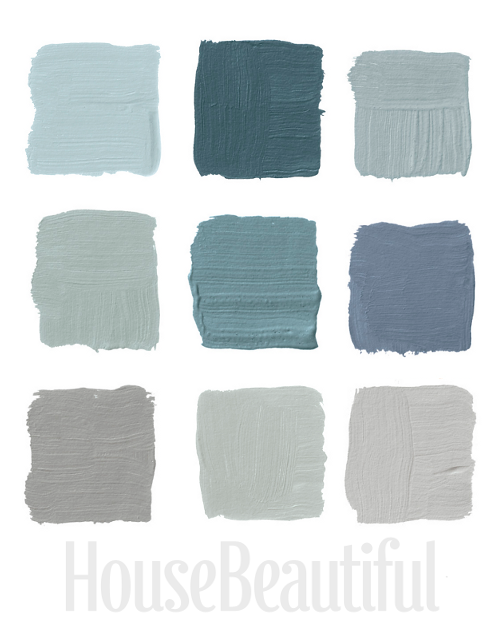
Featured above are the colors, Top Row: Pratt & Lambert’s Argent 1322, Farrow & Ball’s Claydon Blue 87, Farrow & Ball’s Green Blue 84, Middle Row, Farrow & Ball’s Light Blue 22, Benjamin Moore’s Sea Star 2123-30, Benjamin Moore’s Wolf Gray 2127-40 Bottom Row, Benjamin Moore’s Graytint 1611, Sherwin-Williams’s Magnetic Gray SW-7058, Benjamin Moore’s Stone Harbor 2111-50
Home Beautiful featured an article on 26 Designers who shared their favorite Grays. Gray painted interiors can be the perfect color palette for Swedish Gustavian or Rococo antique furniture. Gray can showcase antiques like no other color, because it is neutral, and doesn’t compete with the furniture and decor. The last thing you want after spending thousands on a piece of furniture, is to have someone notice anything but what you spent your hard earned money on! Pair your painted gray antiques with a backdrop of white gray interior walls and trim, and add a punch of color with your upholstery, accessories, and flowers.
Many of the designers featured in the article, were those of Richard Gluckman, Stephanie Stokes, David Kleinberg, Tori Golub, Stephen Sills, Phoebe Howard, Steven Gambrel, Gerrie Bremermann, and Sharone Einhorn and Honey Walters.
Here are just a few of the designer quotes:
“Mesquite is a flattering light moss green without much yellow. I love it because it doesn’t shout ‘I’m green!’ It says, ‘I’m a very beautiful color.'” –Jennifer Garrigues, Benjamin Moore’s Mesquite 501
“Lago Argentino is a glacier lake in Patagonia, and it’s the most amazing color, an aqua, milky because as the ice melts it pulls minerals off the mountain. I stayed in an inn with a stunning view of the Perito Moreno glacier.” –Suzanne Rheinstein , Ralph Lauren Paint’s Blue-Green GH81
“For me, the most appealing colors in summer are not hot but cool. You don’t need to be reminded of the sun and heat — you’re in it. What you want is a cool breeze through the pine trees, like this chalky gray green.” –Frank Roop, Benjamin Moores Soft Fern 2144-40
“In my cutting garden I have morning glories climbing over a lattice obelisk painted this wonderful silvery sage green. It reminds me of lavender leaves.” –Michael Whaley, Benjamin Moores Cedar Grove 444
“I have a big, hugely functional Georgian Revival lawyer’s desk in tired dry mahogany, bought from a tired dry lawyer. I painted it this pale gray-green in an oil-base stain finish, cleanable, very calm, but not so pale that it dies. The gimmick is the old-fashioned desk in an unexpected color. It catches light and makes for a more interesting surface.” –Carey Maloney, Donald Kaufman Color Collections DKC-10
“It’s kind of robin’s egg blue, and with mahogany furniture and neutral upholstery, it looks great. I see dining rooms as mostly evening rooms, and this has life to it. It’s very soothing.” –Mariette Himes Gomez, Benjamin Moore’s Sage Tint 458
“Green is the great neutral, all the way from pond scum to soft sage or pale celery. I recently moved into a new house surrounded by greenery, and when I was thinking of what color I might use for a drapery lining, it came to me to reflect the green that is present year-round right outside that window.” –Barbara Barry – Donald Kaufman Color Collection’s DKC-8
“This is the color of the sky in Old Master paintings, when the varnish has yellowed; it’s luminous. Paint just the floor and you’d feel as if you were floating.” –Thomas Jayne, Benjamin Moore’s Heavenly Blue
“In my cutting garden I have morning glories climbing over a lattice obelisk painted this wonderful silvery sage green. It reminds me of lavender leaves.” –Michael Whaley, Benjamin Moore’s Cedar Grove 444
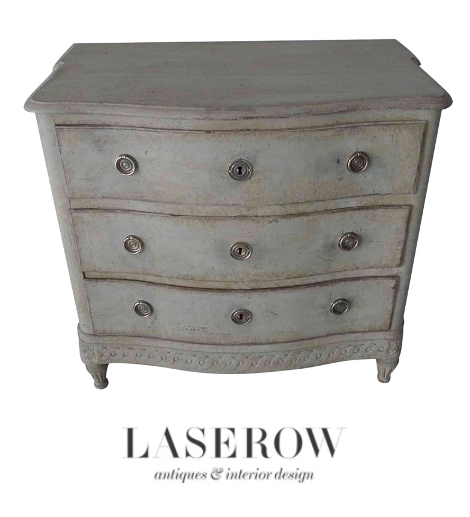 Gray Painted Swedish Furniture – Laserow Antiques
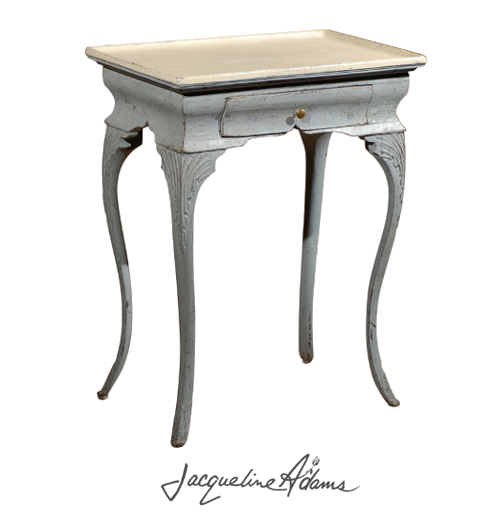
18th Century Swedish Tray Table – Jacqueline Adams Antiques
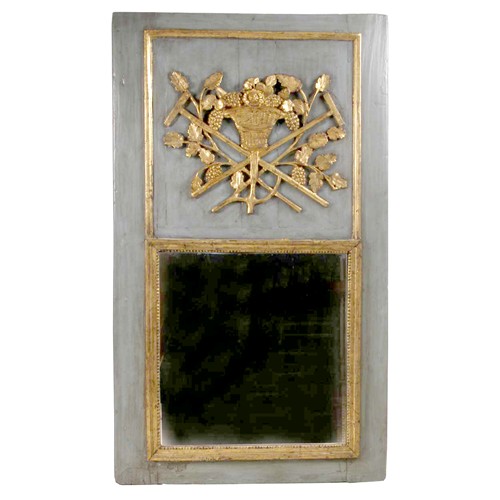
This mirror would have been part of a room paneling. It features a beautifully hand carved and gilded top panel of a basket with flowers and grape bunches before crossed mallets and grape branches and is surrounded with a square, gilt molded frame. Beneath is a square mirror framed with a beaded, molded edge
HOW TO: Paint Gustavian Finishes
Andie, from Divine Theatre Blog, posted an amazing transformation of an outdated Mexican armoire, which was converted into the classic Gustavian styles with layers of distressed paint and new hardware. Andie shows us how to do it ourselves….
“These pine Mexican Armoires are outdated, having seen popularity in the mid to late 90’s, they are a trend whose time has come. It is evident by the sheer volume of pieces like this on Craigslist. This particular armoire is a bit different in that it has a domed top with a carved cutout in front.”
In the post, the biggest challenge with the armoire was changing out the hinges. Hinges can be really tricky. Transforming my own armoire, I know all too well, that not every hinge is alike. Be careful when removing existing hardware. Save the existing hardware until you find another set that will work well.
More From Andie about Hinges….
” There are more than 20 different types. Three of those types made their way into my home and had to be returned because they would not work on this piece. The doors are very thick! I ended up using plain old butt hinges. I chose 2 inch hinges and merely placed them under each existing strap hinge and drilled small pilot holes, then attached them all and finally removed all the existing strap hinges. I then filled the holes with wood putty and let it dry overnight. I also filled the knotholes with wood putty. It required two applications, allowing the putty to dry thoroughly between applications. I then sanded the putty with a fine grit sandpaper”
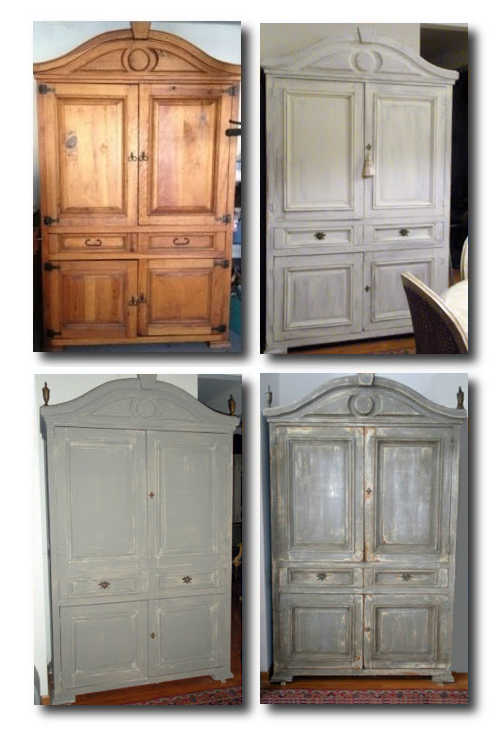
Painting Steps:
1). One Coat Annie Sloan Old White
2). (Not Shown) Second Coat Annie Sloan Old White
3). One Coat French Linen
4). Sand with Medium grit sandpaper.
Andie explains more about the Swedish paint finishes:
“Following these foreign impulses the Swedes created a more restrained or austere style of decoration more suitable for Sweden than the over embellished continental Baroque and Rococo styles. Original 18th century finishes were achieved by multiple layers of a pigment such as black Iron Oxide, mixed with linseed oil. The typical Gustavian grey was reached by mixing these two ingredients and the depth of the color depended upon how much iron oxide was used. A high sheen is not common among Gustavian painted pieces.”
“When I paint a piece I peruse hundreds, if not thousands, of photographs, as well as old paintings. I look to see how the piece withstood the ages, where the paint is worn away and the patina of time and use. With this piece I imagined it came from a large home that had only fireplaces for heat and candles for light. I was heavy handed with the Annie Sloan Dark Wax to mimic the acrid, clinging smoke that no amount of cleaning could erase. Then I sanded the corners, where busy hands may have grabbed the doors through the centuries, taking bits of paint and depositing oils. I then sanded around the hardware to mimic the efforts of the housekeeping staff to keep the hardware clean. I imagined a servant buffing in the same pattern each time she was assigned the task of cleaning this armoire. Up and down…side to side…year after year… until the pattern became engraved upon the surface. The mops they used sometimes nicked the base of the piece and removed paint.”
Andie’s Paint and Hardware Suggestions:
– Remember to have clean t-shirts or terry towels on hand to rub the wax in after it is applied.
– Place laurel, torch keyhole escutcheons on each drawer and used mock key pulls as well. In this post, “The Best 5 Sites For Purchasing Hardware” shows these torch keyholes. Find additional Swedish and French hardware here
– “The mock key pulls had a shiny brass finish. I first soaked them in acetone to remove the clear sealer, wiped them off , rinsed in hot water, then boiled them in a mixture of salt and white vinegar. I used a ratio of one cup to one cup. After you boil them for 10 minutes, remove them from the vinegar and salt solution and place them on a baking sheet in the oven at 450 degrees for ten minutes. Please be cautious when working with chemicals and high temperatures!”
– Add additional architectual details such as the large finials Andie found on ebay
Additional Posts From Andie:
-Craigslist Mirror Transformation and Tutorial – Divine Theatre Blog
-Louis Chairs Before and After- Divine Theatre Blog
-Rags To Riches- A Table Transformation- Divine Theatre Blog
– Craigslist Tutorial -The Craigslist Guru is sharing her secrets!- Divine Theatre Blog
-More Ormolu For Louis –Divine Theatre Blog
-You did What? A Table Transformation- Divine Theatre Blog
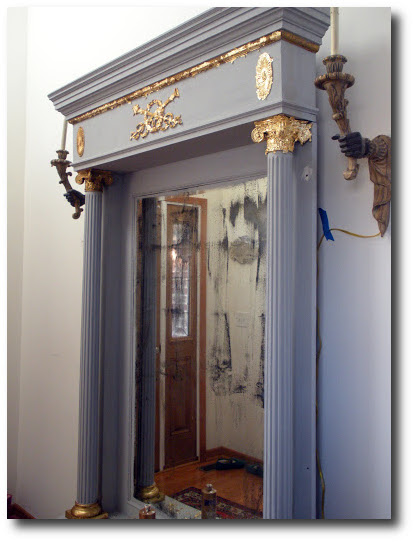
Gold Leaf Process Victoriaan Pier Mirror- Divine Theatre Blog
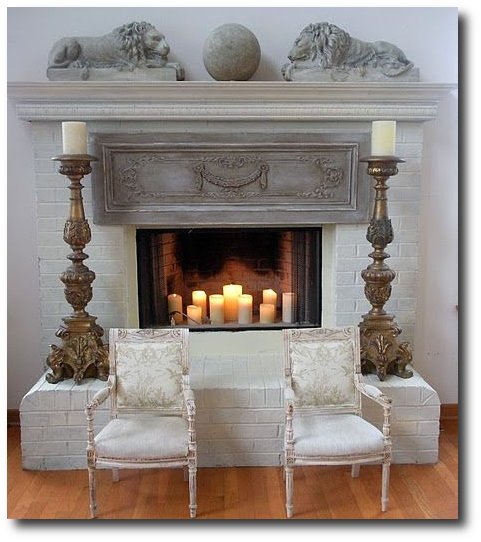
Paris Grey With Dark Wax
“Söderbo” A Home Untouched Since 1920
This Swedish home takes several chairs and combines them with a day bed. One way to unify several pieces of furniture is to simply paint them the same color, as they have done here.
“Söderbo” is a summer home, and perfect for all those who love history, because this home is practically untouched. Nothing has changed since the house was decorated in the 1920s. In fact, every piece of furniture, every picture, and the decor is such as it was in the early 1900’s. The interior lets in lots of light as large windows reveal the beautiful greenery outside. Elegant white painted furniture makes the home larger than it really is. Reading a book, playing a few games, and having a hot bath might be what you would do in this home in the summer months. Although you may have to haul in the water, and manually heat it! The modern amenities of the home are missing, but that doesn’t stop the owners from getting away and enjoying all the life that this property has to offer. Water must still be carried out and the food collected in the root cellar, so the children of the home don’t have to wonder how grandma and grandpa did things, the old way of live is very evident in the day to day functioning of the home.
“Söderbo” in the past was only used as a summer house. Servants were brought out into the country with lots of luggage, and the residents from the big city enjoyed the summer life to rest and enjoy the rich fresh air, and all that the countryside could offer. Besides the main house, the property is equipped with a boathouse pre-existant from the mid-1800s, a root cellar and a cabana by the water.
Inside the house, white painted wooden furniture shows a classic Swedish design which can be seen throughout the home. The furniture was originally purchased back in the days of the era’s most fashionable department store NK. The various pieces of furniture are seen in the country style which if fluent in the dining room, bedroom, desks, chairs and shelves. The kitchen is set up to function for food preparation, such as cooking, baking and canning. The upstairs of the home is mostly how it was originally. Some fabrics have been worn through time and replaced, but the beautiful Art Nouveau wallpaper in the parents’ bedroom are original. Gather some ideas from this time period for your home.
Images and full article found on husohem.se
“Söderbo” A Home Untouched Since 1920
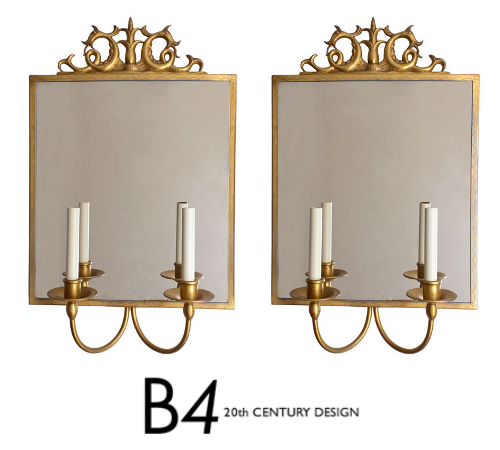
A rare pair of Swedish Art Deco 2-arm mirror sconces designed by Gustav Bergstrom. Frames are gilt over pewter and Incised with a serpentine pattern.The frame tops are decorated with a sculpture of a lotus flower flanked by 2 mythical sea creatures. Candles are newly wired for candelabra bulbs. Mirror glass is original and show highly desirable movement in the reflection. Sconces are the perfect example of “Swedish Grace” style.
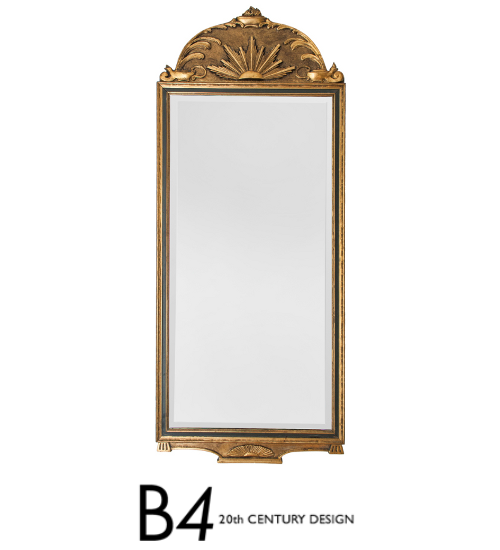
Delicate gilt wood Swedish Art Deco wall mirror with cared details depicting a sunburst and ancient oil lamps. Mirror glass is original and has a one inch beveled edge
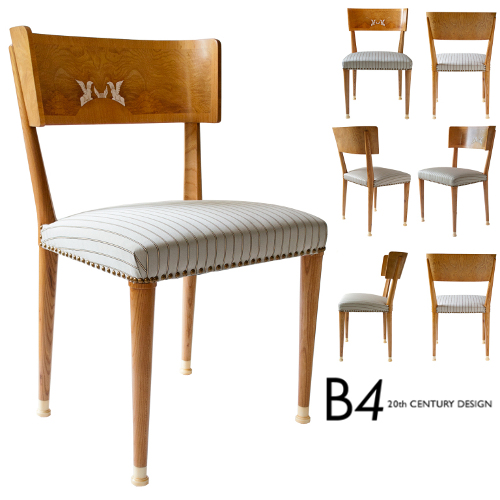
8 Swedish Art Deco Klismos dining chairs griffin inlays in bone
Elegant set of 8 Swedish Art Deco “Klismos” style chairs in solid elm and elm root-wood veneer. Each chair features bone inlays of griffins and bakelite sabots that mimic ivory. Newly restored and reupholstered. An accompanying dining table is available.
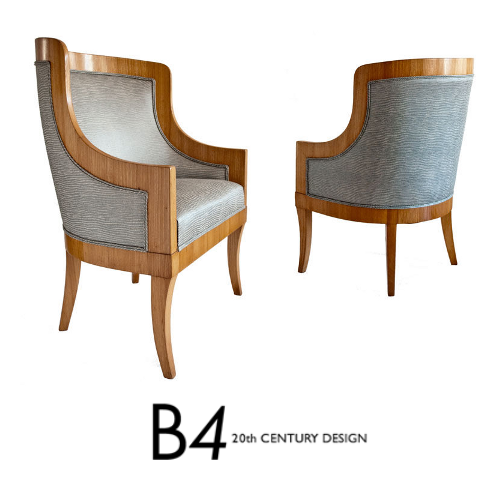
Carl Bergsten Swedish Art Deco chairs from M/S Kungsholm 1928
Elegant pair of Swedish Art Deco bergeres designed by architect Carl Bergsten for the luxury ocean liner M/S Kungsholm. The chairs are documented in the 1928 photograph of one of the Kungsholm’s reading
rooms. Chairs are elm wood veneer, newly restored and reupholstered. Bergsten designed the Stromsholm cafe chair which is considered an icon of 20th century Swedish design.
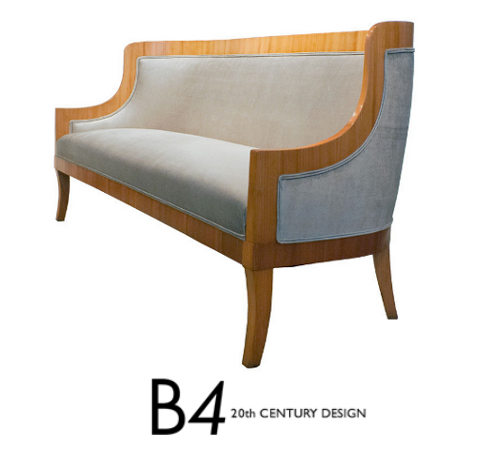 Elegant Swedish Art Deco sofa designed by architect Carl Bergsten
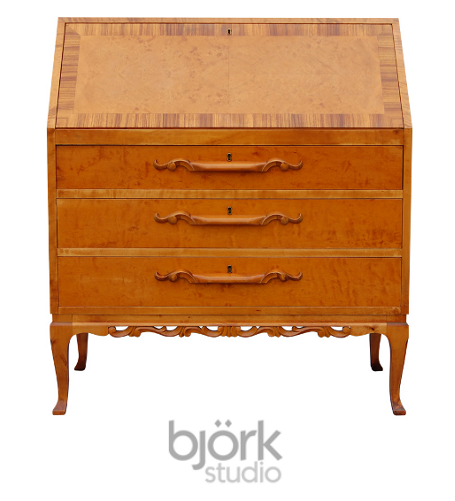 Swedish Art Moderne Drop-Leaf Secretary Writing Desk
Uniquely sized drop-leaf secretary in sleek golden elm. Leaf folds down to reveal shelves, cubbyholes and six drawers of golden masurbjork (birch burl) and a drop-leaf desktop – just the right size for a notebook computer. Lower section features three ample drawers with brass ring hardware – a great space to store your computer, office equipment or extra bedding or clothes. Perfect as a small home office – close the leaf and it’s a beautiful piece of furniture in any room


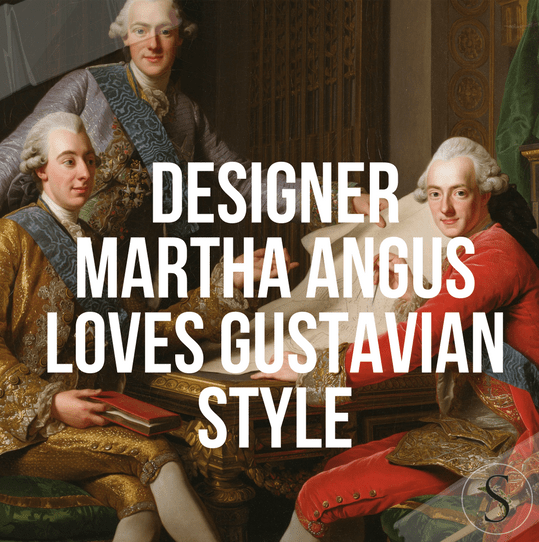
Designer Martha Angus Loves Gustavian Style
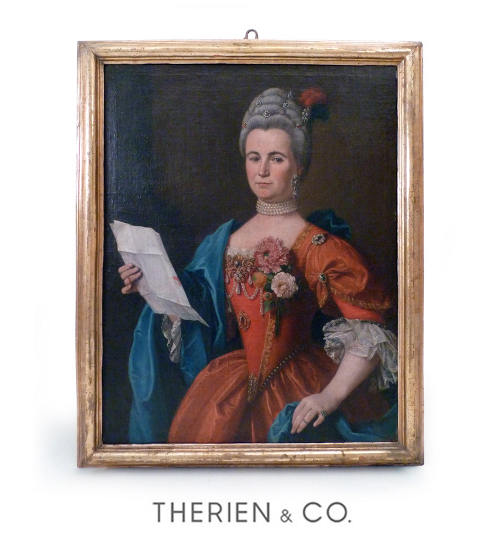 Swedish Portrait -the figure of noble women, in courtdress, within giltwood frame
The Style Saloniste posted an interview with designer Martha Angus, founder of the San Francisco-based firm, Martha Angus Inc. about her favorite style and paint colors. It turns out she loves the Gustavian Swedish styles, and gives out the paint colors she uses most often in her designs.
Q- Favorite design period?
Martha Angus: Gustavian. It’s late eighteenth-century, and feels like Louis XVI but not as grandiose. In addition, I love the painted finishes typical of the period, often in gray. Swedish design can offer a type of low-key opulence. During the Gustavian period, a light wash of paint in earth colors of light blue, gray, green and yellow was used instead of gilding. The prices of antiques vary, depending on the object. They’re now very collectible, so prices are rising fast. I’ve seen some fantastic examples at the Marche Paul-Bert at the Paris flea market, Clignancourt.
My favorite local source for Gustavian furniture is Therien & Company in Los Angeles (as well as the Therien & Co 20th-century collection at their gallery in San Francisco.)
Q: Your most versatile paint color?
Martha Angus: It’s Benjamin Moore and my special mix of half Decorator White mixed with half Linen. Works every time.
The finest paints are those designed by Donald Kaufman in New York. They are all elegant and multi-dimension and complex, so you could pick one with your eyes closed.
I’m a big fan of Farrow & Ball, colors: Parma Gray, Folly Green and Mouse’s Back are very individual and give rooms character.

Q: Which fabric could you use over and over?
MA: Heavy Belgian linen by Henry Calvin Fabrics, # 8793 “Mail Bag Linen” texture in natural. To the trade, Henry Calvin Fabrics, 151 Vermont Street, San Francisco, 415-565-1981. I often use antique textiles, tapestries, and pillows from Kathleen Taylor, The Lotus Collection, 445 Jackson Street, San Francisco, 415-398-8115.
Home Dit also features an interview with Martha Angus, where she reveals more of her love for French and Gustavian antiques.
Q: Tell us about the moment when you decided to follow a career in the field of interior design.
Martha Angus: I always felt like an artist growing up. I moved around constantly for my father’s career, so the whole idea of ‘home’, a place where you feel comfortable and can settle into, is the most important thing in the world to me. When I was a child, I absolutely fell in love with color, especially coloring books. I became so passionate about art and color, I thought “Oh, wow!” this is all I ever want to do, which led me to
eventually study painting at Carnegie Mellon and the Ecole des Beaux Arts de Paris.
When I came out of college the options for a female artist were quite limited yet art has always been a driving force in my career. As a young artist fresh out of school, I got my start as a fashion illustrator and textile designer in New York City. That eventually led to store design and high-end residential design. My work and interests are always evolving but I never abandoned my first love –painting and contemporary art. To this day, art is the most important feature in my designs. It’s usually the first thing I discuss when starting a new project.
Q:Where do you look for an obscure source of inspiration?
Martha Angus: I find inspiration in my usual trips to the Paris flea markets. I believe my ideal shop would include that sense of history, unstated elegance and fun that the French do so well. As in my projects, my ideal shop would include timeless and elegant items such a Gustavian settee or a weathered neoclassical zinc planter paired with a super chic custom designed plexi-glass bench upholstered in zebra silk-screen hide and bold Ellworth Kelly prints.
Q:What would be your recommendation for “what to do first” in a decorating project?
Martha Angus: Start with a good floor plan and remember that upholstery is the key. High quality upholstery can go a long way. Not only is it a good investment but it also brings a sense of tailoring and richness that other items can’t. Once the art and essential furniture items have been selected, accessorizing can do wonders. Scented candles and cashmere throws add a sense of luxury to a room without a significant investment. I always include small trays and boxes that bring the project down to a warm and livable level.
I always say that art is the most important aspect of a space, aside from the people collecting it. I live for bold, statement art. High art should not be treated as a mere decorative item that accessorizes a room, but almost a living element of the space – something with a very distinct personality.
Q: What’s your current paint color obsession?
Martha Angus: I believe in airy, fresh spaces that usually call for very subtle neutrals so that I can come in later and play with fun splashes of color in art, fabrics or accessories. When it comes to paint I find myself constantly going back to some Farrow and Ball colors precisely because they have that timeless elegance that relates so well with my philosophy. Some of my favorites are Middleton Pink and Arsenic.Throughout my career I have always recommended Benjamin Moore’s decorator’s white for its freshness and vibrancy. I have a life-long love affair with textiles of every kind. In fact my career started in New York City as a textile designer and fashion illustrator. I believe David Hicks style fabrics are classic and always so chic.
Q : What advice do you have for someone with a new house to decorate and perhaps a limited budget?
Martha Angus: Small changes can go a long way. I also advise my team to use color as envelopes for a room. Soft neutrals like French Gray or even Decorator’s White are great colors for walls, ceilings and trim because they can give an atmospheric look to a room and make it timeless, standing the test of time and whimsy trends. The one item I would recommend investing in is good upholstery pieces. The big items should also be covered in a neutral material that can stand the test of time. It will not only look good but will wear well for many years to come.
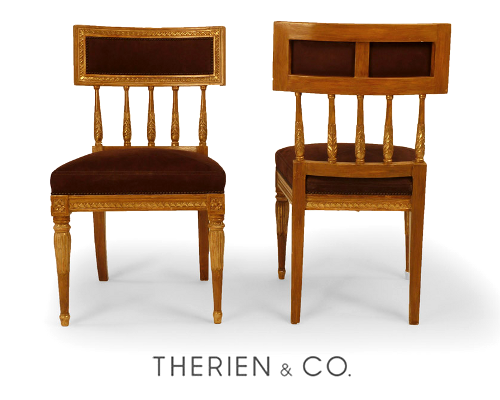
Pair of Swedish Late Gustavian Side Chairs- the rectangular upholstered crest rail within carved and moulded frame on foliate carved spindle supports, over upholstered seat with carved and moulded apron flanked by rosette filled blocks, raised on foliate carved round section tapering legs ending in toupee feet
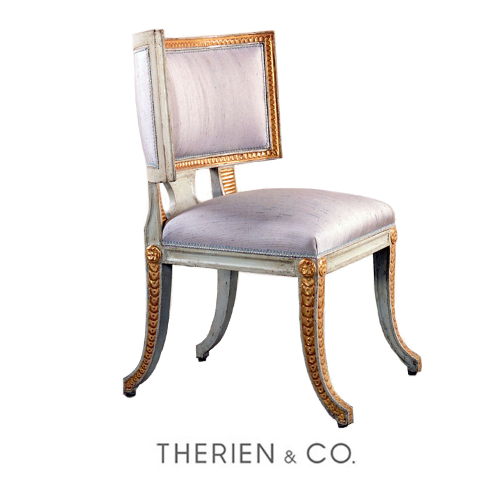 The Neoclassical period replaced the Rococo influences during the second half of the eighteenth century. Cabinet makers responded to the excavation of Herculaneum and Pompeii with great fervor, eliminating the robust naturalistic forms of the Rococo in favor of delicate colors and a less exaggerated line. The Klismos, the original antique form of this chair, was brought to light late in the Neoclassical period in Sweden as well as other countries. The Gustavian, another name for this chair, was developed during the reign of Gustavian III who seized power in 1771. This chair is believed to have been made for the marvelous pavilion at Haga, the summer home of Swedish royalty
Pair of Roman Neoclassic Painted And Parcel Gilt Armchairs with horseshoe shaped foliate carved back with downswept arms, joined to Greek key carved seat and raised on tapering fluted legs
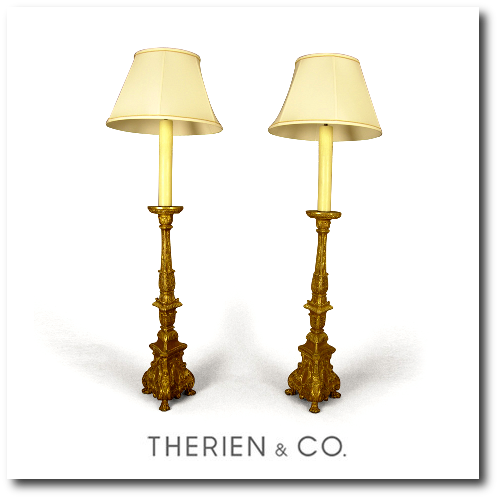
Pair Of Swedish Baroque Giltwood Candlesticks each of compound foliate and gadrooned tripartite form rising to flaring foliate sheathed bobeche, raised on conforming scrolling volute base, centering ribboned and foliate swagged cabochon medallion and ending in lion paw feet; now electrified and fitted with beeswax candle and calf skin shade
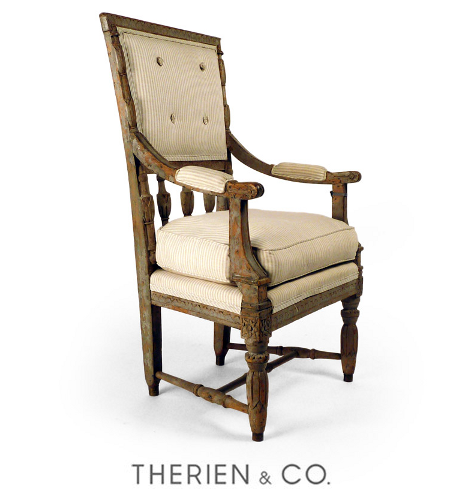
Swedish Neoclassic Painted Armchair- the upholstered back within conforming moulded and carved flaring frame, over urn shaped carved spindles joined by down swept supports to upholstered seat, raised on stylized foliate carved swelling round section legs ending in brass sabots and headed by rosette filled carved corner blocks; the whole retaining original paint
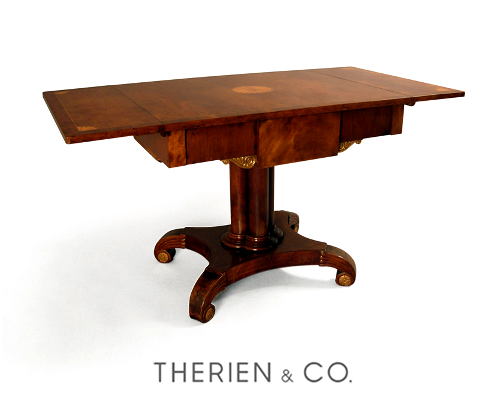
Swedish Karl Johan Mahogany Satinwood and Olivewood and Parcel Gilt Sofa Table- the rectangular top with satinwood stringing centering satinwood and olivewood inlaid central patera medallion and corresponding corners, with two drop leaves over breakfront apron incorporating single drawer, flanked by relief carved foliate volutes, on cluster columnar support in the early English taste, with molded socle and concave platform ending in foliate carved downward scrolling feet centering floral medallions


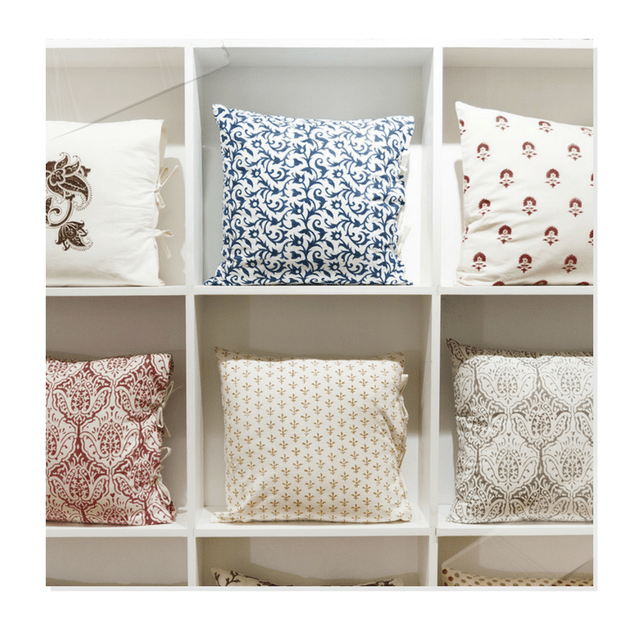
Les Indiennes Fabrics

Mary Mulcahy’s designs, first developed for her block-printed textiles, now grace the wall with the Les Indiennes collection by IVM Prints. The 12 hand-screened wallpapers include Rayure, left, and Veronique, both in indigo; additional colors are offered, Seen in Elle Decor April 2011
The company Les Indiennes is known for their beautiful hand-blocked textiles. Founder, Mary Mulcahy had a desire to find naturally dyed cotton, with large scale single colored motifs, but was unable to locate fabrics close to what she had in mind, so she created her own. Her concept started to take form after running into a craftsman in southern India, who knew exactly what she was after. In fact, the craftsman was one of the very few artists who still practiced the ancient art of kalamkari, which was an extremely complex and rare method of printing on fabric.
The Kalamkari Process:
1. Fabric Preparation- Cotton fabric is initially softened and bleached. This process needs to be done before any printing takes place. The process involves bales of organic cotton which are repeatedly rinsed and beaten against large rocks, then laid out on the grass to bleach in the sun. These steps ensure that the fabric will feel soft and luxurious, and so that the color application remains bright and vibrant.
2. Block Printing- After the fabric has been softened and lightened, printing begins. Craftsmen dip hand-carved wood blocks in dyes and presses them into the cotton. The dyes are derived from plants, roots, earth, and rock. One can only imagine the great care, and measurements taken to ensure the patterns are straight and line up with one another. Today we take for granted large printing machinery, when at one time, much of this work was done by hand. At Les Indiennes, the fabric is printed by hand, and hours go into each fabric panel. After the patterns are applied, the printed fabric is air dried for at least two days.

Decorating Secrets- 60 Quotes From The Best Experts In Design

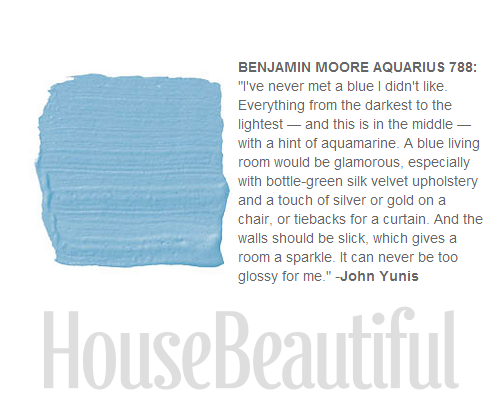
Swedish winters are long, dark and dreary, so historically Swedes have always turned to lighter interiors. Swedish style isn’t all about the gray and the white interiors they are famous for, but many homes feature brighter, richer colors to decorate around.
There are so many shades and tones of paint, that it can be impossible to decide on one color. Buy sample-size colors to help you make the perfect selection. A color can look quite different at night than the day. We recently painted the outside of our home, and the color which looked to be a creamy yellow at night, turned green in the day. Be sure to try your selected colors on a few different walls to determine what suits which room. You’ll thank yourself for making this extra effort before spending $$$ on the wrong shade.
Don’t judge the room until the paint is in place, and accessories and furniture are placed. A color which may seem to bright can be toned down by wall accessories, coordinating drapes, and art work. Consider working with the off shades of the primary colors. Intead of purple, consider lilac, or a raspberry tint.
Consider whether you are a warm or cool person. I once was asked this by a hairdresser, looking to choose a shade of blonde. I never gave it much thought before, but knowing which color you lean towards can certainly make picking colors a lot easier. Earthy reds, dusty warm plums, and rusty golds are in the warm color range. Silver blues, mint, and lavenders are colors which are cooler.
Advice From Pros
“Design is not just what it looks like and feels like. Design is how it works” Steve Jobs
“Green pigment was expensive in the 18th century, making it a status symbol. So it would have been appropriate for the royal governor’s house. I’ve been a curator at Colonial Williamsburg for 20 years, and when my husband and I lived in a historic house, we had similar green woodwork. It worked with every fabric I wanted to use, and it’s a great mood enhancer—chlorophyll for the spirit!” —Liza Gusler
“People think that they need to use small furniture and light colors to make a small room look big, but that’s not the case at all. Dark colors and just a few pieces of large-scale furniture, with the appropriate lighting and accessories, can give a room a larger, more luxurious feel.” —Mona Hajj
“Everything else in my house is off-white and grey, and I just had to have a break from that. I was looking at my pond, which is this murky shade of acid green, and I thought, ‘I’ll do that in high gloss to make it even more watery and translucent.’ It’s strange, but I love it.” —Stephen Sills
“Luxury must be comfortable, otherwise it is not luxury.” – Coco Chanel
“While looking at one of my first New York apartments, David Hicks told me diplomatically,’Dear boy, if you’re going to paint the walls white, you need art.'” Peter Dunham
“The only time white curtain lining should be used is with white curtains- J Randall Powers
“Use the precious for everyday purposes. We’ll rummage through clients closets and find loads of precious hand-me-downs like porcelain vases and crystal that are a bit out of vogue. We’ll use them for completely ordinary purposes – a case becomes a chic pencil holder, a crystal bowl holds makeup brushes. Turn the ordinary into a special moment” Benjamin Dhong
“I learned that passion about objects and furnishings makes for fearless decorators—and that if you are comfortable in your home, everyone else will be too. That sense of authenticity is what gives a home its soul.”- Courtnay Daniels Haden
“The most elegant interiors are just slightly tatty.” – David Netto
“Playing it safe. Instead, put a large-scale printed fabric or wallpaper on the walls and even the ceiling. It’s easier, safer, and less expensive to be dramatic in a small space. You might get tired of a bold print in the main living area, but it can make a smaller, less-used room an exciting space to spend time.” —Victoria Neale
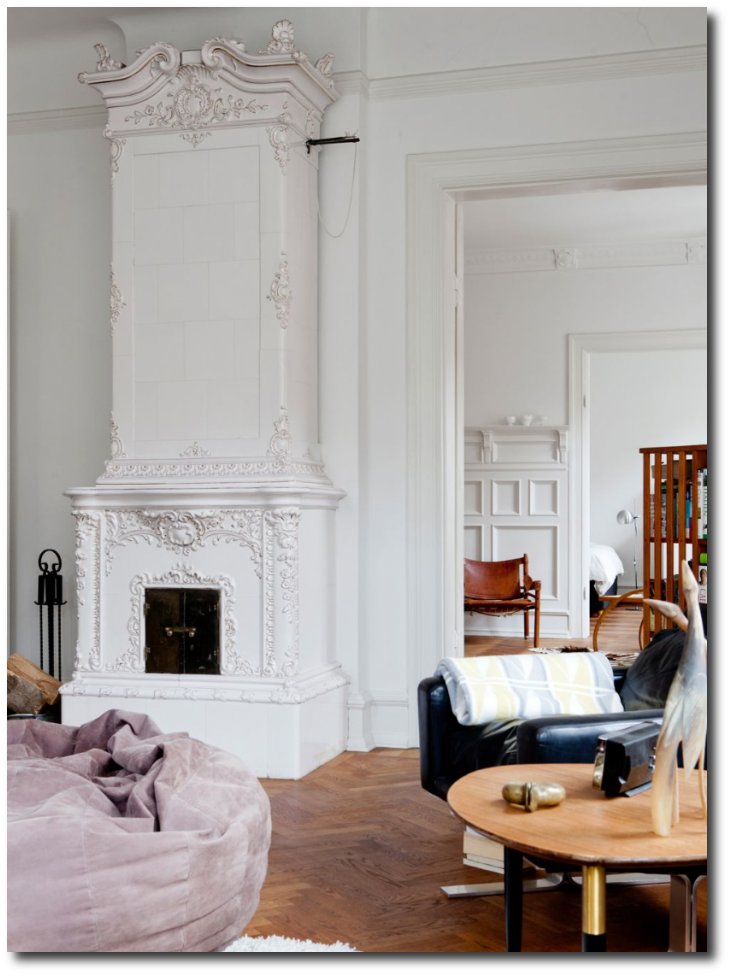
Swedish Kakelugn Stoves
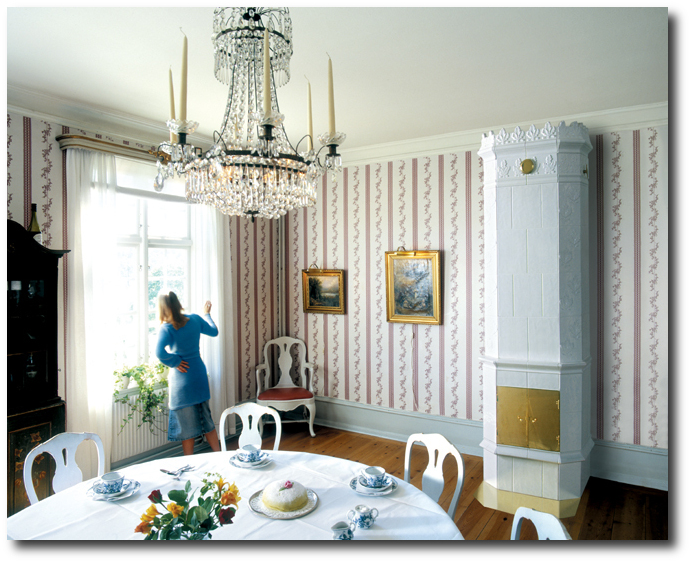
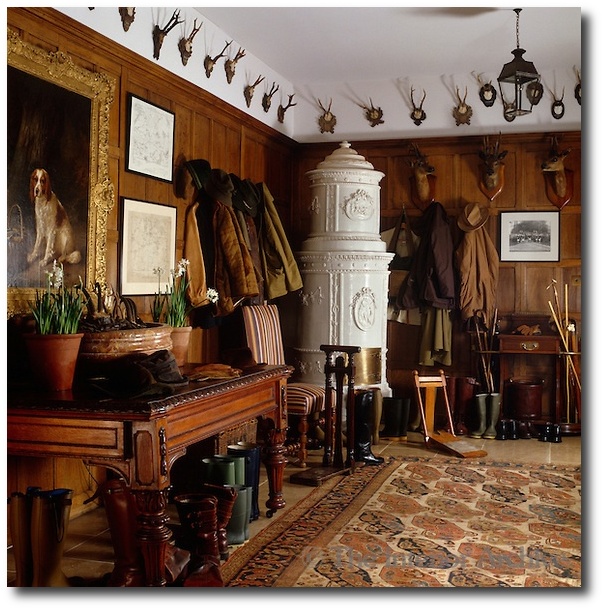
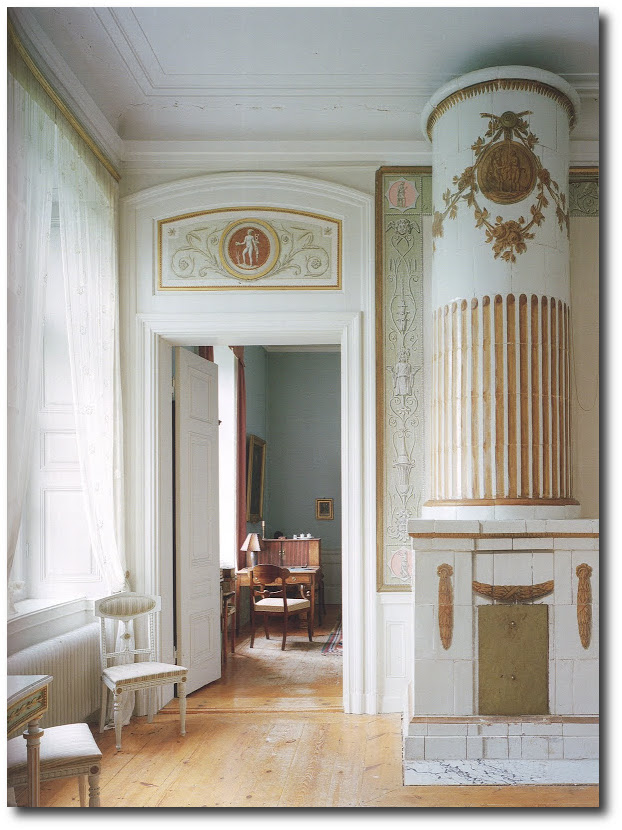
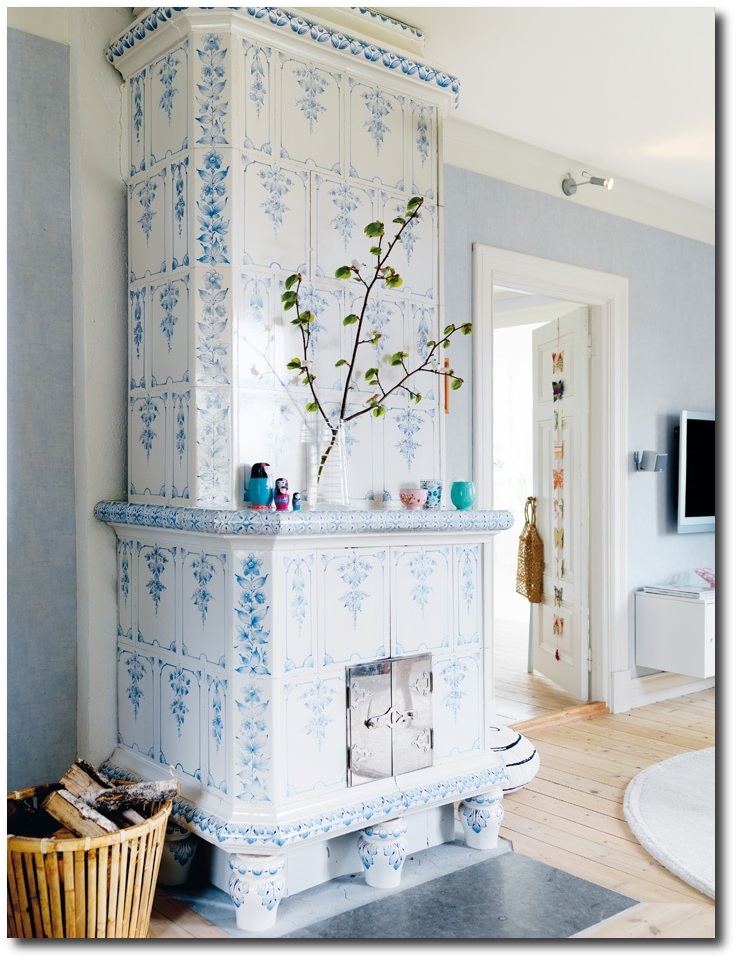
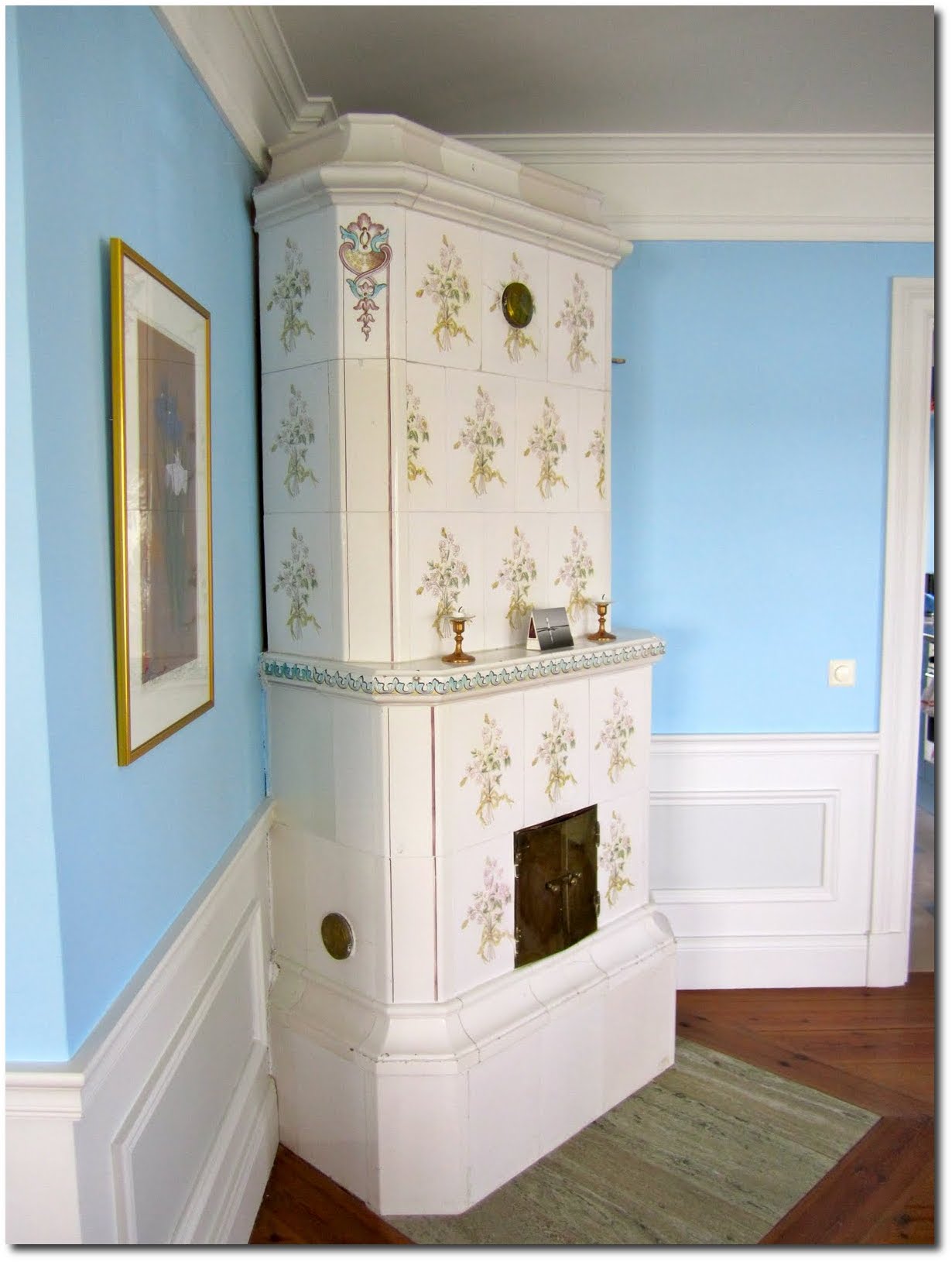
The “Kakelugnar” stove is a Swedish tiled stove whose design is still in use today. This classic stove dates back to the eighteenth century, and adds a historical element to a Scandinavian room. These tile fireplaces usually resemble a column, while the shape is generally very simple. The most popular designs tend to be round or rectangular, and are generally white, and are placed either in corners or against a straight wall. The heights of the stoves range everywhere from six to ten feet or more. The stoves often feature two small folding doors where the wood is placed, and the top of the fireplace forms a crown.
Fire was essential for warmth and food in the Nordic region a century ago. Over time, we have lost some of survival techniques that were passed down through generations. Houses were smaller, and fires were first and foremost placed in the kitchen areas, where the cooking was done. The very first buildings were designed as one large room. An entire family lived in one room, than having many rooms to heat. Today it is fashionable to have vaulted ceilings, and large rooms, but the very opposite was true in throughout history where smaller rooms retained their heat better. Families often slept in the same room to conserve t the warmth, and be near the fire to keep warm through the nights where the temperatures dropped. The earliest homes had no windows, but rather a modest opening to let any smoke out. It wasn’t until the 1600’s when the chimney was invented, and the fireplace was designed to let smoke out of a chimney through the roof.
Above Picture Credit Gullesen Masonry Stoves
The Kakelugn stove’s design first came about when a shortage of wood became a crisis. In an article written by Stone Mason, they describe what prompted the stove design: “The period between 1500 and 1800 was known as ‘Europe’s little ice age’. In Sweden, where it was even colder than it is nowadays, it was clear that the constant use of fireplaces from morning till night would eventually lead to the total depletion of the nation’s forests. It was most fortunate, then, that in 1776 Adolf Frederik, the King of Sweden, commissioned Carl Johan Cronstedt to develop a stove that would make better usage of the country’s timber resources.”
The winters were colder than normal, and the people at this time needed to get as much heat out of the wood as possible. The problem was, too much wood was being consumed, that the government needed to intervene before the forestry was used up. Carl Johan Cronstedt and Fabian Wrede, had received a government mandate to try to find more fuel efficient solutions, and ended up inventing a fuel efficient tiled stove which burned the wood slower, and retained the heat for hours.
The Swedish Kakelugn stoves are a distinguished piece found in the Nordic countries. You won’t find these stoves in Canada, where the winter temperatures are just as cold. During the latter part of the 1800s, the stove found a prominent place in rich mansions and palaces. Beginning around 1830-1840, large farms were being equipped with stoves which soon lead to the countryside and middle class.
Swedish Kakelugnar stoves produced by Swedish Camina, are one of market leaders in Sweden who make stoves. Lindholm Kakelugnar also sells stoves in their original design. Lindolm Kakelugnar, based in Sweden, has been selling and building antique tiled stoves for the past 45 years. The company stocks a range of pieces, including a selection of stoves manufactured from the 1860s to the 1920s, or buy a modernized version from Contura.
The beauty of these classic stoves is that they retain the heat for long periods of time. New modern stoves often heat up fast, but once the flames die out, the stove cools off quickly. The “Kakelugnar” stove burns wood for a period of 1-3 hours, and then provides even heat for several hours after the fire has gone out. In fact, these classic stoves have a better design than the modern day stoves that are produced today.
Read more about the tiled stove visit alltomkakelugnar.se
- Antique Kakelugn
- Fritz von der Schulenburg, Interior Archive
- The Swedish Country House By Susanna Scherman- Buy It On Amazon
- Svindersvik Featured On Wikipedia
- Kakelugn Stove- Vía: Hus & HemA Swedish apartment for sale through Bolaget.