Designer Martha Angus Loves Gustavian Style
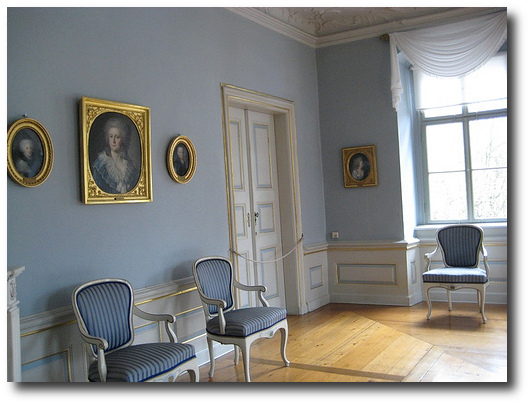
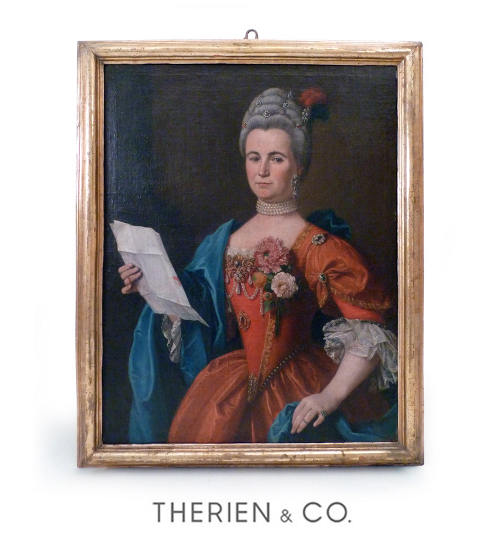 Swedish Portrait -the figure of noble women, in courtdress, within giltwood frame
The Style Saloniste posted an interview with designer Martha Angus, founder of the San Francisco-based firm, Martha Angus Inc. about her favorite style and paint colors. It turns out she loves the Gustavian Swedish styles, and gives out the paint colors she uses most often in her designs.
Q- Favorite design period?
Martha Angus: Gustavian. It’s late eighteenth-century, and feels like Louis XVI but not as grandiose. In addition, I love the painted finishes typical of the period, often in gray. Swedish design can offer a type of low-key opulence. During the Gustavian period, a light wash of paint in earth colors of light blue, gray, green and yellow was used instead of gilding. The prices of antiques vary, depending on the object. They’re now very collectible, so prices are rising fast. I’ve seen some fantastic examples at the Marche Paul-Bert at the Paris flea market, Clignancourt.
My favorite local source for Gustavian furniture is Therien & Company in Los Angeles (as well as the Therien & Co 20th-century collection at their gallery in San Francisco.)
Q: Your most versatile paint color?
Martha Angus: It’s Benjamin Moore and my special mix of half Decorator White mixed with half Linen. Works every time.
The finest paints are those designed by Donald Kaufman in New York. They are all elegant and multi-dimension and complex, so you could pick one with your eyes closed.
I’m a big fan of Farrow & Ball, colors: Parma Gray, Folly Green and Mouse’s Back are very individual and give rooms character.

Q: Which fabric could you use over and over?
MA: Heavy Belgian linen by Henry Calvin Fabrics, # 8793 “Mail Bag Linen” texture in natural. To the trade, Henry Calvin Fabrics, 151 Vermont Street, San Francisco, 415-565-1981. I often use antique textiles, tapestries, and pillows from Kathleen Taylor, The Lotus Collection, 445 Jackson Street, San Francisco, 415-398-8115.
Home Dit also features an interview with Martha Angus, where she reveals more of her love for French and Gustavian antiques.
Q: Tell us about the moment when you decided to follow a career in the field of interior design.
Martha Angus: I always felt like an artist growing up. I moved around constantly for my father’s career, so the whole idea of ‘home’, a place where you feel comfortable and can settle into, is the most important thing in the world to me. When I was a child, I absolutely fell in love with color, especially coloring books. I became so passionate about art and color, I thought “Oh, wow!” this is all I ever want to do, which led me to
eventually study painting at Carnegie Mellon and the Ecole des Beaux Arts de Paris.
When I came out of college the options for a female artist were quite limited yet art has always been a driving force in my career. As a young artist fresh out of school, I got my start as a fashion illustrator and textile designer in New York City. That eventually led to store design and high-end residential design. My work and interests are always evolving but I never abandoned my first love –painting and contemporary art. To this day, art is the most important feature in my designs. It’s usually the first thing I discuss when starting a new project.
Q:Where do you look for an obscure source of inspiration?
Martha Angus: I find inspiration in my usual trips to the Paris flea markets. I believe my ideal shop would include that sense of history, unstated elegance and fun that the French do so well. As in my projects, my ideal shop would include timeless and elegant items such a Gustavian settee or a weathered neoclassical zinc planter paired with a super chic custom designed plexi-glass bench upholstered in zebra silk-screen hide and bold Ellworth Kelly prints.
Q:What would be your recommendation for “what to do first” in a decorating project?
Martha Angus: Start with a good floor plan and remember that upholstery is the key. High quality upholstery can go a long way. Not only is it a good investment but it also brings a sense of tailoring and richness that other items can’t. Once the art and essential furniture items have been selected, accessorizing can do wonders. Scented candles and cashmere throws add a sense of luxury to a room without a significant investment. I always include small trays and boxes that bring the project down to a warm and livable level.
I always say that art is the most important aspect of a space, aside from the people collecting it. I live for bold, statement art. High art should not be treated as a mere decorative item that accessorizes a room, but almost a living element of the space – something with a very distinct personality.
Q: What’s your current paint color obsession?
Martha Angus: I believe in airy, fresh spaces that usually call for very subtle neutrals so that I can come in later and play with fun splashes of color in art, fabrics or accessories. When it comes to paint I find myself constantly going back to some Farrow and Ball colors precisely because they have that timeless elegance that relates so well with my philosophy. Some of my favorites are Middleton Pink and Arsenic.Throughout my career I have always recommended Benjamin Moore’s decorator’s white for its freshness and vibrancy. I have a life-long love affair with textiles of every kind. In fact my career started in New York City as a textile designer and fashion illustrator. I believe David Hicks style fabrics are classic and always so chic.
Q : What advice do you have for someone with a new house to decorate and perhaps a limited budget?
Martha Angus: Small changes can go a long way. I also advise my team to use color as envelopes for a room. Soft neutrals like French Gray or even Decorator’s White are great colors for walls, ceilings and trim because they can give an atmospheric look to a room and make it timeless, standing the test of time and whimsy trends. The one item I would recommend investing in is good upholstery pieces. The big items should also be covered in a neutral material that can stand the test of time. It will not only look good but will wear well for many years to come.
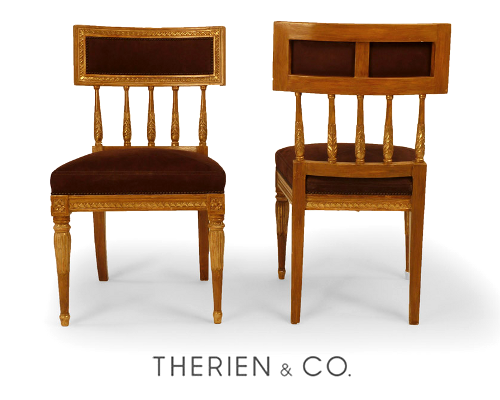
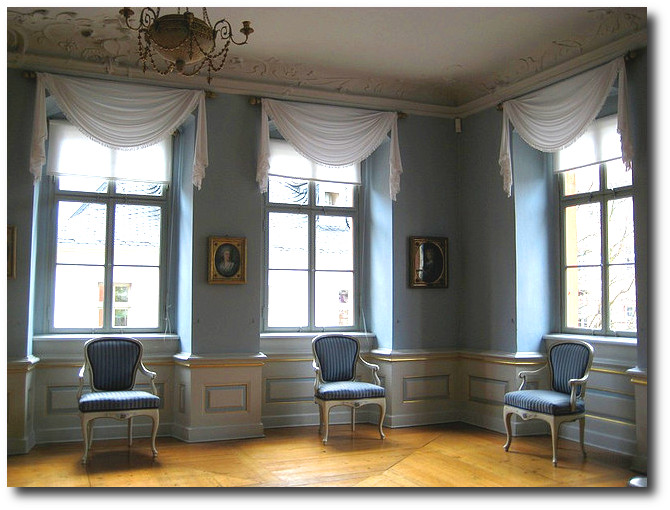
Pair of Swedish Late Gustavian Side Chairs- the rectangular upholstered crest rail within carved and moulded frame on foliate carved spindle supports, over upholstered seat with carved and moulded apron flanked by rosette filled blocks, raised on foliate carved round section tapering legs ending in toupee feet
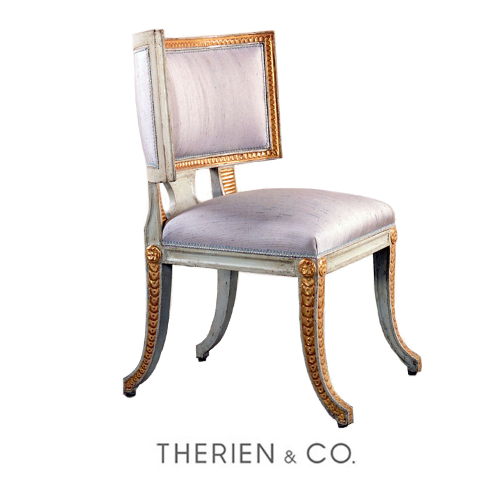 The Neoclassical period replaced the Rococo influences during the second half of the eighteenth century. Cabinet makers responded to the excavation of Herculaneum and Pompeii with great fervor, eliminating the robust naturalistic forms of the Rococo in favor of delicate colors and a less exaggerated line. The Klismos, the original antique form of this chair, was brought to light late in the Neoclassical period in Sweden as well as other countries. The Gustavian, another name for this chair, was developed during the reign of Gustavian III who seized power in 1771. This chair is believed to have been made for the marvelous pavilion at Haga, the summer home of Swedish royalty
Pair of Roman Neoclassic Painted And Parcel Gilt Armchairs with horseshoe shaped foliate carved back with downswept arms, joined to Greek key carved seat and raised on tapering fluted legs
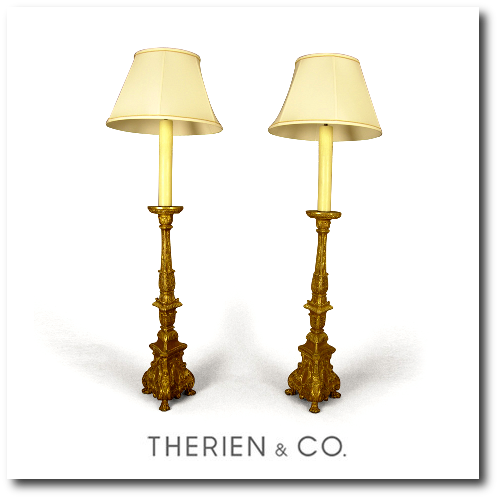
Pair Of Swedish Baroque Giltwood Candlesticks each of compound foliate and gadrooned tripartite form rising to flaring foliate sheathed bobeche, raised on conforming scrolling volute base, centering ribboned and foliate swagged cabochon medallion and ending in lion paw feet; now electrified and fitted with beeswax candle and calf skin shade
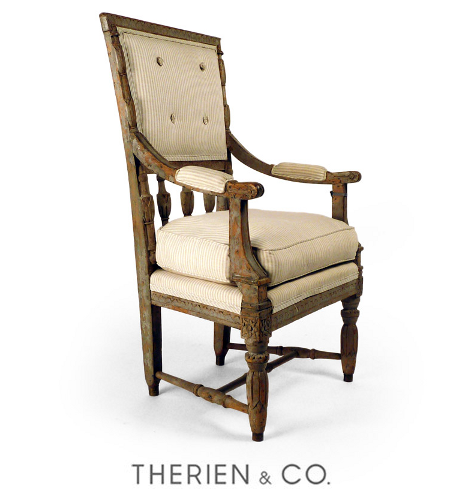
Swedish Neoclassic Painted Armchair- the upholstered back within conforming moulded and carved flaring frame, over urn shaped carved spindles joined by down swept supports to upholstered seat, raised on stylized foliate carved swelling round section legs ending in brass sabots and headed by rosette filled carved corner blocks; the whole retaining original paint
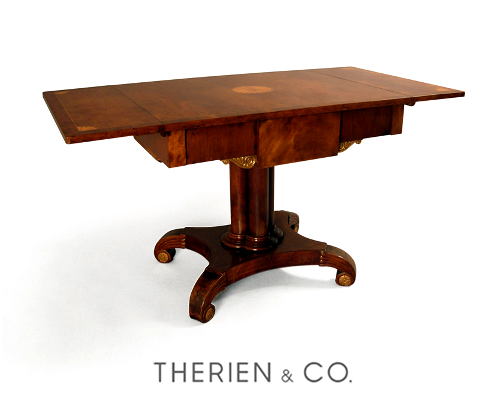
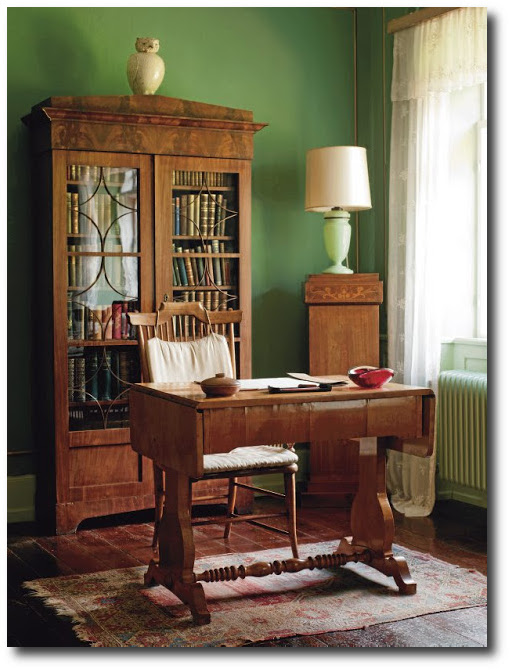
Swedish Karl Johan Mahogany Satinwood and Olivewood and Parcel Gilt Sofa Table- the rectangular top with satinwood stringing centering satinwood and olivewood inlaid central patera medallion and corresponding corners, with two drop leaves over breakfront apron incorporating single drawer, flanked by relief carved foliate volutes, on cluster columnar support in the early English taste, with molded socle and concave platform ending in foliate carved downward scrolling feet centering floral medallions


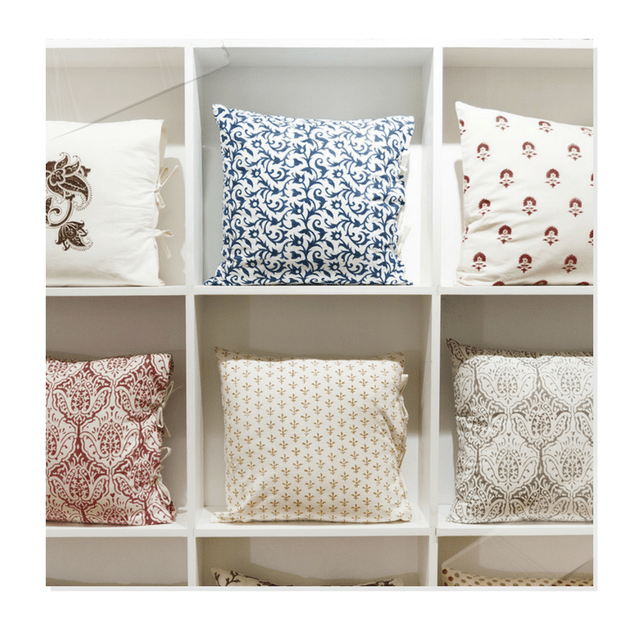
Les Indiennes Fabrics

Mary Mulcahy’s designs, first developed for her block-printed textiles, now grace the wall with the Les Indiennes collection by IVM Prints. The 12 hand-screened wallpapers include Rayure, left, and Veronique, both in indigo; additional colors are offered, Seen in Elle Decor April 2011
The company Les Indiennes is known for their beautiful hand-blocked textiles. Founder, Mary Mulcahy had a desire to find naturally dyed cotton, with large scale single colored motifs, but was unable to locate fabrics close to what she had in mind, so she created her own. Her concept started to take form after running into a craftsman in southern India, who knew exactly what she was after. In fact, the craftsman was one of the very few artists who still practiced the ancient art of kalamkari, which was an extremely complex and rare method of printing on fabric.
The Kalamkari Process:
1. Fabric Preparation- Cotton fabric is initially softened and bleached. This process needs to be done before any printing takes place. The process involves bales of organic cotton which are repeatedly rinsed and beaten against large rocks, then laid out on the grass to bleach in the sun. These steps ensure that the fabric will feel soft and luxurious, and so that the color application remains bright and vibrant.
2. Block Printing- After the fabric has been softened and lightened, printing begins. Craftsmen dip hand-carved wood blocks in dyes and presses them into the cotton. The dyes are derived from plants, roots, earth, and rock. One can only imagine the great care, and measurements taken to ensure the patterns are straight and line up with one another. Today we take for granted large printing machinery, when at one time, much of this work was done by hand. At Les Indiennes, the fabric is printed by hand, and hours go into each fabric panel. After the patterns are applied, the printed fabric is air dried for at least two days.

Decorating Secrets- 60 Quotes From The Best Experts In Design

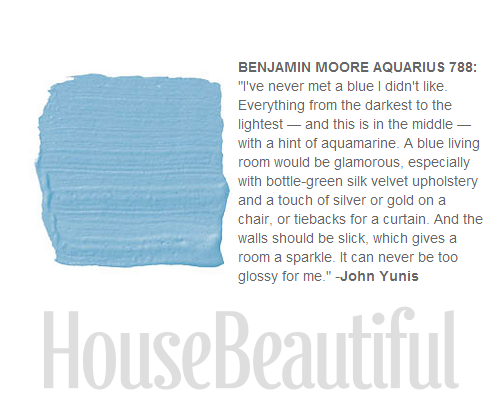
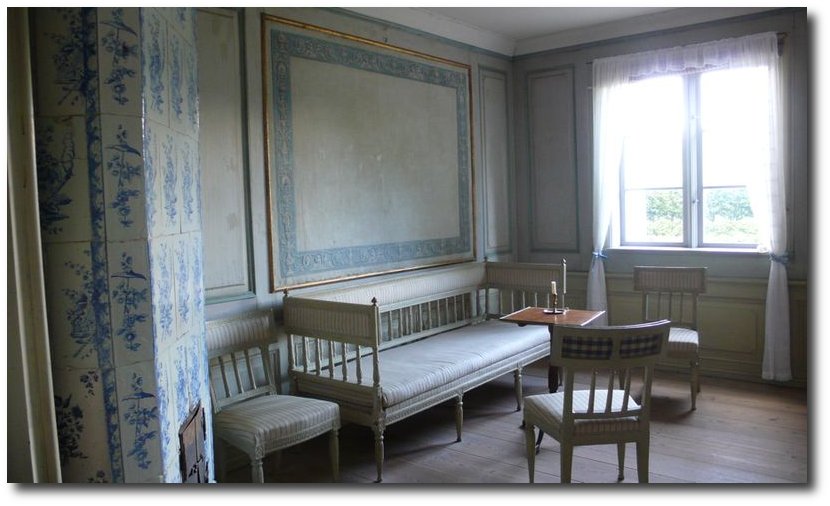
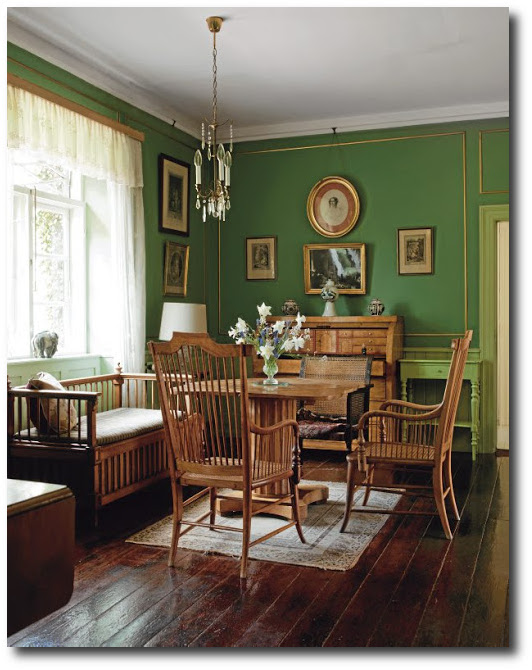
Swedish winters are long, dark and dreary, so historically Swedes have always turned to lighter interiors. Swedish style isn’t all about the gray and the white interiors they are famous for, but many homes feature brighter, richer colors to decorate around.
There are so many shades and tones of paint, that it can be impossible to decide on one color. Buy sample-size colors to help you make the perfect selection. A color can look quite different at night than the day. We recently painted the outside of our home, and the color which looked to be a creamy yellow at night, turned green in the day. Be sure to try your selected colors on a few different walls to determine what suits which room. You’ll thank yourself for making this extra effort before spending $$$ on the wrong shade.
Don’t judge the room until the paint is in place, and accessories and furniture are placed. A color which may seem to bright can be toned down by wall accessories, coordinating drapes, and art work. Consider working with the off shades of the primary colors. Intead of purple, consider lilac, or a raspberry tint.
Consider whether you are a warm or cool person. I once was asked this by a hairdresser, looking to choose a shade of blonde. I never gave it much thought before, but knowing which color you lean towards can certainly make picking colors a lot easier. Earthy reds, dusty warm plums, and rusty golds are in the warm color range. Silver blues, mint, and lavenders are colors which are cooler.
Advice From Pros
“Design is not just what it looks like and feels like. Design is how it works” Steve Jobs
“Green pigment was expensive in the 18th century, making it a status symbol. So it would have been appropriate for the royal governor’s house. I’ve been a curator at Colonial Williamsburg for 20 years, and when my husband and I lived in a historic house, we had similar green woodwork. It worked with every fabric I wanted to use, and it’s a great mood enhancer—chlorophyll for the spirit!” —Liza Gusler
“People think that they need to use small furniture and light colors to make a small room look big, but that’s not the case at all. Dark colors and just a few pieces of large-scale furniture, with the appropriate lighting and accessories, can give a room a larger, more luxurious feel.” —Mona Hajj
“Everything else in my house is off-white and grey, and I just had to have a break from that. I was looking at my pond, which is this murky shade of acid green, and I thought, ‘I’ll do that in high gloss to make it even more watery and translucent.’ It’s strange, but I love it.” —Stephen Sills
“Luxury must be comfortable, otherwise it is not luxury.” – Coco Chanel
“While looking at one of my first New York apartments, David Hicks told me diplomatically,’Dear boy, if you’re going to paint the walls white, you need art.'” Peter Dunham
“The only time white curtain lining should be used is with white curtains- J Randall Powers
“Use the precious for everyday purposes. We’ll rummage through clients closets and find loads of precious hand-me-downs like porcelain vases and crystal that are a bit out of vogue. We’ll use them for completely ordinary purposes – a case becomes a chic pencil holder, a crystal bowl holds makeup brushes. Turn the ordinary into a special moment” Benjamin Dhong
“I learned that passion about objects and furnishings makes for fearless decorators—and that if you are comfortable in your home, everyone else will be too. That sense of authenticity is what gives a home its soul.”- Courtnay Daniels Haden
“The most elegant interiors are just slightly tatty.” – David Netto
“Playing it safe. Instead, put a large-scale printed fabric or wallpaper on the walls and even the ceiling. It’s easier, safer, and less expensive to be dramatic in a small space. You might get tired of a bold print in the main living area, but it can make a smaller, less-used room an exciting space to spend time.” —Victoria Neale
Swedish Kakelugn Stoves
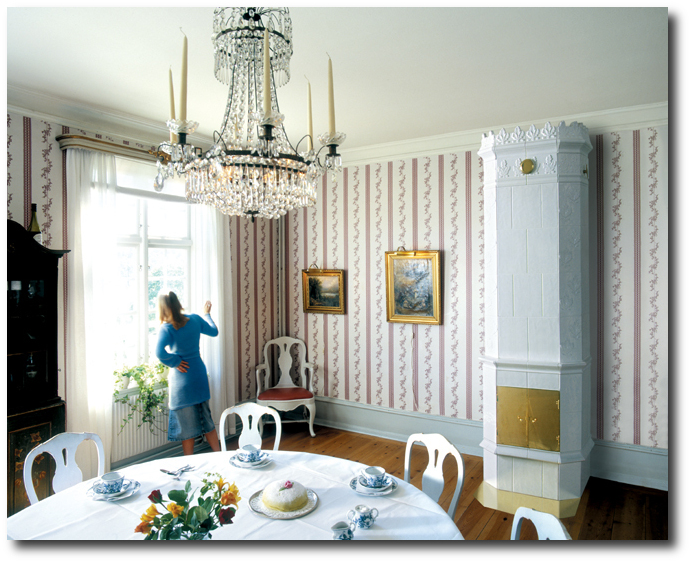
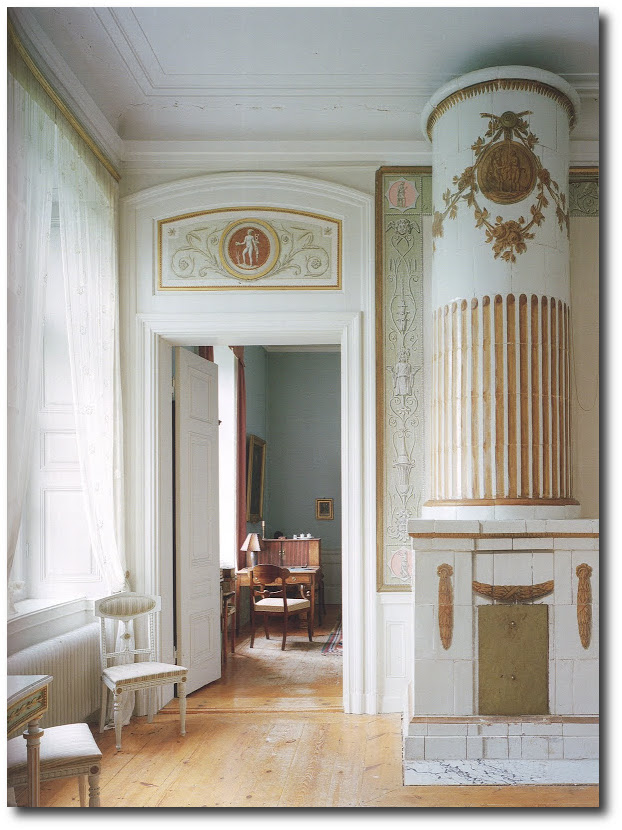
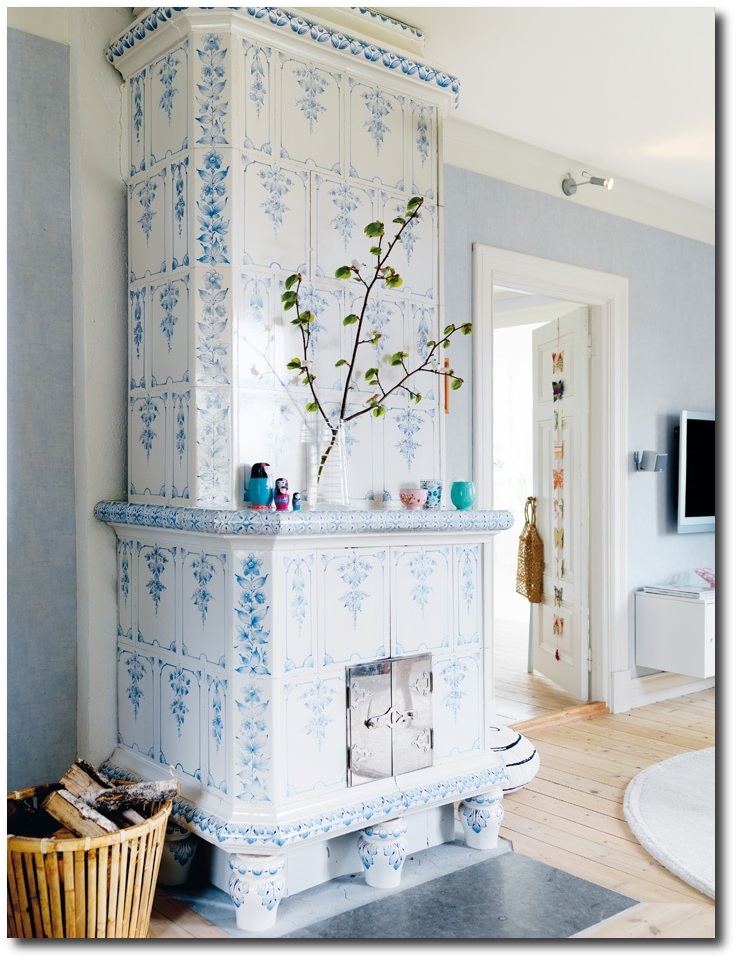
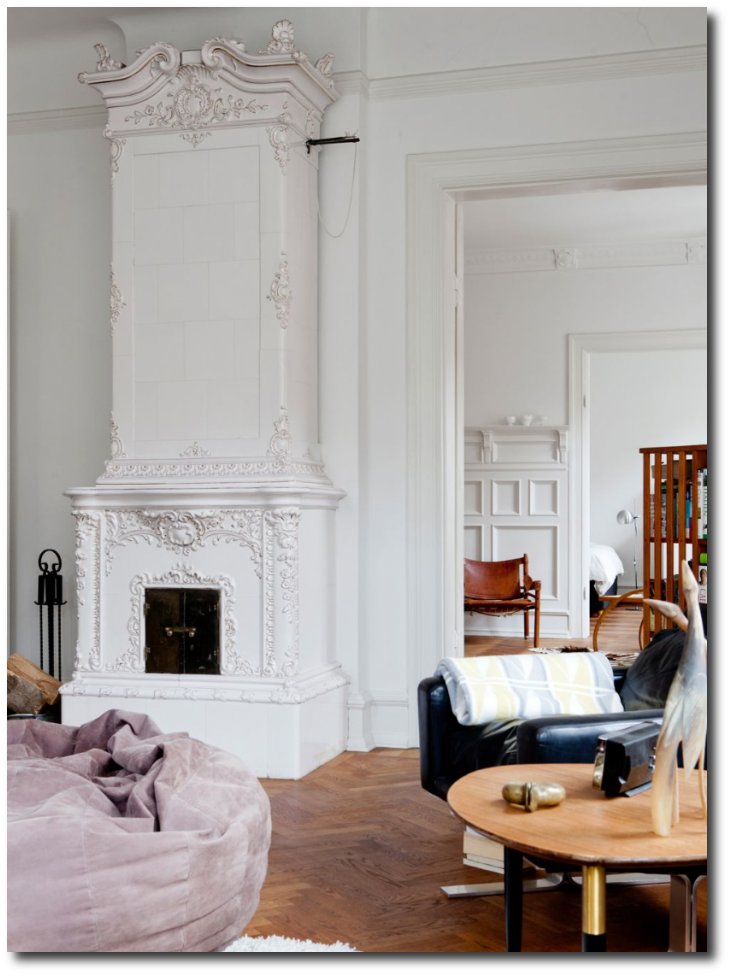
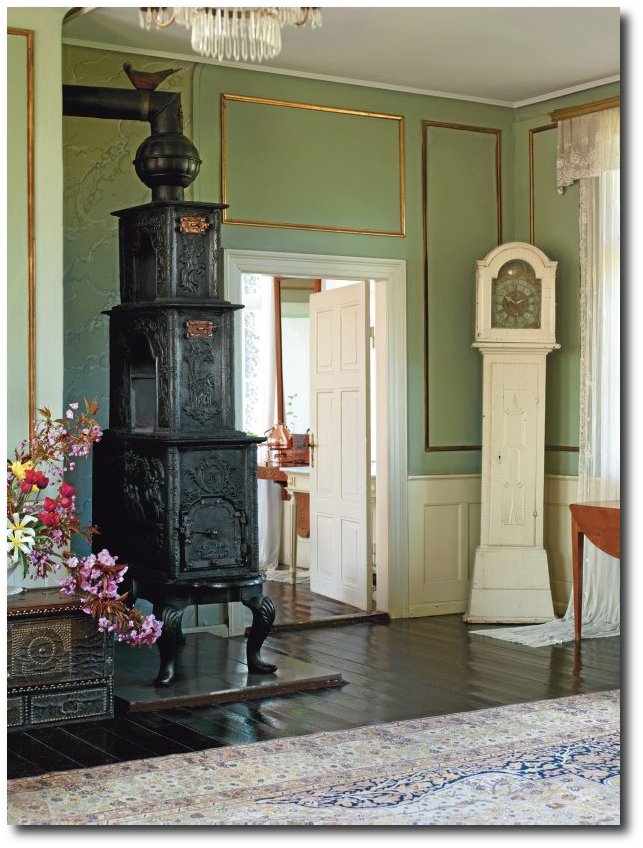
The “Kakelugnar” stove is a Swedish tiled stove whose design is still in use today. This classic stove dates back to the eighteenth century, and adds a historical element to a Scandinavian room. These tile fireplaces usually resemble a column, while the shape is generally very simple. The most popular designs tend to be round or rectangular, and are generally white, and are placed either in corners or against a straight wall. The heights of the stoves range everywhere from six to ten feet or more. The stoves often feature two small folding doors where the wood is placed, and the top of the fireplace forms a crown.
Fire was essential for warmth and food in the Nordic region a century ago. Over time, we have lost some of survival techniques that were passed down through generations. Houses were smaller, and fires were first and foremost placed in the kitchen areas, where the cooking was done. The very first buildings were designed as one large room. An entire family lived in one room, than having many rooms to heat. Today it is fashionable to have vaulted ceilings, and large rooms, but the very opposite was true in throughout history where smaller rooms retained their heat better. Families often slept in the same room to conserve t the warmth, and be near the fire to keep warm through the nights where the temperatures dropped. The earliest homes had no windows, but rather a modest opening to let any smoke out. It wasn’t until the 1600’s when the chimney was invented, and the fireplace was designed to let smoke out of a chimney through the roof.
Above Picture Credit Gullesen Masonry Stoves
The Kakelugn stove’s design first came about when a shortage of wood became a crisis. In an article written by Stone Mason, they describe what prompted the stove design: “The period between 1500 and 1800 was known as ‘Europe’s little ice age’. In Sweden, where it was even colder than it is nowadays, it was clear that the constant use of fireplaces from morning till night would eventually lead to the total depletion of the nation’s forests. It was most fortunate, then, that in 1776 Adolf Frederik, the King of Sweden, commissioned Carl Johan Cronstedt to develop a stove that would make better usage of the country’s timber resources.”
The winters were colder than normal, and the people at this time needed to get as much heat out of the wood as possible. The problem was, too much wood was being consumed, that the government needed to intervene before the forestry was used up. Carl Johan Cronstedt and Fabian Wrede, had received a government mandate to try to find more fuel efficient solutions, and ended up inventing a fuel efficient tiled stove which burned the wood slower, and retained the heat for hours.
The Swedish Kakelugn stoves are a distinguished piece found in the Nordic countries. You won’t find these stoves in Canada, where the winter temperatures are just as cold. During the latter part of the 1800s, the stove found a prominent place in rich mansions and palaces. Beginning around 1830-1840, large farms were being equipped with stoves which soon lead to the countryside and middle class.
Swedish Kakelugnar stoves produced by Swedish Camina, are one of market leaders in Sweden who make stoves. Lindholm Kakelugnar also sells stoves in their original design. Lindolm Kakelugnar, based in Sweden, has been selling and building antique tiled stoves for the past 45 years. The company stocks a range of pieces, including a selection of stoves manufactured from the 1860s to the 1920s, or buy a modernized version from Contura.
The beauty of these classic stoves is that they retain the heat for long periods of time. New modern stoves often heat up fast, but once the flames die out, the stove cools off quickly. The “Kakelugnar” stove burns wood for a period of 1-3 hours, and then provides even heat for several hours after the fire has gone out. In fact, these classic stoves have a better design than the modern day stoves that are produced today.
Read more about the tiled stove visit alltomkakelugnar.se
- Antique Kakelugn
- Fritz von der Schulenburg, Interior Archive
- The Swedish Country House By Susanna Scherman- Buy It On Amazon
- Svindersvik Featured On Wikipedia
- Kakelugn Stove- Vía: Hus & HemA Swedish apartment for sale through Bolaget.
Helen Olsen’s Rungstedlund Home Revealed In Gods & Gardar Magazine
After 17 years in Kenya, Danish author Karen Blixen returned to her childhood home in Rungstedlund, Denmark . The magazine Gods & Gardar reveal the history behind this magnificent property, where Danish elegance meets the drama of Africa.
“It was Karen’s father, Captain and author Wilhelm Dinesen who bought the property in 1879.
Two years later, after his marriage to Ingeborg Westenholz, the couple moved there and had five children, three daughters and two sons. Karen came to stay at Rungstedlund until age 28, except for two periods. The first period was the year the family had to leave Rungstedlund when the farm was restored after a fire in 1898. The second time Karen did Rungstedlund for a long time was when she studied art in Paris.”
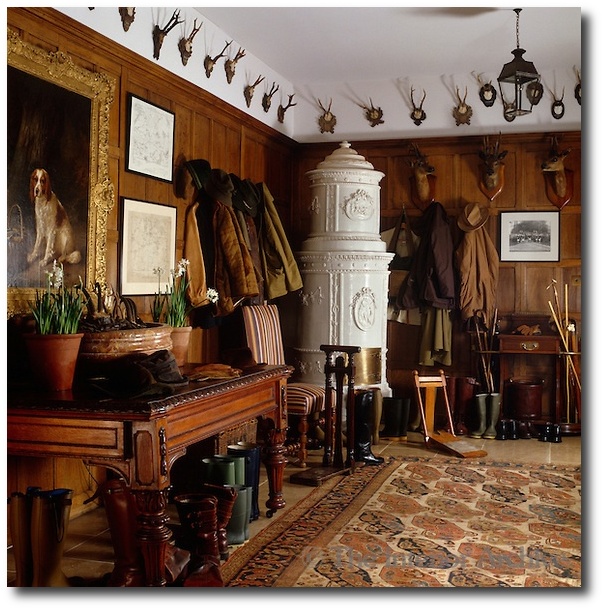
“What makes Karen Blixen Rungstedlund so fascinating to visit is that the different rooms reflects two distinct phases of her life. For just as Karen packed some things from Rungstedlund before his trip to Africa, silver candelabras, English porcelain, Bohemian crystal and mahogany furniture, so she brought her most prized possessions, the essence of her Afrikaår, when she moved back to Denmark. On Rungstedlund intermingled memories of Africa still with antique family heirlooms, large carpets, delicate lace curtains, mahogany tables and furniture in the Louis Seize style and a Norwegian Rococo stove from in 1760.”
How To Combine African Elements Into Your Swedish Style
1. Keep the Architecture Nordic.
It is remarkable that Karen Blixen’s home looks both Scandinavian, and African at the same time. How did she pull it off? One of the ways the Scandinavian feel is so clearly evident is in the architecture. The framed walls are one of the hallmarks of the Nordic style. You don’t need several thousand dollars to get this look. One way of doing this is simply by adding some wood trim on the walls. To get Blixen’s look, spray paint your wood trim with gold paint, and finish it off with gold leaf.
Easy Gold Leafing- French Style Authority
Another way of adding architectural detail to your walls is to paint lines in shapes of boxes. A post that clearly shows this idea is Lars Sjoberg’s Swedish Gustavian Decorated House. In this post, you can clearly see lines painted on the walls, which gives the appearance of architectural trim. Where to start? If there is a door in the room, or windows, start with the box above the window or door.
2. Include A Few Moroccan Textures
In the dining area, Karen Blixen uses an area rug with a strong pattern. In this photo, moroccan floor tiles are used to create an entry way. The photo is quite close to Nordic design. A simple white is used on the walls, and the flooring gives this room the edge it needs. The gilt wood mirror gives this room a polished touch. An inexpensive way off adding the pattern into the room is to use throw pillows and tablecloths.
Royal Design Studio sells a moroccan stencil in a star diamond pattern. Consider stenciling your walls in a bright color found in Africa. Consider placing simple painted furniture with this pattern such as white furniture, or black painted furniture. With a white and orange pattern, white furniture can still work quite elegantly. Incorporate pine flooring, and add texture to the walls in natural wood, or metal such as what Karen did with her study.
3. Avoid Clutter.
One of the biggest mistakes people make is have too many accessories. Showcase your art, and draw attention to your furniture by having less accessories, and an open floor space. Even if you jam pack the furniture in, be sure that table tops don’t have dozens of ornaments. Reduce them, pair down, and donate pieces that simply just don’t work with the overall theme.
4. Incorporate The Colors Of Africa
The colors of Africa central around earth tones, such as brown, cream, rich greens, oranges, and reds. For example, you can work with these colors on the walls such Karen did for her home. If the dominant colors are the richer colors, consider toning down the room with a few natural wood pieces. White furniture would provide a rich contrast to the vibrant hues on the walls. If you choose to go with white walls, consider working with painted furniture, or heavily distressed furniture with the richer colors in the upholstery. Can you imagine, raw pine wood floors, with a white settee, gold accents, with burgundy upholstery? Perhaps throw in a rich red chest, and the room can take on the African flavor quickly. To include the Swedish style, pick upholstery fabrics with sweeping vertical lines, stripes or florals, or a combination of both.
6. Create A Wall Collection
Karen’s study is an excellent example of a collection that reflects the African culture. Collect African hand-made pottery, baskets, rugs, swords, plates, knives, but stay away from the masks, or statues which are involved in the ceremonial worship. Woven baskets are an ancient form of art in African culture. Typically crafted with simple geometric designs, African baskets will vary in design, making them great to decorate with.
Space is one of the main considerations when planning a wall based around objects or collections. Avoid a crowded or crammed look when using African wall decor, a little can go a long way. Placing too many items together can look messy, and give the idea that the look isn’t well thought out. Spacing your pieces, or collecting like objects, like a collection of baskets, or knives pays special attention to individual pieces.
Another designer trick is to place even tones together. Working with the color wheel will give you a great idea of the colors to work with, and those to avoid. Try to place the same colors, hues or tones together to give a more organized presentation. Metal, woods, and natural materials work with practically every color, although when working with china, or pottery, it helps to work with the color wheel, when placing items on a painted wall.
Picture Credits
- African Designer Catherine Raphaely
- Medieval Strong Box Ottoman $406
- British Plantation Chair $361
- Floral Bouquet Pedestal Table $185
- Medieval Cross Frame Arm Chair$350
- Grand Medallion Crescent Console Table $455
- African Designer Karen Roos
- Camellia Wall Console Table $229
- Chateau Marquee Occasional Fabric Arm Chair $588
- Mademoiselle Cezanne’s French Slipper Chair $244
- The Beaufort End Table $310
- The Scottish Country House by James Knox
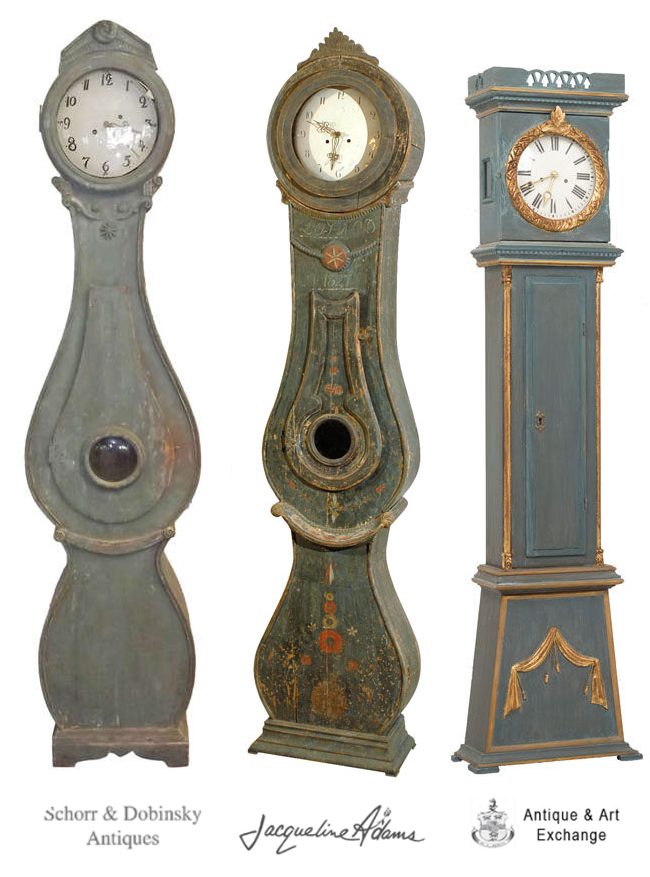
- Early 19th Century Painted Swedish Mora Clock- Dated 1827-
- A nice small scaled Danish grandmother’s clock in the 18th century style made during the 1950’s
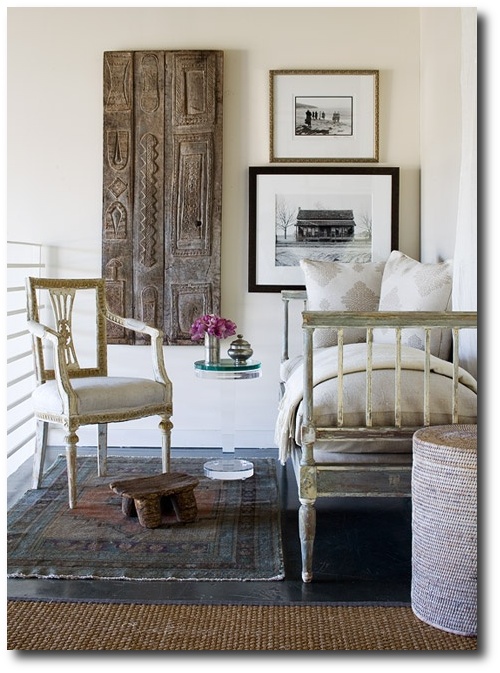
Swedish Style Traditional Home Magazine




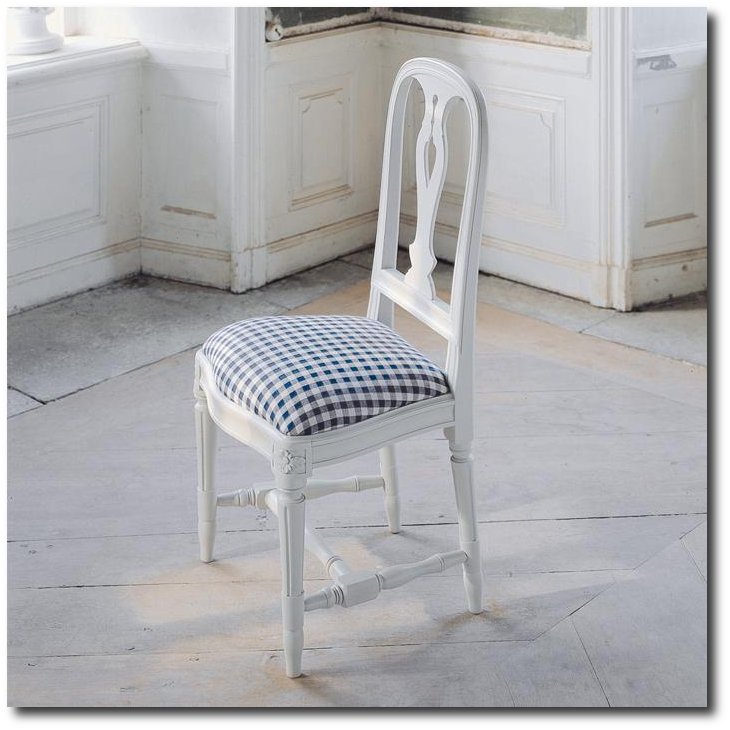
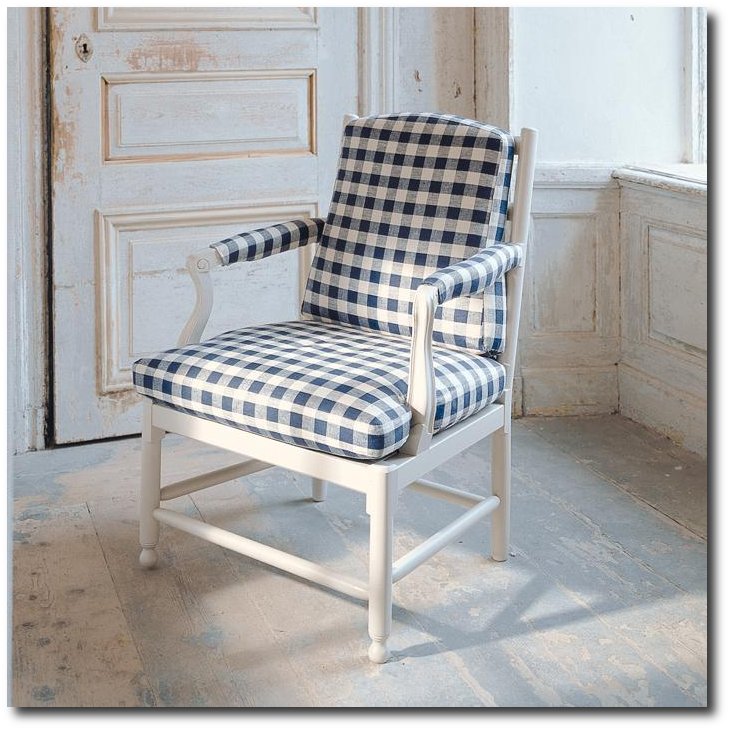
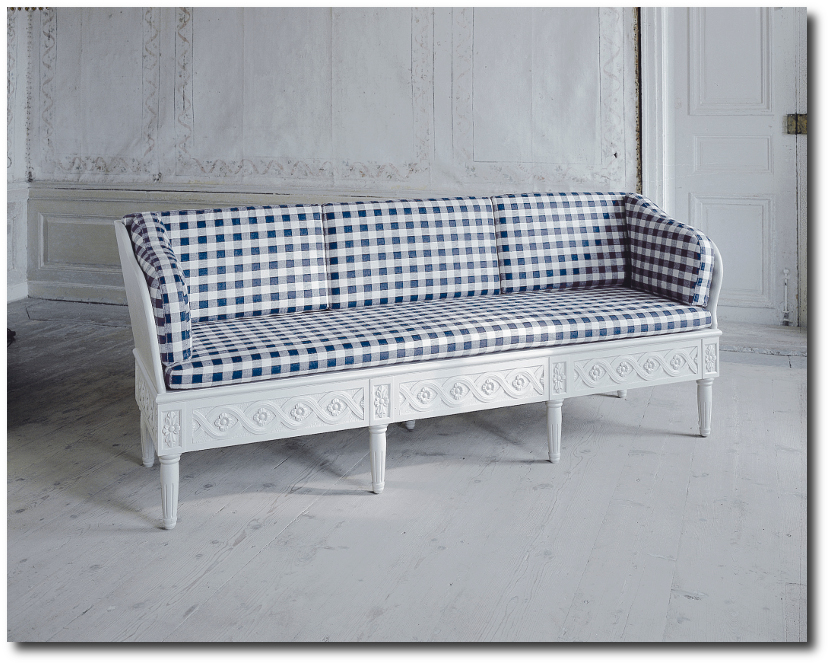
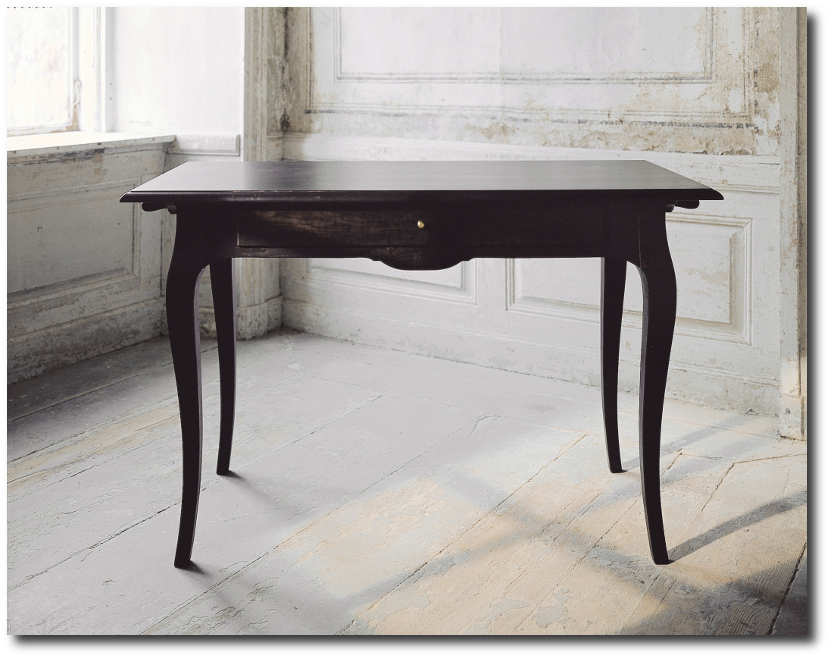
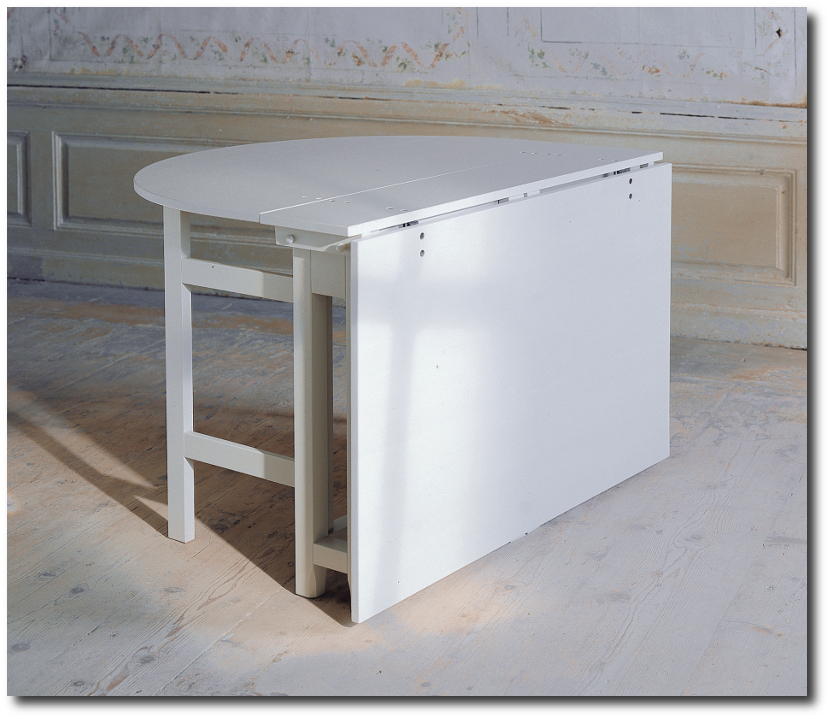
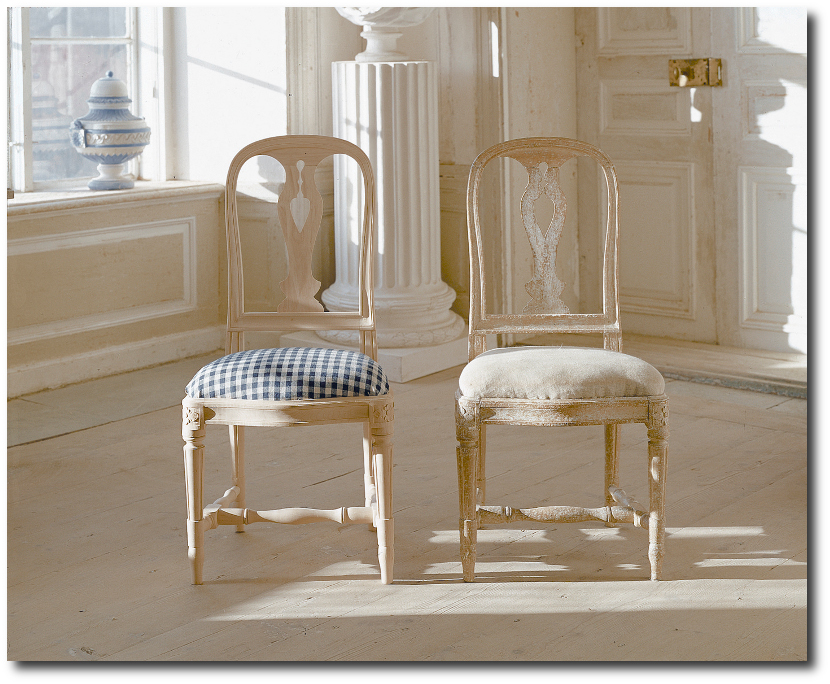
The 1700 Collection Swedish Furniture
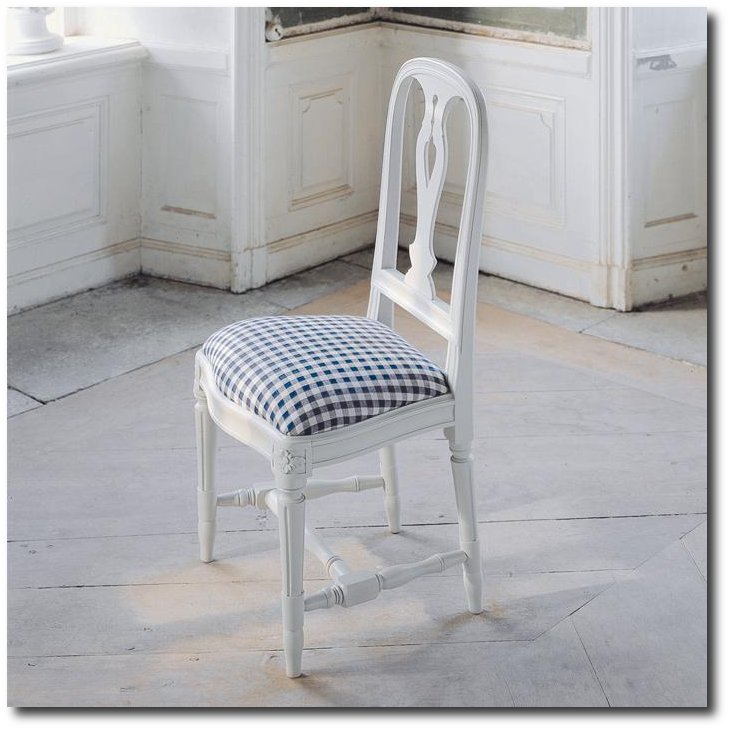
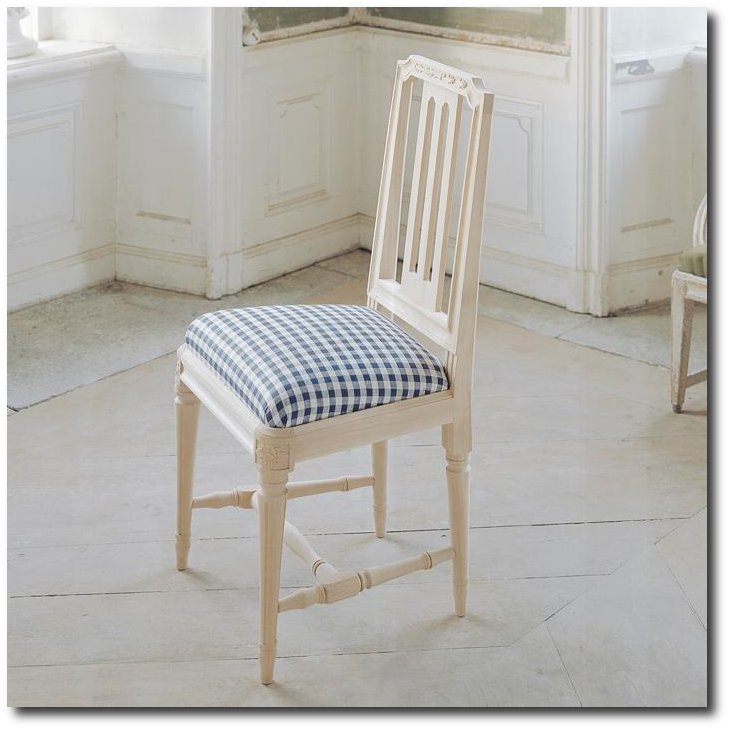
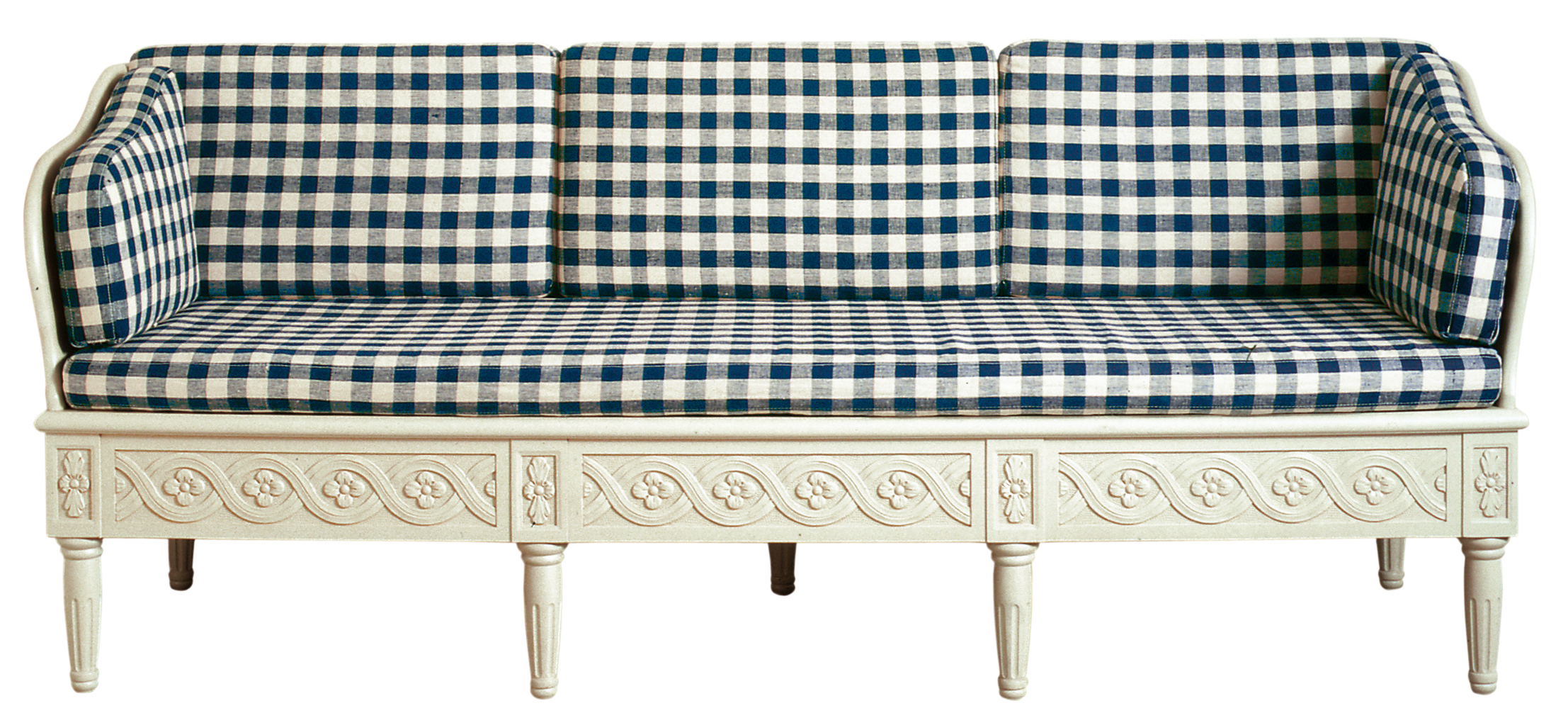
The 1700 Collection Swedish Furniture produces furniture that combines the elegant shapes of the furniture found in 18th century Sweden. With the cooperation between the Swedish National Museum of Fine Arts and furniture manufacturer MOVE Möbler & Bohag, they created several authentic replicas of selected pieces of furniture originating from Swedish castles, manors and salons of fashionable health resorts.
The craftsmanship behind each handmade piece remains true to the original. Skilled woodworkers sign each piece next to the seal of the National Museum of Fine Arts. The furniture is made from the woods found in Sweden such as birch, alder and pine.
If you are hoping to purchase a reproduction that is as close to the original antiques, the 1700 collection is deeply rooted in the 18th Century. The collection is a preservation of the Swedish cultural heritage, also giving you an elegant piece of furniture from this era.
Möbler AB
Smyge
Strandv. 71. SE- 231 79 SMYGEHAMN.
Sweden

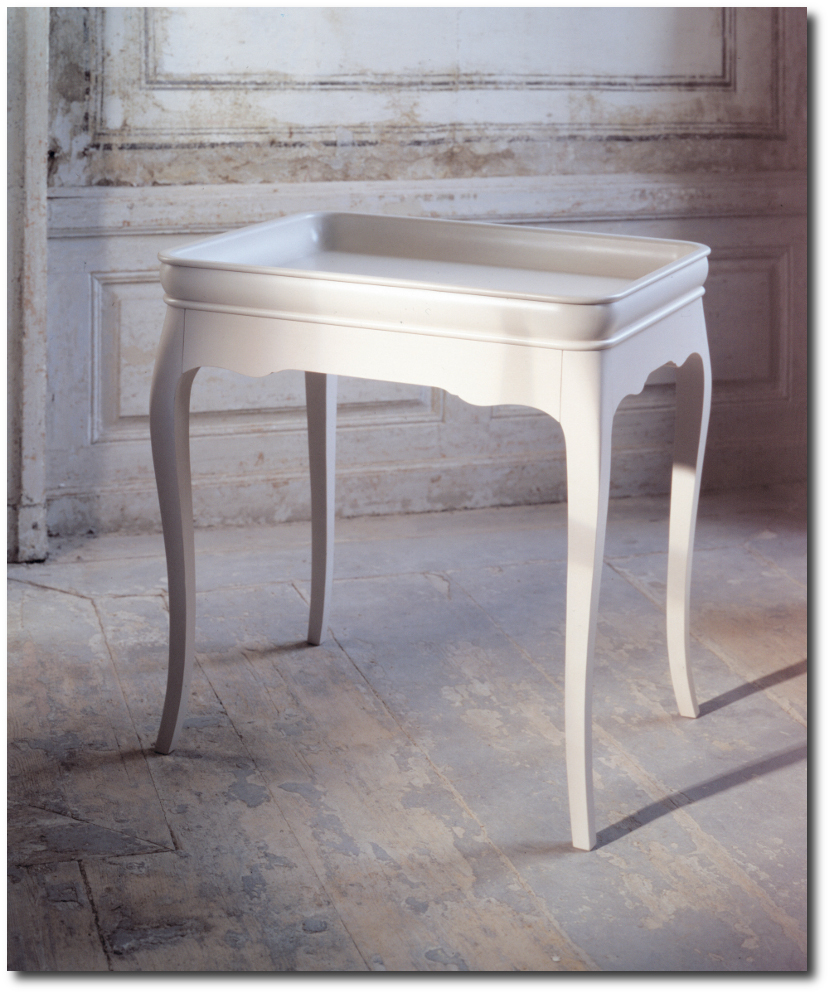
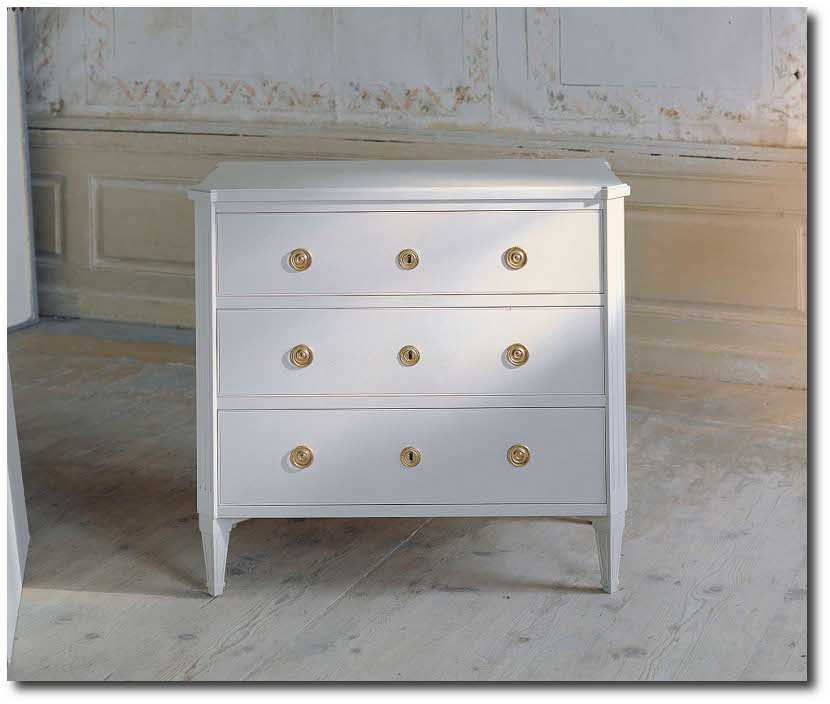

Swedish Plaster Medallions
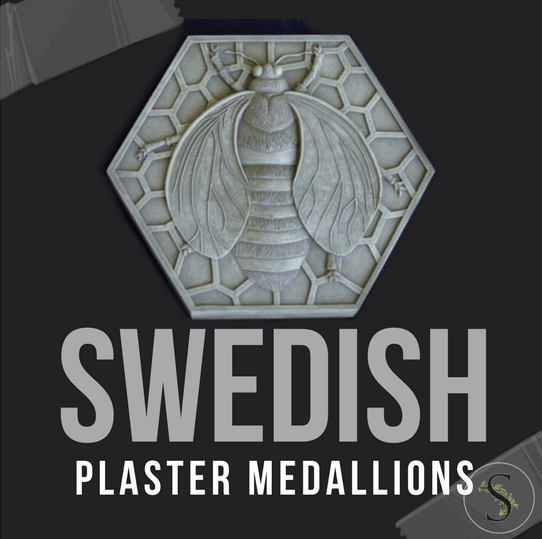
Make this bee mold for just dollars. Find the original listing here
Everyone has their favorite interiors, and one of mine happens to be Ekensberg, a home owned by Lars Sjoberg also featured on the cover of the book Paint And Paper In Decoration . Ekensberg, completed in 1790 is a three-story neo-classical building located on the banks of the Lake Mälaren, about 40 km away from the Swedish capital Stockholm.
Lars Sjoberg is well known in Sweden for the restoration of many cultural sites. Half of all the cultural sites he restored he saved from demolition. His passion for 18th century classical buildings was something he did professionally and outside of work. He invested in a number of classical buildings, in which he restored to the classic 18th style. As a senior director at the National Museum, he was one of Sweden’s leading authorities on Gustavian interiors, architecture, décor, furniture, paints, and everything associated with the reign of King Gustav III. So naturally, all of his homes were restored to the Gustavian style of decoration. This post shows the interior of this home from several angles. His book Classic Swedish Interiors features this home in detail. Interior Archive also gives us a new glimpse into the interior showing many views of this spectacular home.
Here are some of the photos I haven’t seen before.
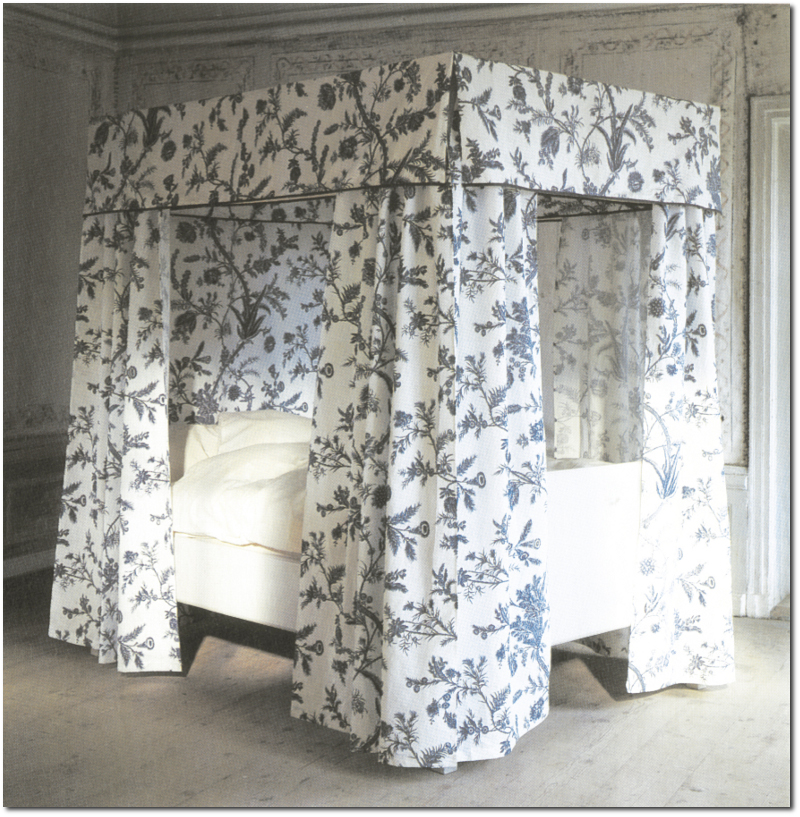
-Detail of the patterned blue and white fabric of the bed canopy and curtains- here
– An armchair with a red and white gingham cover adds contrast to the otherwise blue and white colour scheme in this elegantly proportioned bedroom- here
– Detail of a distressed wooden tray table used for serving tea here
-To the left of the canopied bed in the master bedroom stands an 18th century dolls’ house-here
– Detail of the end of a wooden sofa with a worn leather seat and carved border- here
– Detail of a wooden chair in front of a distressed wooden door with a bowl of fruit on a tray table in the foreground- here
– View through open double doors into the master bedroom with its canopied four-poster bed here
– The French Directoire wallpaper pattern reflects neoclassical influences from the early 19th century here
-A pair of plaster medallions by Johan Tobias Sergel, a leading Gustavian sculptor, hangs in the dining room- here
-A pair of gilt-framed plaster medallions hangs on the worn walls of the second floor sitting room – here
– A chair in front of a wall lined with hand-painted linen canvas panels and Gustavian plaster medallion- here
Portrait medallions were originally mounted around the public buildings in Stockholm , Sweden. It has been fashionable to use these medallions on the walls inside the home. Portrait medallions in Sweden often are seen round in shape and have a decorative edge much like a round picture frame.
Acquired Objects blog wrote a post showing some of the prettiest plaque pictures which have been seen on Tone on Tone Antiques, Master Henriks Blog, Trouvais Blog and Splendid Willow Blog; all Swedish inspired blogs. They all have great information and exceptional pictures.
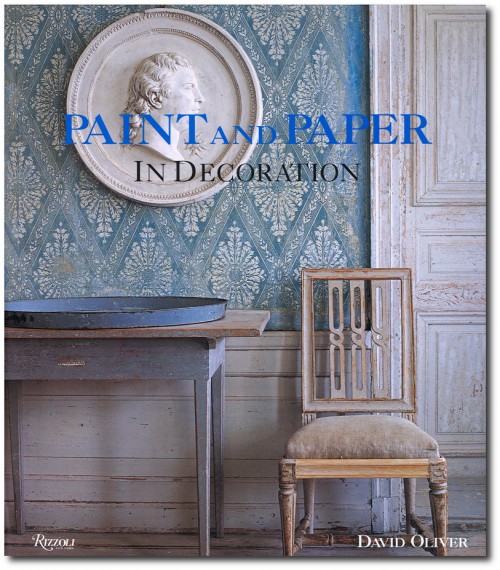
Paint And Paper In Decoration – David Oliver
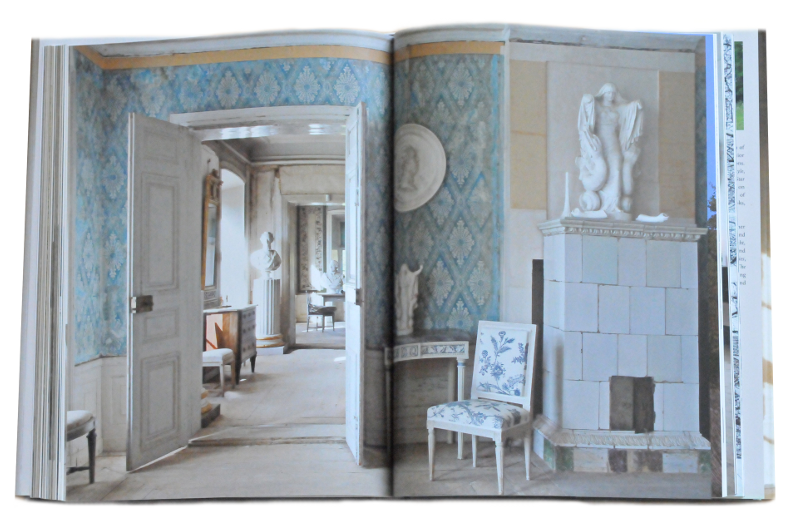
Classic Swedish Interiors By Lars Sjoberg
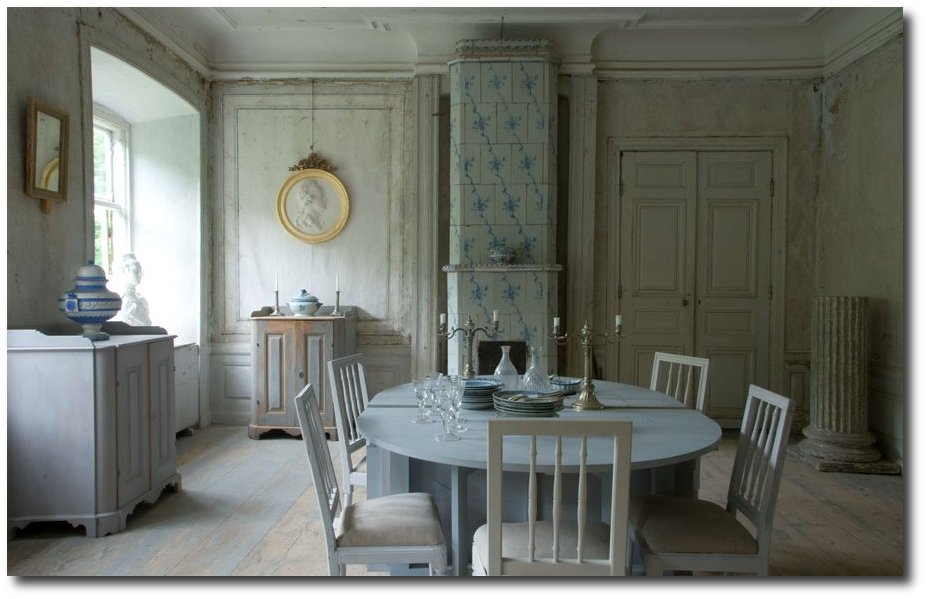
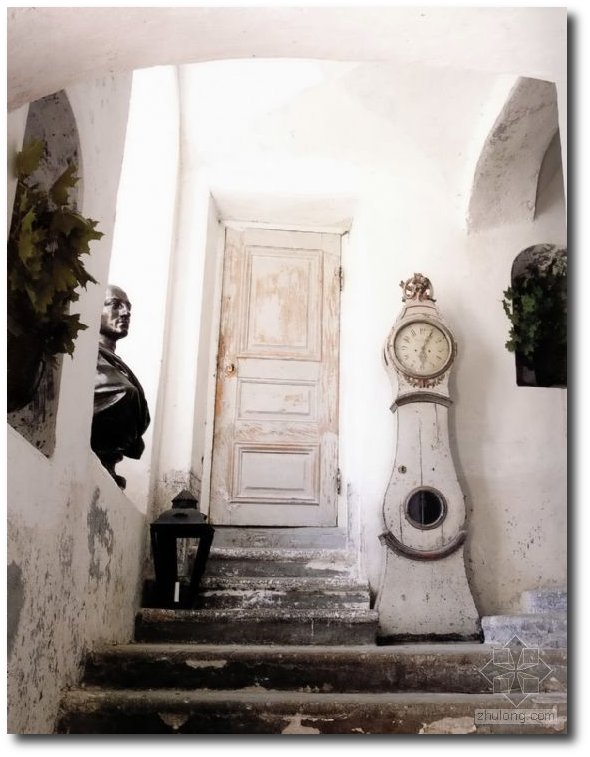
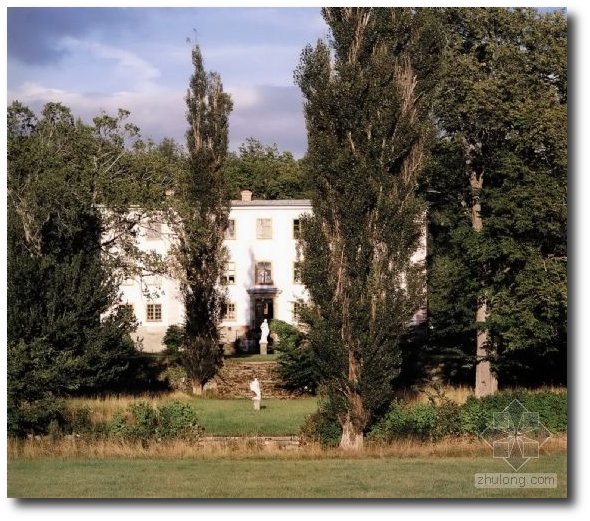
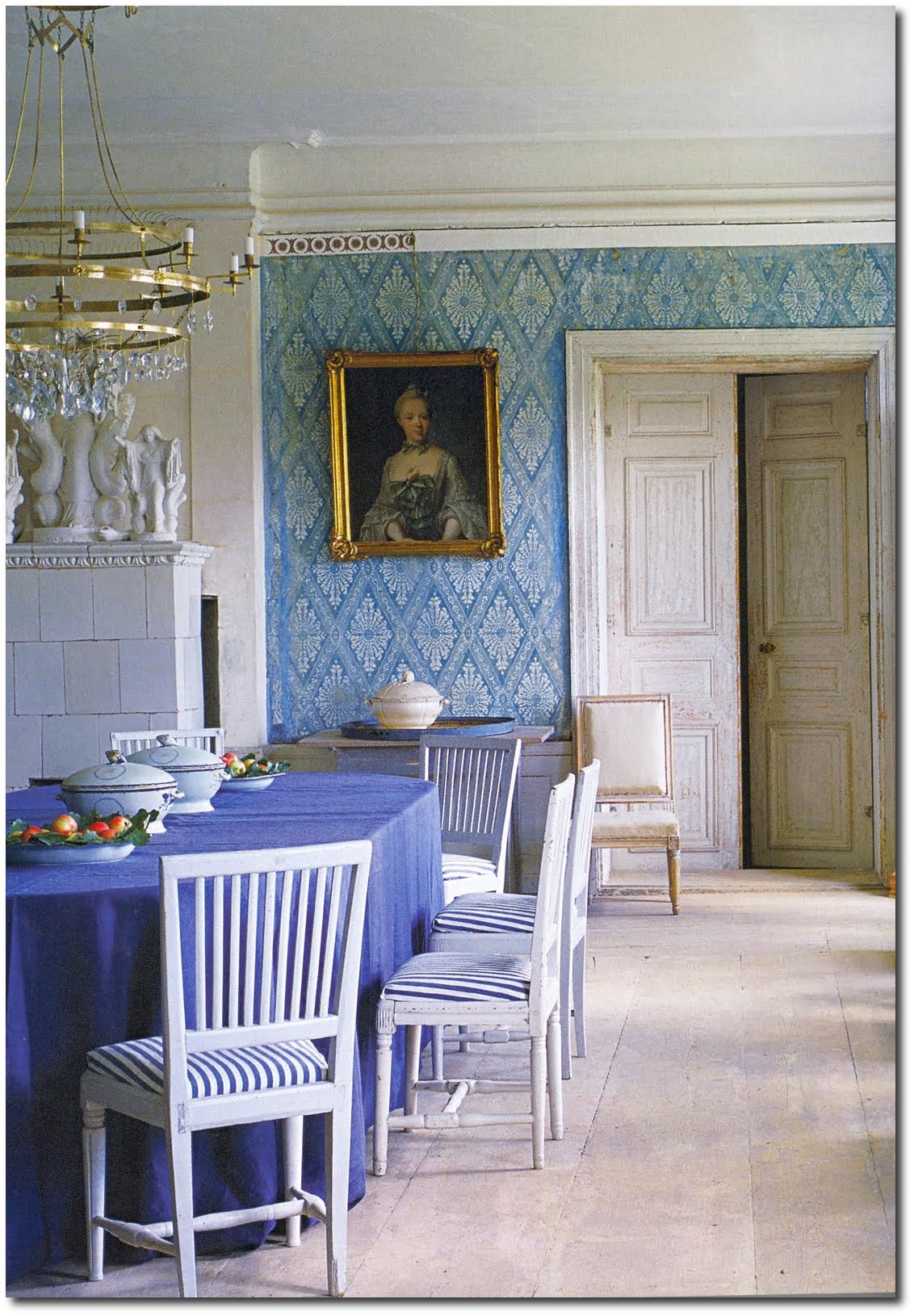
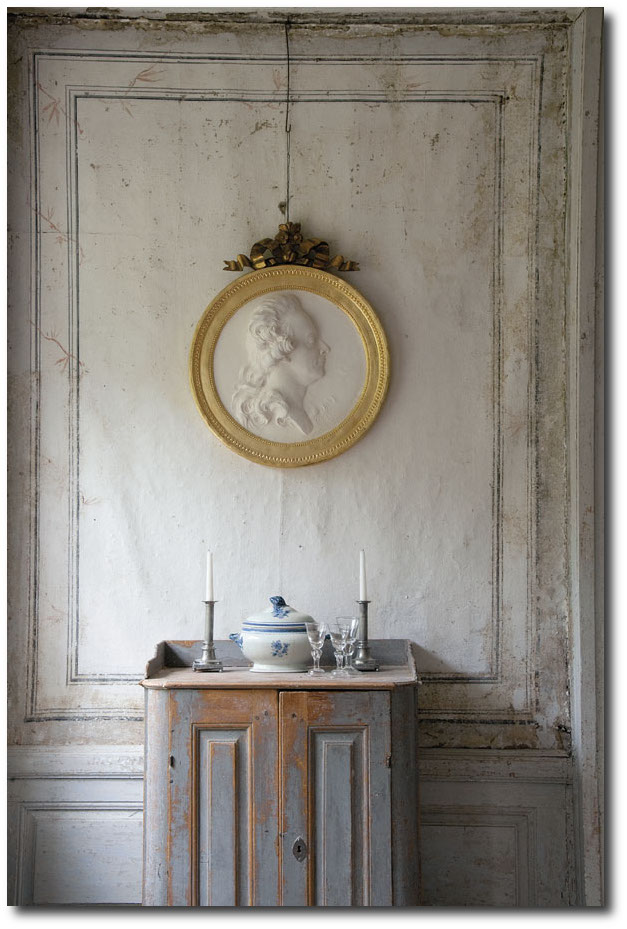
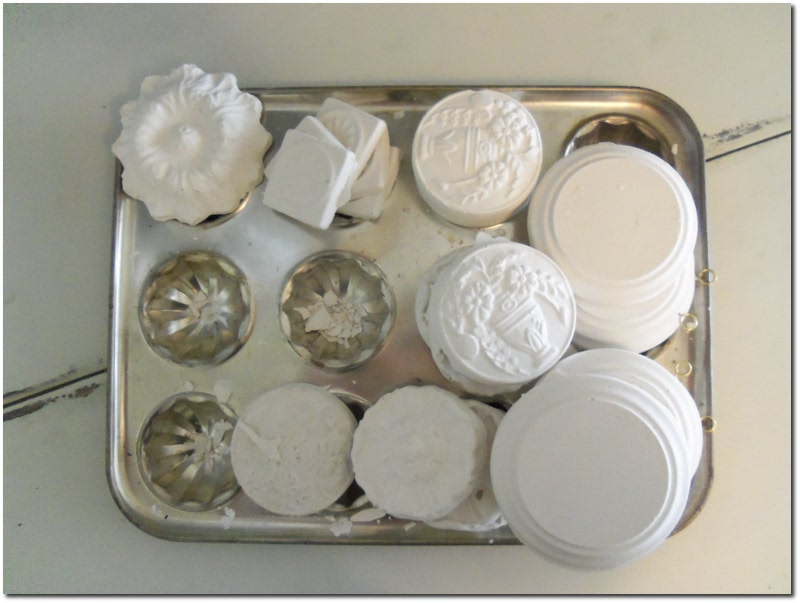
Make your own or sell them….Pastic mold concrete plaster mould $49 on ebay.
This medallion comes from Go Statue on Ebay, You can find the original listing here
Get The Look Yourself
Many of the Swedish Gustavian furniture sites will occasionally have these medallions for sale. Ebay is another place to find wall plaques.
One word of caution, many plaques and busts do feature false gods, so you have to be careful what you purchase and bring into your home. Personally over the years, I have had to throw out many plaques and busts, later to find out they were statues of Roman deities. Before you buy, research what you are buying.
I have found many beautiful plaster plaques with fruit and flowers. The larger medallion molds are harder to find, although you can find some beautiful flower styled plaques on ebay which are quite affordable, and look just as nice.
Instead of one large plaque, consider collecting a series of 9, 18, 27 ect smaller plaques which you can feature on your wall.
Here are some examples:
– Set of 2 metal wall hangings, plaques made in England, Found On Ebay, Pinned to Pinterest
– Vintage Fruit Chalk Ware Apples & Plums, Found On Ebay, Pinned to Pinterest
– Vintage Turner Cameo Wall Plaque, Found On Ebay, Pinned to Pinterest
– 10 inch White Resin Cameo Art Nouveau Head, Found On Ebay, Pinned to Pinterest
– Furniture Appliques From Do It Yourself Chic
- Swedish Decorating Gustavian Furniture From Lars Sjoberg
- Featured On Tweedland & The Gentlemans Club Blog
- Swedish Decorating Gustavian Furniture From Lars Sjoberg
- Featured On Tweedland & The Gentlemans Club Blog
- My Own Molds, Yaley Round Basket and Flower Molds on Amazon, Judges Plaster Mold Ebay
Consider Making Your Own Art
–This article has some amazing inspirational photos of what can be produced with the plastic throw away containers and lids from found at your local bakery. In one photo they create a round plaque possibly from plastic margarine containers. Who knew!
– Mid-century plastic plaques can be antiqued by an application of paint. Simply mix together non-sanded grout and white paint and brush on. This look shouldn’t give away that your plaque is plastic.
– Make Your Own Round 11 Inch Fireman Maltese Cross Cement or Plaster Mold
– 6 3/4″ round Concrete, Baking, Plaster Plaque
– Dogwood Wall Plaques- here, Architectural Plaques, here
– 3 1/2 x 2 7/8 Square Frame Molds. Mount different shells and hang them on the wall.
– Oval Flower Plaque– Make Your Own Chocolate, or gifts with this Swedish looking mold
– Set of 6 Designs For Chocolate or Plaster Molds Here, and Here
– Perfectcast– The professionals choice for casting medium, PerfectCast is five times stronger than any other regular plaster. It is AP Non-Toxic and it reproduces intricate detail identical to the original mold. The only substance you need to add is water. PerfectCast produces a perfect cast every time
Here are a couple resources found around the net:
-A magnificent Gustavian portrait medallion by Sergel , royal sculpture to King Gustav III of Sweden. These medallions were mounted around the public buildings in Stockholm , Sweden. The portrait is of renowned Swedish composer Sergel. It has a steel hook fixed to the back for easy suspension. $785
-A portrait medallion of the famous Swedish Gustavian musician and writer Belmann. This is a museum casting in plaster as the original is in marble and still attached to Stockholm castle. $785 AUD
-This stunning cameo portrait medallion was made by Wedgwood & Bentley c.1777, modeled by William Hackwood. Wedgwood & Bentley was in operation from 1769-1780 preceding Wedgwood. The highly detailed portrait and is applied to a rich solid blue jasper plaque. The portrait is in quite high relief.
-Portrait Medallions – Set of 5 in blue and white jasper. ArtValue.com
-A portrait medallion in plaster of King Gustav III. Reproduced after an original 18th century medallion. –Real Gustavian
-A plaster medallion of Charlotta De Geer of leufsta Manor house Sweden- Real Gustavian
Noteable Links:
-Lars Sjoberg’s Swedish Style- The Swedish Furniture
-Lars Sjöberg and his Swedish manor Ekensberg – Belgian Pearls Blog
– Lars Sjoberg, hero of Swedish Heritage Conservation Tweed And The Gentlemans Club
-Lars Sjöberg Trouvais Blog
-Style I Love: Classic Eighteenth-Century Swedish Interiors- The Style Saloniste
-Decorative plaster – Plaques From www.grandissonstoves.co.uk
-Casting Plaster Plaques-westerntractmission.org
Cecilia Dahlback, owner of Country Swedish, moved to the United States with her parents as a teenager and, after studying international economics and marketing at Georgetown University, discovered that what she really liked was interior design. When the family friends who owned Country Swedish retired, Cecilia saw an opportunity to move into the design business.
The Country Swedish Collection includes a variety of Swedish styled interior furnishings. Their Gustavian reproduction furniture includes a wide selection of chairs, dressers and chests, desks, daybeds, and sofas. Shop some of the finest Swedish wallpaper selections for a quick transformation for that special room in your home.
Gustavian reproductions are made in Scandinavia by craftsmen who continue to preserve the centuries-old traditions of Gustavian Swedish furniture making. The furniture collection begins with beech, birch and pine from Scandinavia. Since most of the pieces are painted, the company has its own paint shop, which guarantees the consistency of the 30 available colors and finishes.
Country Swedish furnishings are sold through designers and architects, but the showroom in Norwalk is open to the public for viewing.
- Classic Swedish Interiors By Lars Sjoberg
- Ekensberg –gal.zhulong.com
- Ekensberg –gal.zhulong.com
- Ekensberg- Belgian Pearls Blog
-
Ekensberg –gal.zhulong.com
-
Ekensberg –gal.zhulong.com
-
Lars Sjoberg- The Style Saloniste


The History Behind Empire Furniture From The Karl Johan Period -Liza Laserow
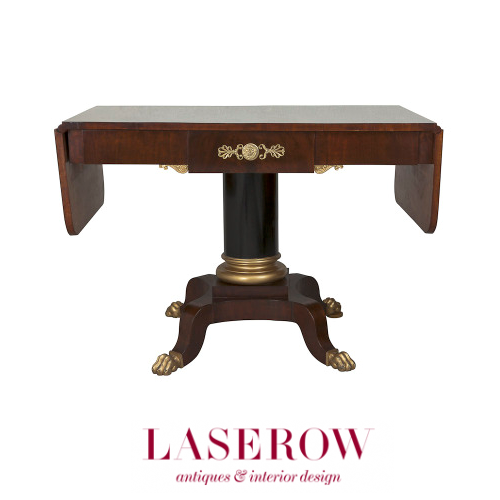 Drop leaf table made in Stockholm, Sweden. Details according to the periods highest fashion such as lion feet and lions head. The drawers keyhole is elegantly hidden behind the gilded lions head.
Authored By Liza Laserow
1810 the french officer Jean Babtiste Bernadotte came to southern Sweden accompanied by one of Napoleons marshals Monsieur Bernadotte , the man who was going to become King Karl XIV Johan. It was at this time the French Empire style came to Sweden. Napoleons architects: Charles Percier and Pierre Fontaine developed the style in France during the late 1790. They took Neoclassicism and gave it heavier look. Inspired by the roman empires strong lined art and architecture warlike attributes such as eagles, shields, helmets and spears became important symbols of the period. The glory years for this period was between 1804-1814 when Napoleon I was the emperor which also gave the period its name; Empire. During 1830 the style got softer and late Empire and in southern part of Sweden it got blonder – Biedermeier.
Mahognay with gilded details dominated the periods materials for furniture and mirrors and it was during this period the wallpaper was introduced in the form of panoramic views with classical ruins. Silk upholstery with matching window treatments in strong colors such as green, lemon yellow, red or gold was the highest fashion. Sweden also got its first silk weaving mill thanks to a Swede who smuggled a weaving chair to Sweden from France.
Read more about Swedish porphyry during the Karl Johan period.
About The Author
Liza Laserow, the daughter of the mother-daughter-owned company Laserow Antiques. Born and raised in Sweden, Liza moved to New York City, where, though she had trained to be a lawyer. Her mother, Karin, founded a showroom in Sweden 30 years ago and, in 2009, Liza helped launch a Laserow Antiques outpost in the New York Design Center in Manhattan. The exquisite gallery features furniture curated from Sweden’s most significant periods—Baroque, Rococo, Gustavian, and Empire—spanning from 1650 to 1820.
Follow Liza’s Blog, Old Is New,
Laserow Antiques Website
Laserow Antiques On 1st Dibs
Britahill
Brandstadvägen 612,
SE 275 67 Vollsjö
Sweden
Phone: +46 (0) 416 352 52
Cell: +46 708 13 52 30
1st Dibs @NYDC
200 Lexington Avenue, 10th Floor #63
New York New York 10016
USA
+1 212 988 9194
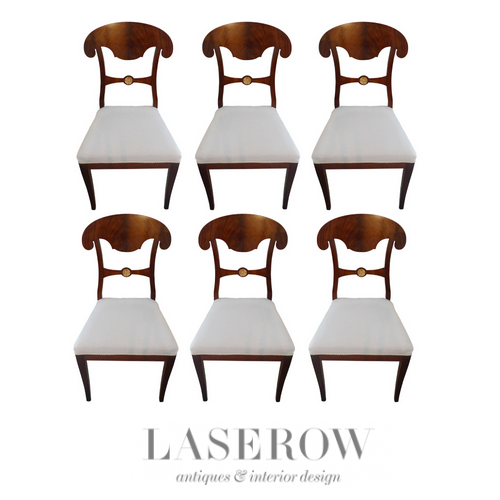
A set of 6 Empire dining chairs made in Sweden during the Karl Johan
Period. Frame in mahogany with gilded flower detail on black splat.
Newly upholstered.
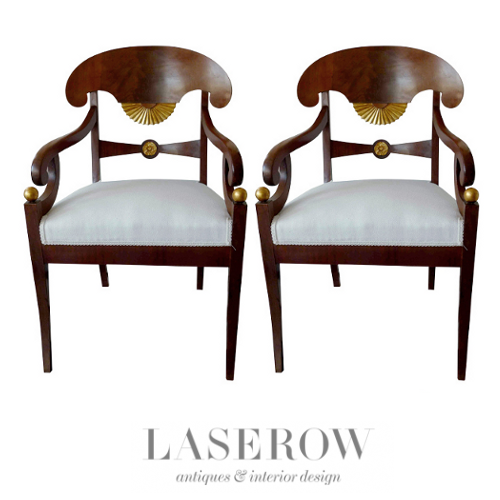
A pair of empire desk chairs in mahogany with gilded details in shapes of balls, flowers and fan
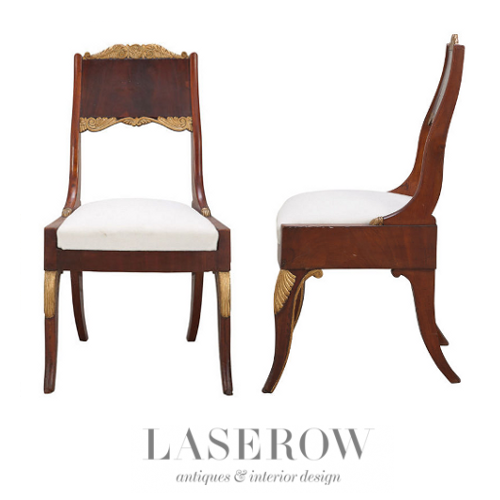
Pair of Russian Empire Mahogany Side Chairs
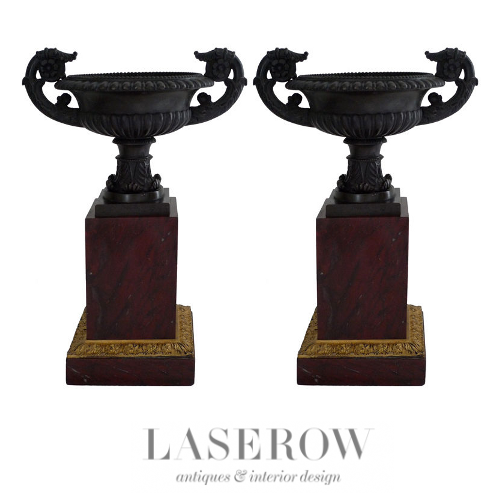
A pair of Tazzas from the late part of the Empire period. Made in Red French Marble, patinated bronze with decor of gilt bronze.
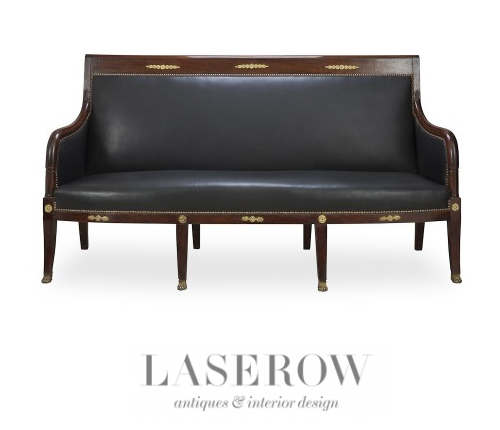
Sofa from the Empire period made in France. Frame of dark polished mahogany with gilt bronze decorations. 4 front legs ending with lion feet in gilt bronze.
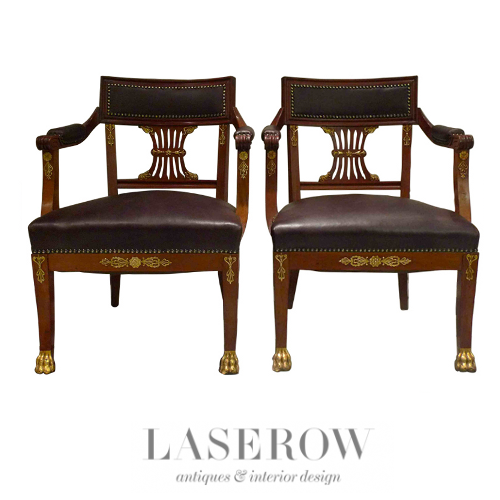
A pair of French desk chairs (can be sold separately as well) made in
Mahogany and decorated with polished bronze details. Legs ending with
lions feet. Upholstered in dark brown vintage leather.
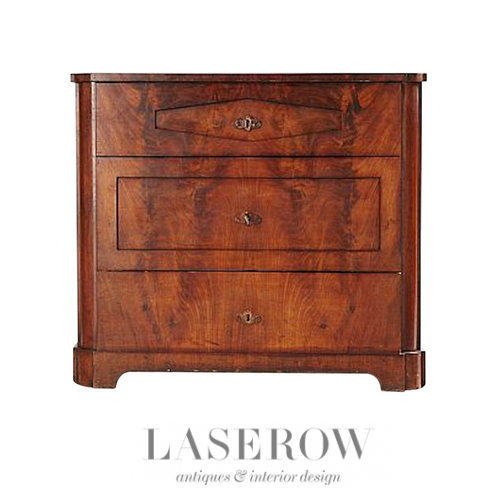
Swedish mahogany chest of drawers amde during the Karl Johan period
1820-1830. Simple carvings on drawers front and rounded corners.
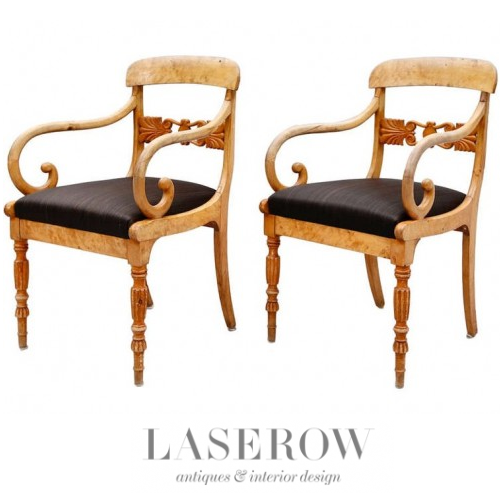
A pair of Swedish Biedermeier armchairs in light birch made during the mid 19th Century ca 1840.
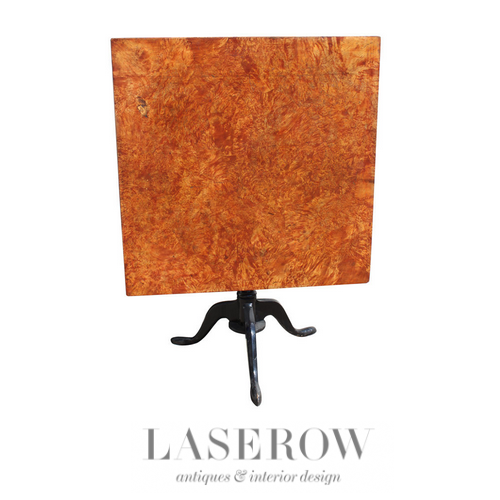
A Swedish Karl Johan Alder Root Tablein a very good quality. Top made by inlayed alder root standing on a blackened tripod base.
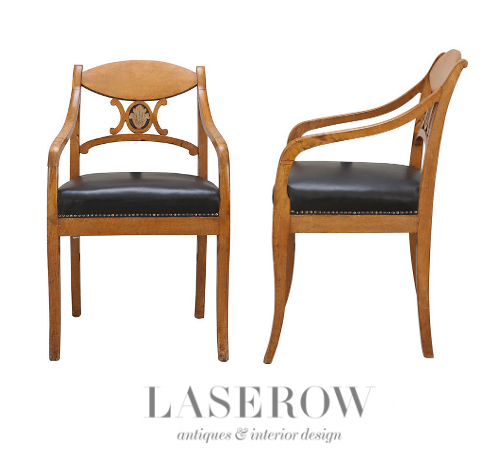
A Pair of Swedish Karl Johan Armchairs
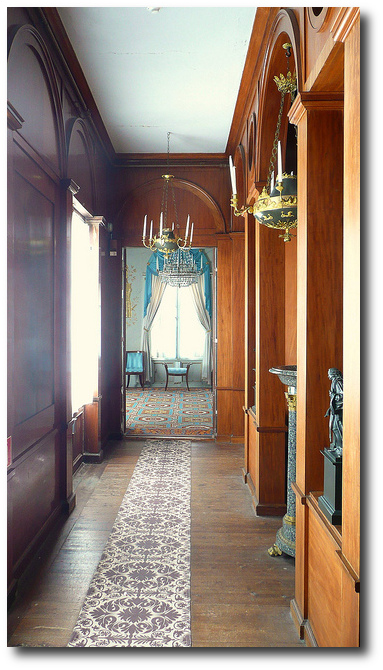
Rosendal Palace- Picture Credits- Faun070 On Flicker
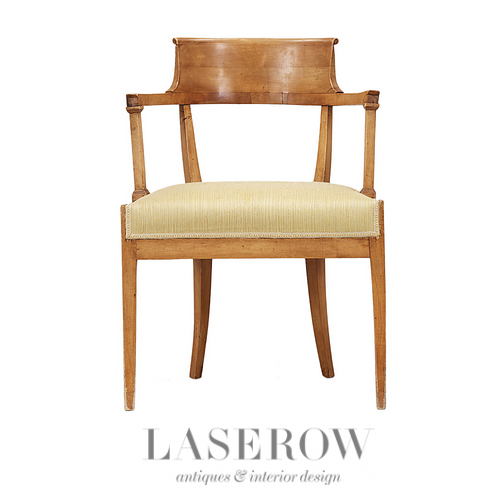
A single Empire desk chair made during the Empire period early 1800’s in Sweden.
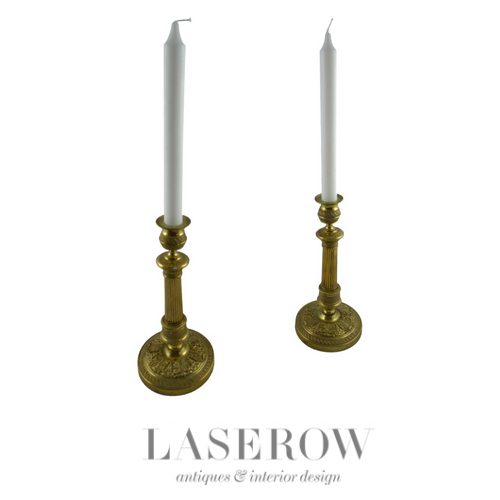
A pair of candlesticks made during the empire period 1810-1830 in
France. Urn shaped candleholders and a rounded channeled body standing
on a round foot decorated with flowers.
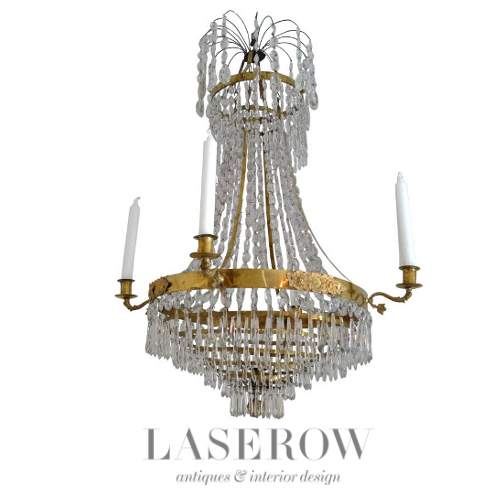
A exquisite crystal chandelier from the early part of 19th Century and
Karl Johan period. Frame made on brass with gilt bronze details. Diamond
shaped crystals. Four arms for candles and one in the middle of lower
basket Calles “welcoming candle”. All original.
An exquisite tall gilt wood mirror made during the Karl Johan period
with a demi lune shaped molding. A rectangular ending decorated with
leaves.
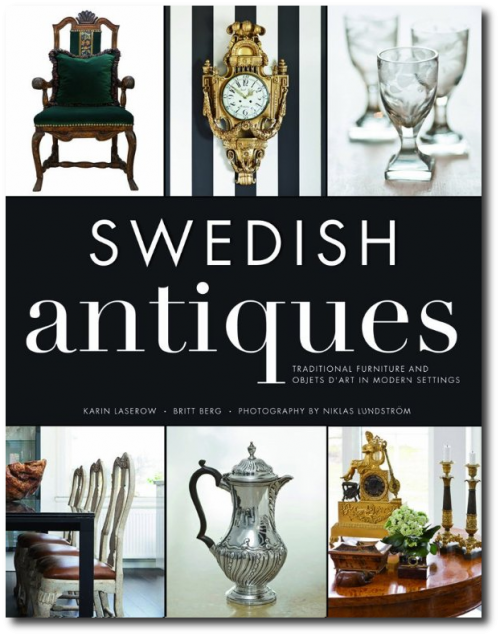
Antiques In A Modern Settings By Karin Laserow
A comprehensive guide to blending beautiful antiques into a modern home.
Incorporating antique furniture and art into a modern home may seem like a contradiction, but Karin Laserow and Britt Berg show just how easy it is and how stunning the results can be. Highlighting the rich traditions of Swedish furniture and other décor, this full-color guide begins by explaining the basics of antique furniture, from style histories to the nuanced differences of Baroque, Rococo, Empire, Gustavian, Art Nouveau, and more, with striking photographs throughout. Readers are taught how to tell the difference between old and new, how to evaluate antiques, and how to determine whether repairing, repainting, and refinishing are worthwhile decisions for protecting antique investments.
Swedish Styled Wallpaper
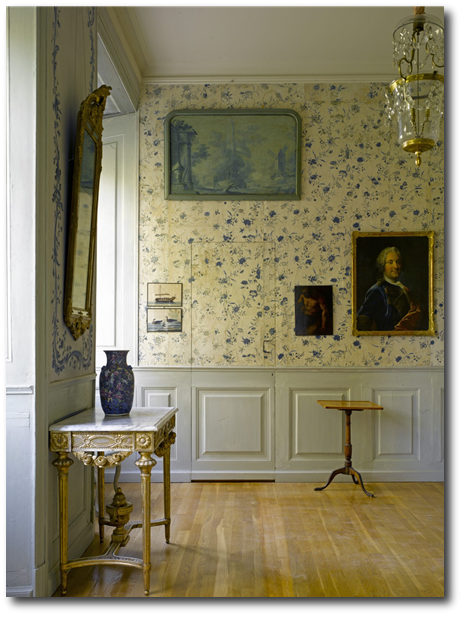
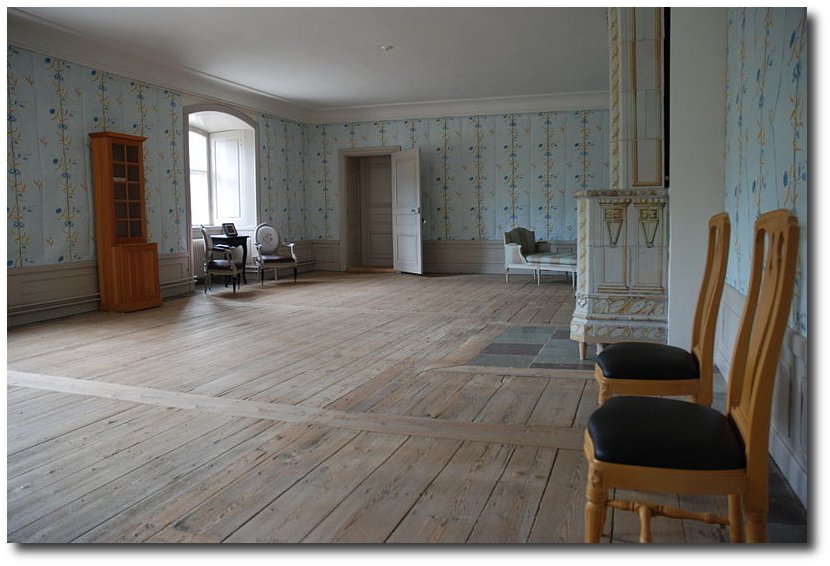
Stola Herrgård, Sweden
Wallpaper can make a tremendous difference in a room decorated around the Swedish style. It has the ability to add historical flavor to a room, and infuse color on the walls in a way that is decorative. Prints can be a remarkable tool for a designer or homeowner who wants to give an impression of a room based around a period theme.
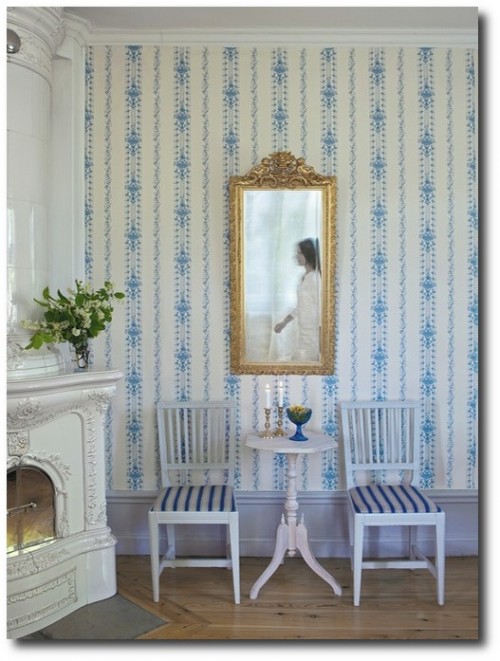
Stripes are known to be particularly Swedish, and are often seen combined with a floral pattern. See an example in this room. Floral patterns, or all-over patterns which repeat themselves are also heavily used in Swedish decorating. During the Gustavian period, damasks also became popular as many elements of the French Style were brought to Sweden. Castles and houses of the wealthy had contemporary
wallpapers imported from France to decorate the walls of their gracious reception rooms.
In the 12th Century, papermaking reached Europe, and by 1481, Louis XI of France ordered Jean Bourdichon to paint angels on blue background on 50 rolls of paper. It was then that the ruling class began to commission artists to paint paper for their walls. In 1599, a Paperhangers guild was established in France. Then in 1675, Jean-Michel Papillon started making block designs in matching and continuous patterns. He was considered the inventor of wallpapers. Come the 18th century, wallpaper products from London became popular. Wallpapers gained popularity because they were less expensive, than hand painted papers. Later, Louis XVI issued a decree that wallpaper rolls should be about 34 feet in length, in 1778. It was Christophe-Philippe Oberkampf of France who invented the wallpaper printing machine in 1785. Nicholas Louis Robert of France invented a way to make endless roll of wallpaper.
Duro, Gammalsvenska Wallpaper From Sweden
Since 1946, the past three Kings of Sweden have appointed Duro as supplier to the Royal Court. Today Duro shares this honour with only about 120 other companies in all of Sweden. In addition, the fact that the Royal Family and Court are very restrictive with the distinction makes it all the more appreciated.Over the years, Duro has accumulated thousands of wallpaper fragments from castles, manor houses, and historical buildings throughout Sweden.Working closely with antiquarians and museums, Duro has meticulously recreated many of these beautiful patterns that can be found in their Gammalsvenska Collection.
Country Swedish
Country Swedish sells a variety of Swedish furniture, fabrics, rugs and wallpaper; everything you need to put together a Gustavian styled room. Country Swedish makes fine reproductions are designed and developed by craftsmen with careful attention to scale, proportion and ornamental details. Many of their wallpaper designs can be paired with sophisticated interiors or country interiors depending on the furniture you select, and the coordinating accessories. They have a wide variety of period style wallpapers with several colors to choose from which would aid in furnishing a Swedish country house or an elegant Gustavian city home. Check out their wallpaper selections here, and my favorite picks are below.
The Gustavus Collection By Zoffany
Zoffany has turned to the restrained classical style of eighteenth century Sweden to influence a wallpaper collection that exudes character,elegance and simplicity. Core colours of creams, whites, blues and greys are warmed with the addition of earthy reds. The challenge for the Zoffany design studio was replicating the quality of the natural materials inherent to Swedish eighteenth century interiors for a contemporary market. By using modern printing techniques and rich opaque pigments the studio has captured the authentic textures of natural wood and rough plaster.
Noteworthy Posts:
Book Review: Jocasta Innes Scandinavian Painted Furniture- The Swedish Furniture
Spare Room Before Wallpaper- Lily Oake
Master Bedroom Wallpaper Lily Oake
Swedish Interiors: The Chinese Pavilion Continued……. –The Swedish Furniture
Scandinavian Design- The Swedish Furniture
Love Affair With Blue and White Wallpaper – Lily Oake
Picture Credit
- The Best Wallpaper Place
- Aged And Gilded Blog
- Designer Timothy Whealon
- Gammalsvenska Collection
- Henriot Floral wallpaper by Quadrille Featured On House Beautiful Magazine
 Duro, Gammalsvenska Wallpaper
House To Home Magazine- Pierre Frey
Eleonora, By Gustavus by Zoffany
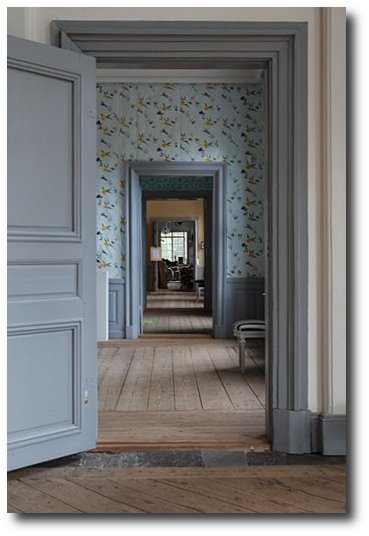
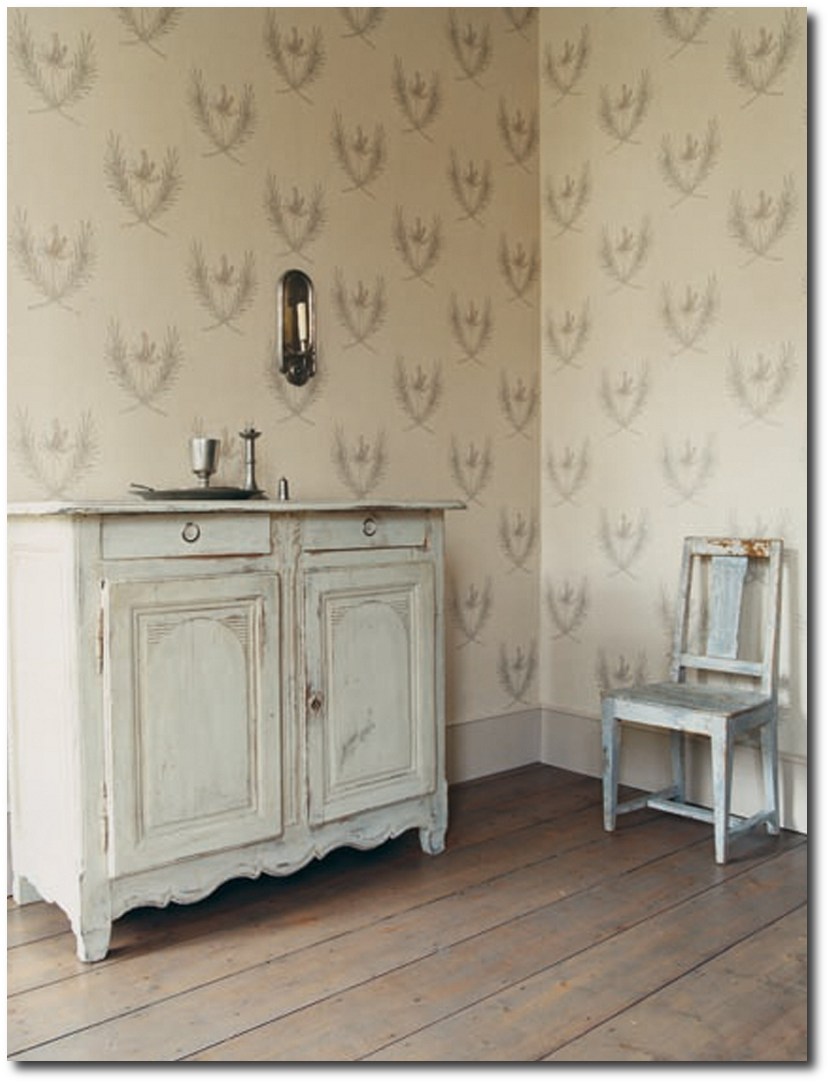
A beautiful design of shaded birds amongst trailing leafy-branches on a
golden lime-washed effect background – ideal for natural freshness and
modern sophistication. Additional colourways also available. Please
request sample for true colour match.- Available Through Wallpaper Direct
Thibaut Piccadilly Birgitta


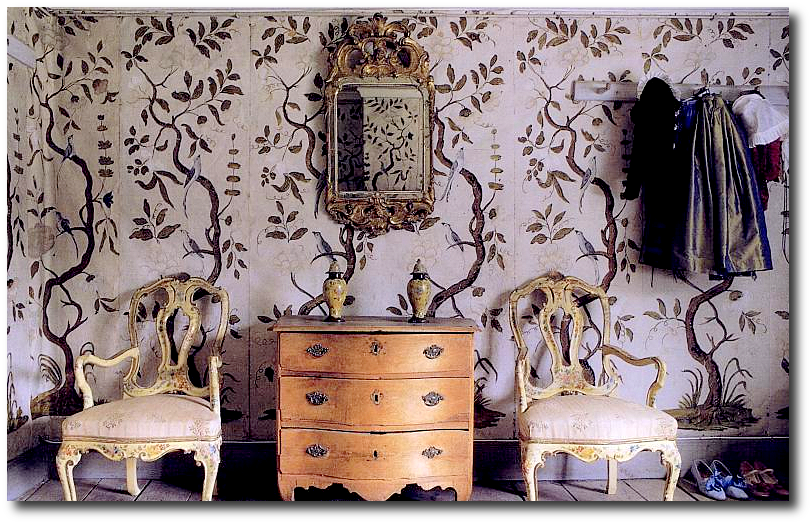
Wallpaper Used In Svartsjö Palace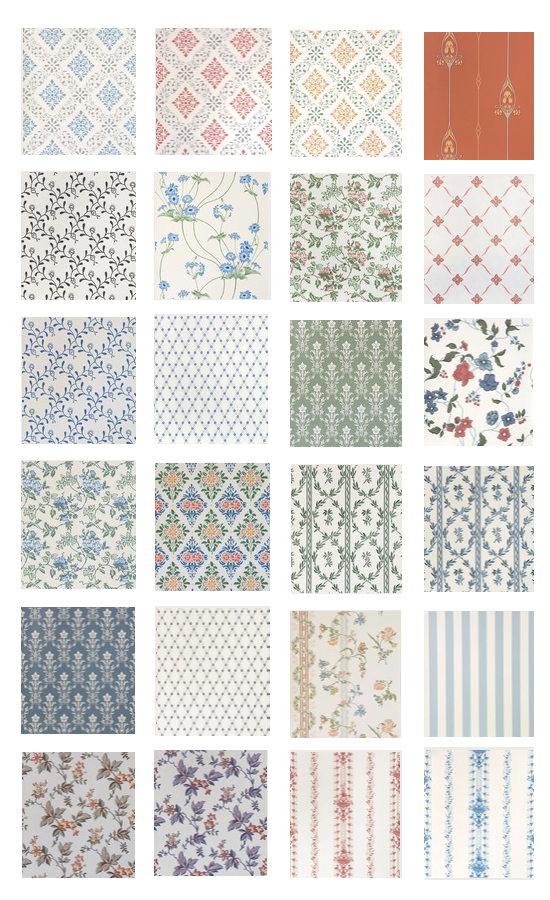




Nordic Style Drapery And Window Coverings
Authored By Curtain Pole Wizard
Rooms with a Scandinavian style white and blue are great colour choices for bedrooms. White-washed floors, walls and high vaulted ceilings are the quintessential hallmarks to classical Scandinavian style.
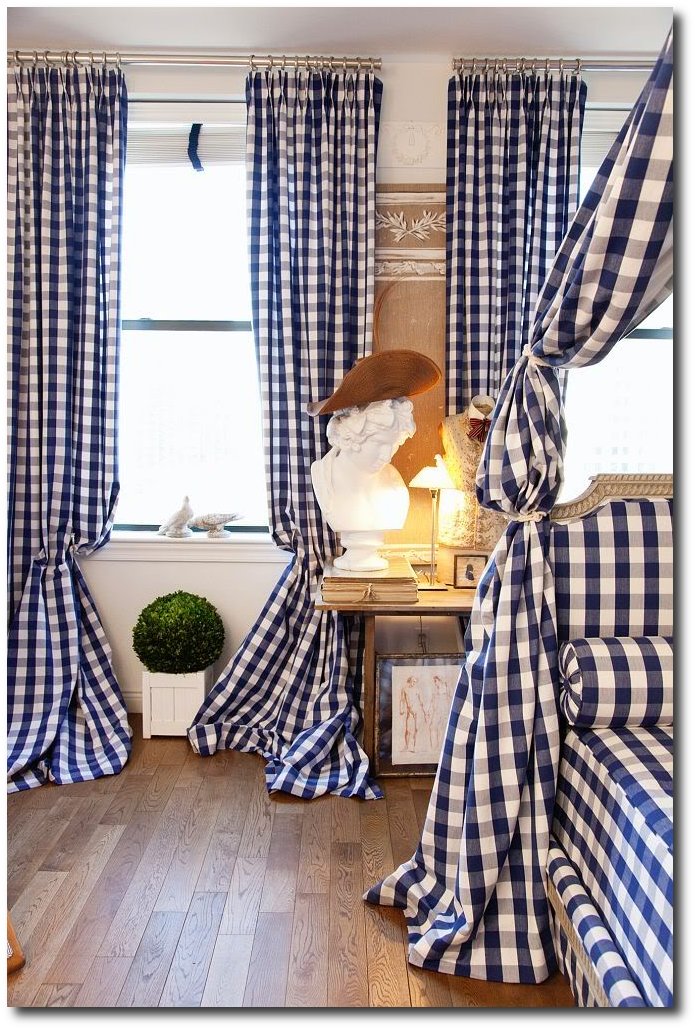
Blue checked fabrics mixed with stripes adds a fun element to the room. You could also add cross-stitched hearts for bed pillows and for hanging as decoration. Homely, with a fresh clean look is predominant in this interior design style and you can make the rooms as folksy as you wish to make your guests feel welcomed in your home.
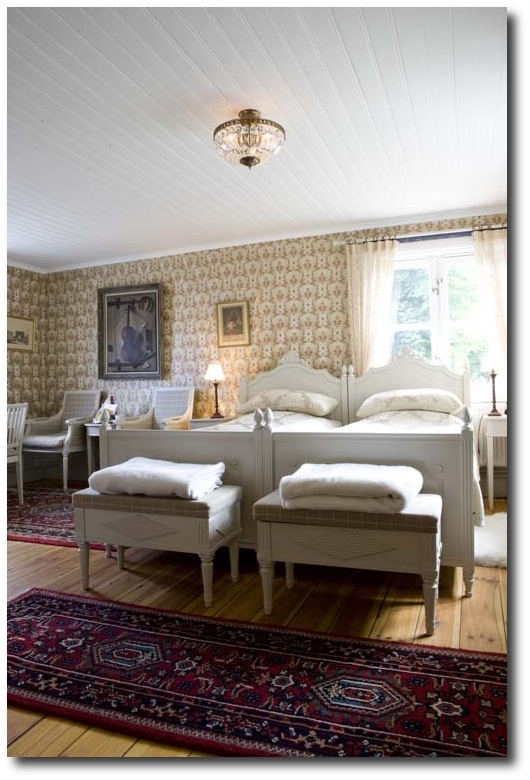
Twin beds are a great idea if your guest room is up in the loft space and lend themselves to being placed at either side of the room. A ‘privacy’ curtain is a great idea and enables guests to have their own space. Simply use curtains or make your own and hang them from wooden curtain poles painted white. Add simple curtain rings or use tab top curtains to slide the curtains across the curtain pole. Use the same technique for the window curtains to create a balance and cohesive look to the room.
If your guest room has a double bed a similar look can be achieved by adopting a twist on four-poster beds. Use curtain poles and curtain pole spares to make a simplistic frame around the bed from which you can hang curtains. It’s a fairly straightforward task and well worth the effort to get the look.
Add floor rugs, along with bedside table lamps and storage space for your guests. Make sure they have a warm duvet, ample pillows and extra blankets to hand should they need them. A pile of fresh towels laid on the bottom of the bed is a charming addition to making your guests feel welcome in your home.
Try not to let your spare room become a dumping ground – always have it clean and ready for unexpected guests to stay the night. Simple wall paintings can be used to add a touch of soft mellow yellow to bring a warm glow to the room. Hand-made cross-stitched samplers also make great wall hangings which give the room a friendly, family touch and is a great way to keep with the Scandinavian style of mixing old with new to create a welcoming ambience.
- Furniture- solarssonstilmobler.se
- Hotel room at Tällbergsgården in Dalarna
- Carolina Herrera Creative Director Hervé Pierre’s Bedroom
- Wallpaper from Colefax & Fowler. skonahem.com
- Hotel room at Vadstena Kloster Hotel in Vadstena, Östergötland
- Gustavian Interiors With Drapery –18thcenturyblog.com
- A Gustavian Manor- Featured On WREN Handmade
- The Widows Palace – Flicker Germany
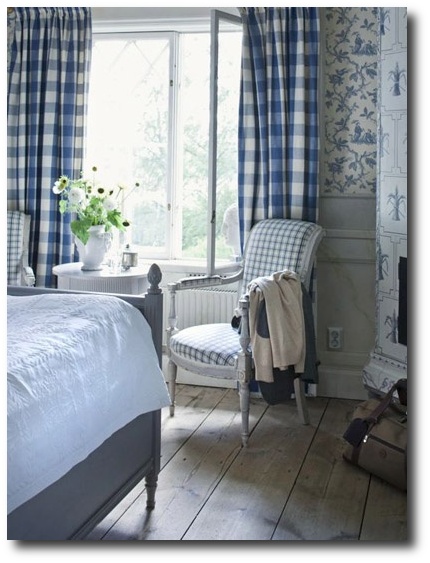
Hotel Wreta Gestgifveri- A boutique hotel located in beautiful surroundings, Wreta Gestgifveri
offers charming guest rooms that mirror different epochs from 17th
century Baroque to turn-of-the-century Romanticism.
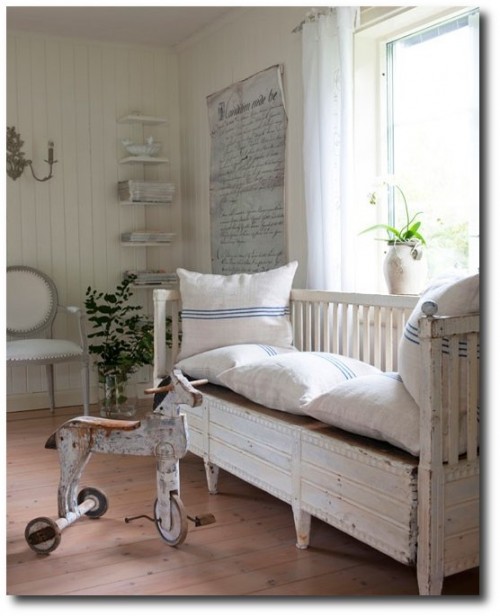
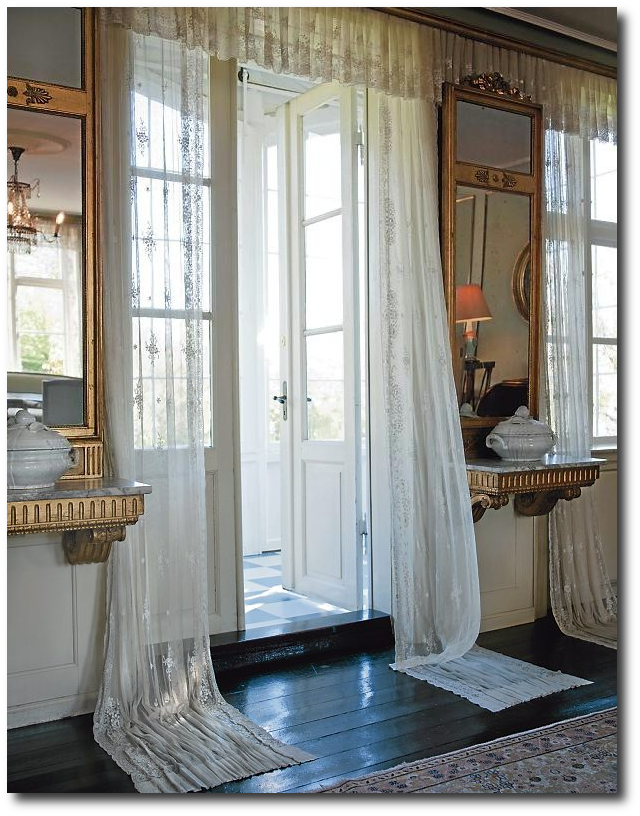
Simple Swedish Room With Sheer Drapery
A Country Styled Room With Sheer Drapery- Lowcola’s photostream
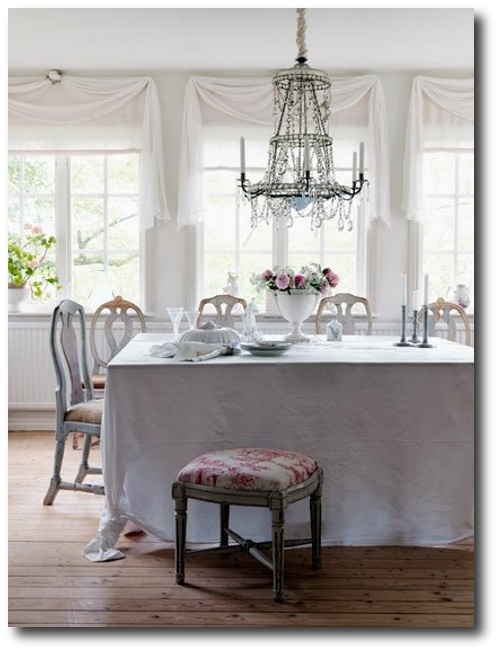
Photographer Carolina Romare
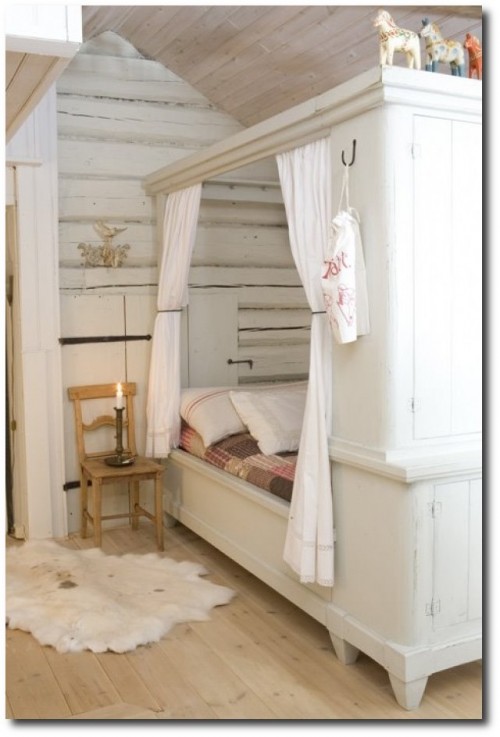
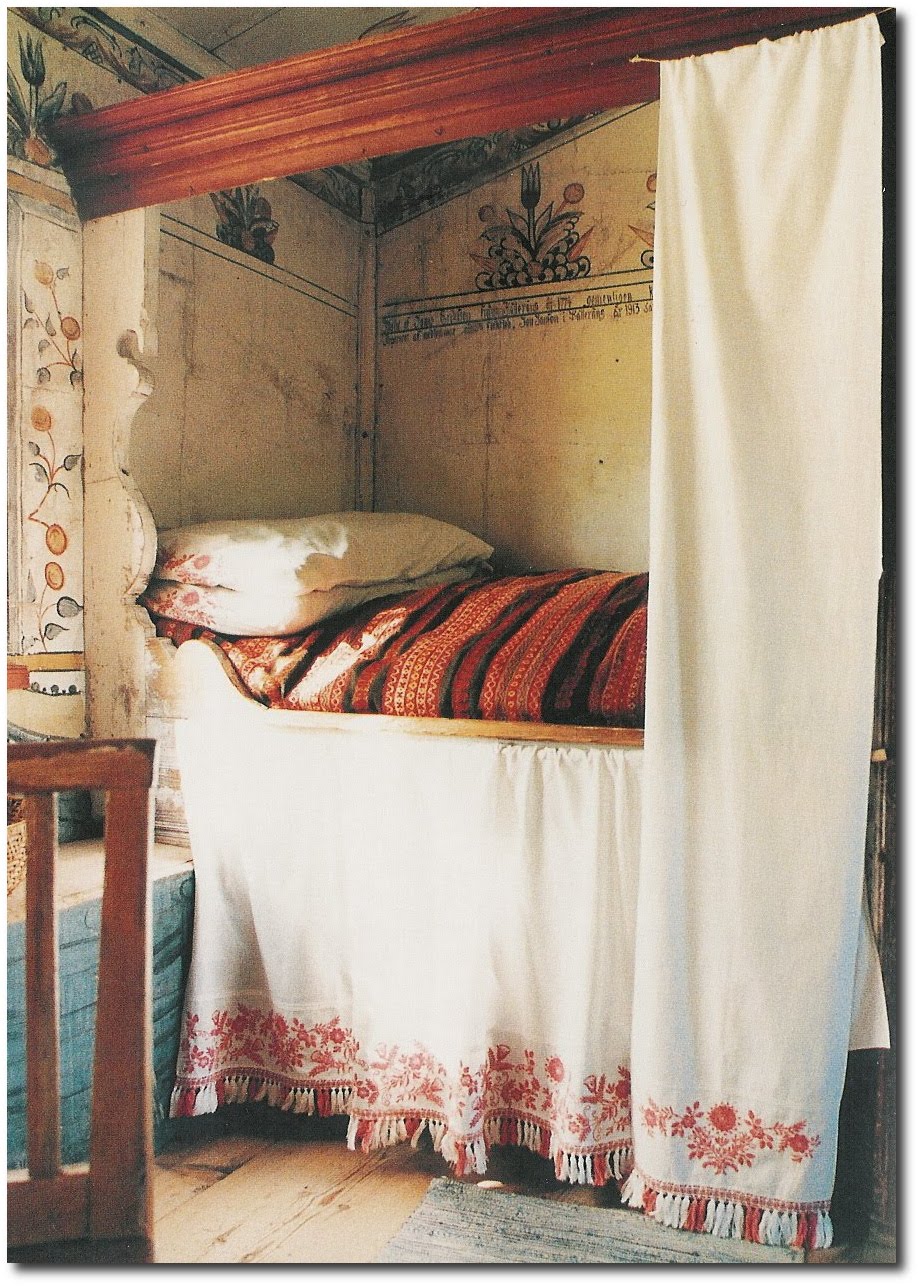
Swedish Cupboard Bed With Drapery
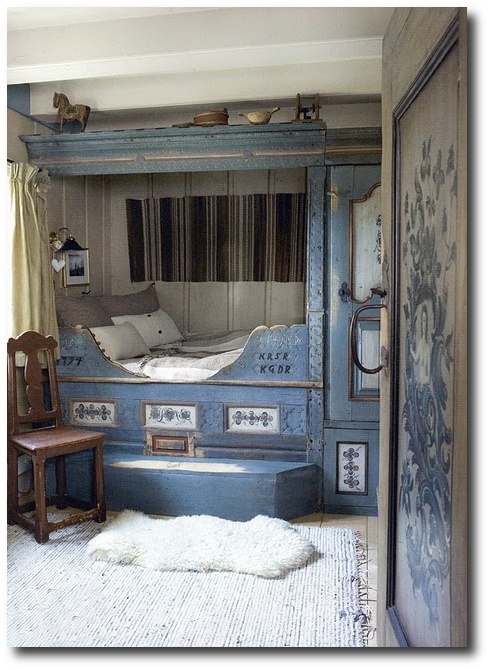
Cupboard bed from Norway, dates to early 1700s.
Extra Photos