5 Ways To Add Life Into Worn-Out Furniture
Furniture ages just like everything else…and like with most other things, you don’t notice the small changes that happen to your furniture until one day, a few years (or maybe even a decade or more) down the line, you stop and say, “When did my furniture develop this natural patina?”
Obviously you love your furniture — you wouldn’t have kept it for so long if you didn’t — but loving your furniture doesn’t mean you can’t update it or dress it up a little. What’s more, you can make your updates and do your dressing up for very little cost (which should be a relief since it’s doubtful you’ve got a Steve Wynn-sized bank account to fund these projects).
Here are a few cost-effective ways to do just that.
1. Put on New Hardware
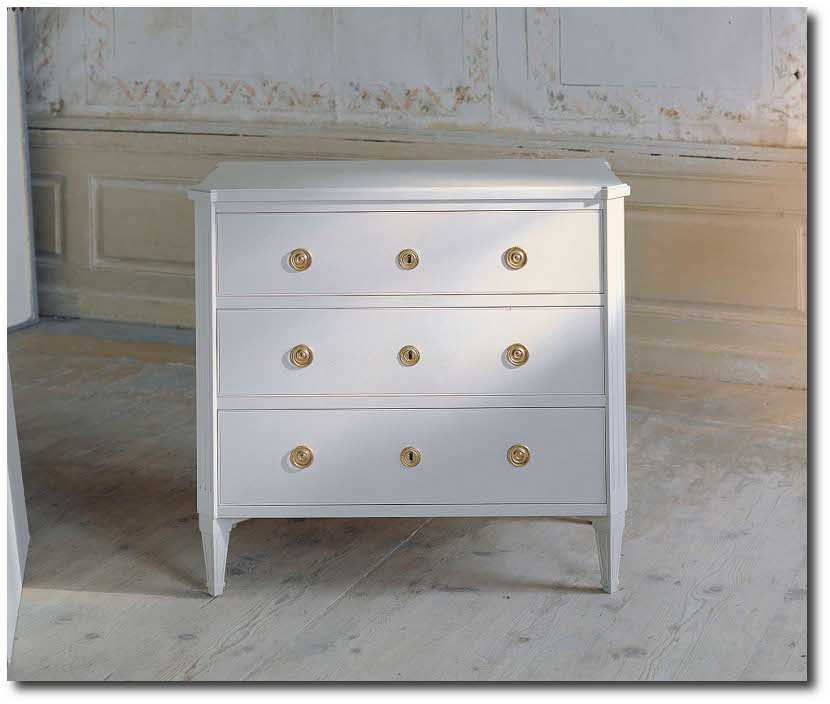
Consider adding a little bit of bling to that old chest that you want to fall back in love with. Putting on new hardware is a great way to dress up old cabinetry and furniture. For example, maybe instead of having handles on the dresser drawers, you can put pulls on instead. New hardware can completely change (and update) the look of a piece and costs way less than buying a whole new item.
2. Refinish It
That chest sitting in the back of the garage may look nice in it’s all natural elements. Consider sanding off the old layers of varnish and finish. Maybe this time you can choose a different paint color, or maybe you’ll leave it all-natural.
Refinishing vintage furniture helps get rid of layers of gunk and grime. It can also remove dings and scratches that might have dampened the appearance of the piece. While it won’t often make the piece look brand new, it can help it look re-energized.
3. Paint
As someone who is undoubtedly into the purity of his or her furniture, the idea of painting over the current finish, stain, or varnish probably turns your stomach. Before you hurl, though, know that light paint colors are very “in” right now (and has been for a while). You don’t have to paint the furniture a garish color if you don’t want to. In fact, one of the best things you can do is paint it white. A coat of white paint helps it keep its integrity while also updating its look.
4. Reupholster It
The simple fact of the matter is that over time, fabric (in spite of your good intentions and good care) starts to rot. Cushions (even with minimal pressure) lose their strength. Reupholstering the seat, sofa, or stool helps maintain its beauty and structural integrity. You can even find antique-looking fabrics fairly cheaply online. Even better — upholstery is something you can easily do yourself, which saves you even more money!
Whatever you choose to do, know this: Updating is not the same as replacing. You can keep the same furniture for decades if you treat it well and give it a facelift now and then!
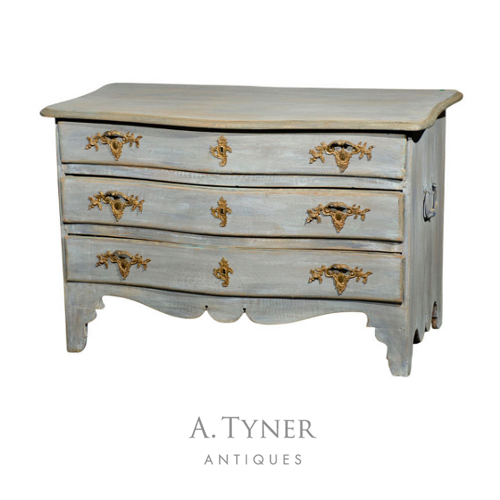
18th century Swedish painted Rococo chest of drawers. Mid 18th century.
Custom paint finish. A Tyner Antiques $9,750
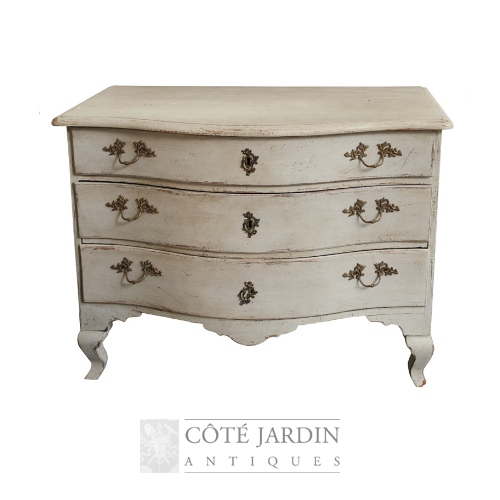
Swedish Rococo Grey Painted Commode -19th Centuty Grey Painted Rococo Commode,Three Drawers Cote Jardin Antiques $8,900
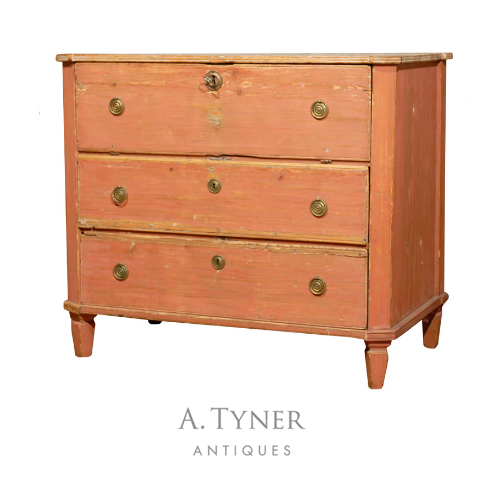
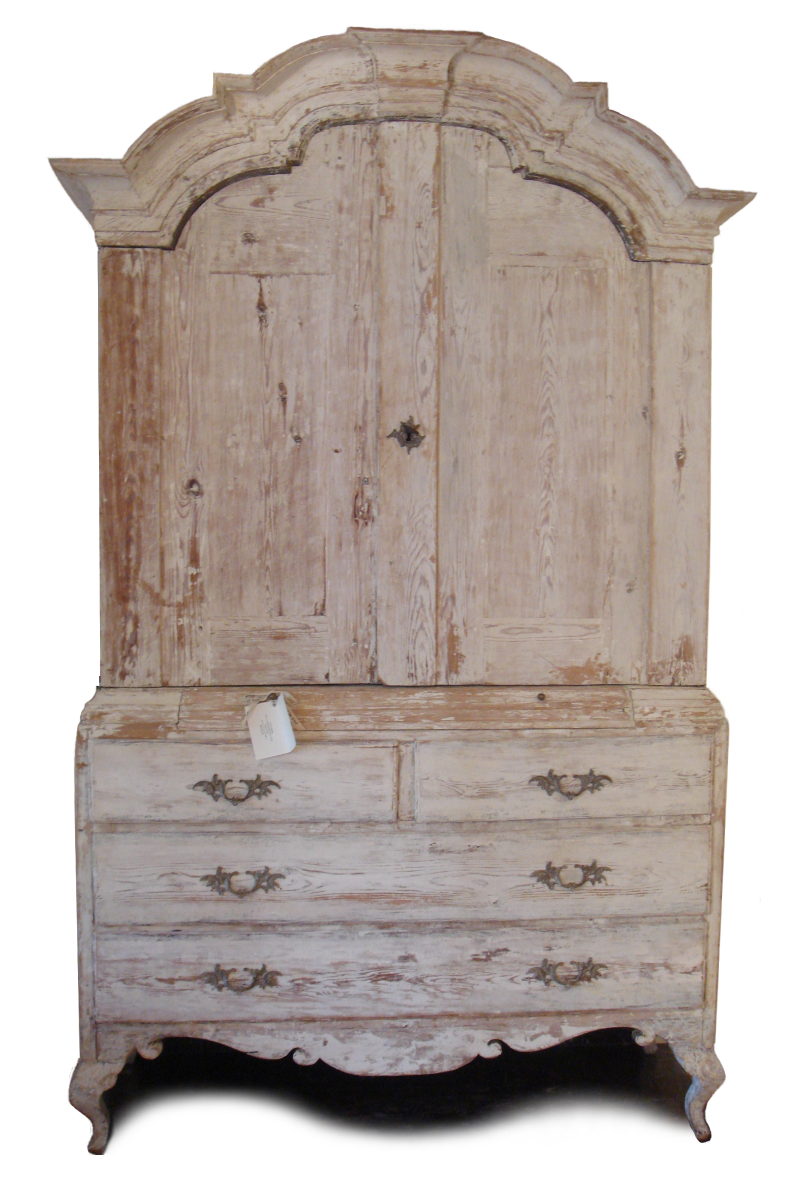
Swedish Chest With Desk- Circa 1790 Swedish Two Door Chest with Drop Down Desk, Original Paint, Original Hardware A Tyner Antiques $4,870
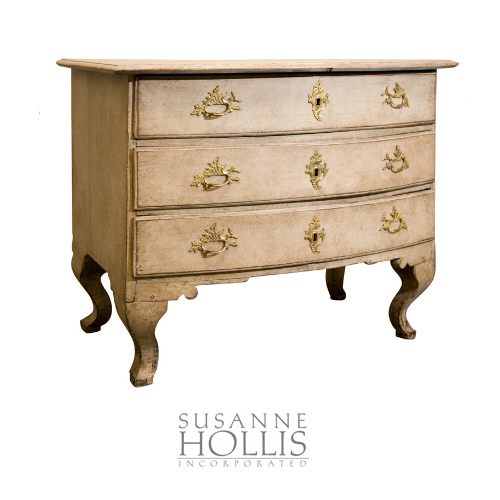
Swedish Chest of Drawers, Dated 1737 Sweden. The chest features all original paint and hardware, three drawers, cabriole legs on squared feet. Provenance on top drawer dates piece to 1737. Susanne Hollis $13,200
White Painted Swedish Furniture
Swedish Gustavian Style Decorating From Eleish and Van Breems Featured on Color Outside The Lines Blog
Swedish Dining Table From The Right Bank Blog
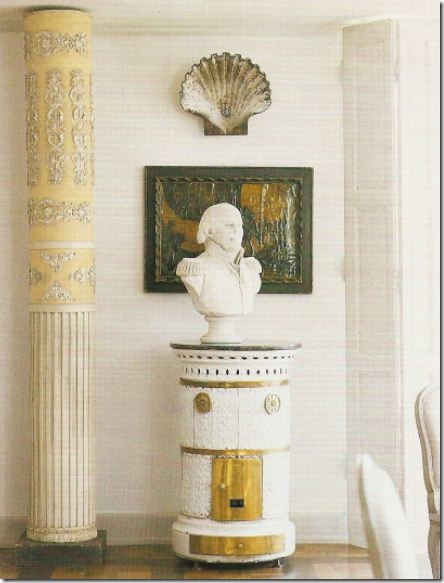
A Swedish Stove Stands Next To Papier Mache Columns- Kay O’Toole Featured on Cote De Texas Blog
18th Century Swedish Giltwood Cartel Clock with Lyre,
Wheat Sheaves, and Classical Drapery. One of a kind clock
Beautiful Primitive Wall Plate Display From Belgian Pearls Blog
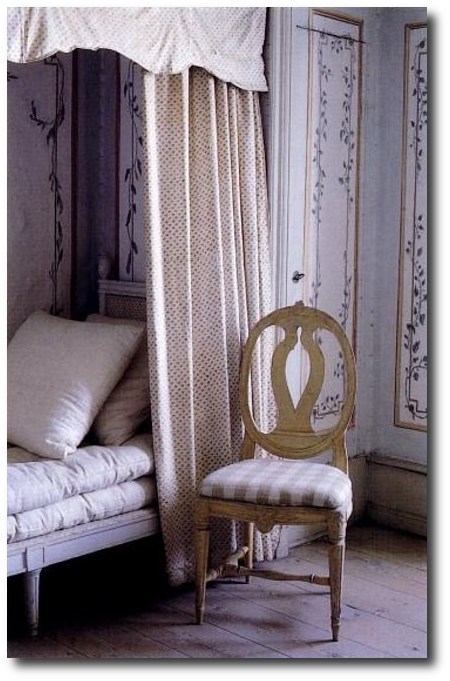
Swedish Decorating Gustavian Styles –
Book- The Swedish Room By Lars Sjöberg, Ursula Sjöberg, Ingalill Snitt
Featured on shabbyechic.blogspot.com
Book – Perfect Country Rooms Emma-Louise O’Reilly- Buy it on Amazon For $1
This beautifully illustrated book casts a fresh look at the new country style, which combines time-honored objects and traditional styles with a new versatility and natural look. This style of decorating is easily adapted to any house, rural or urban–it’s just a matter of focusing on comfort, conviviality, and a combination of traditional, personal, and at times eclectic objects. 175 full-color illustrations
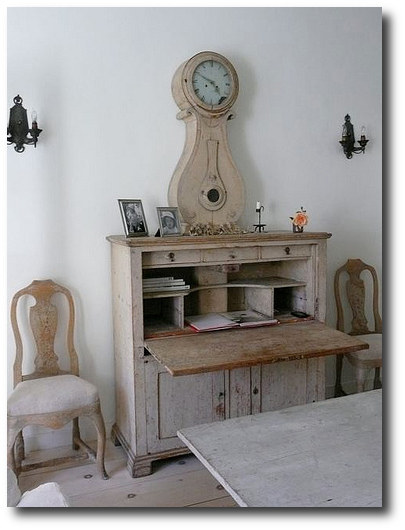
Kennedy Home From Velvet and Linen’s Flicker Stream
Dawn Hill Antiques
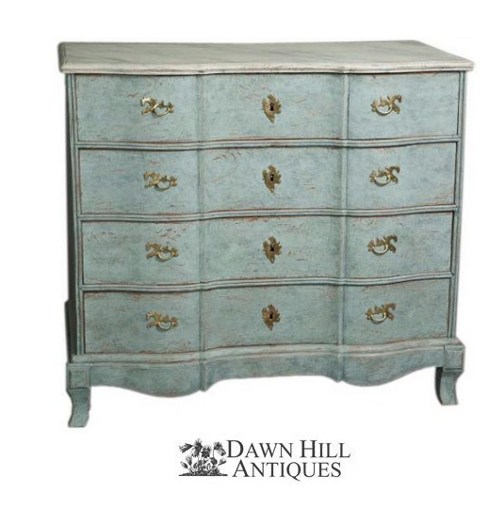
A blue painted, Rococo Period Chest of Drawers with a faux marble
top and elegant curved drawer front. Later paint surface and drawer pulls..
Sweden, circa 1750.
- A pair of Rococo Style Armchairs in Blue paint with elegant carvings and details.
- Circa 1860, Sweden
- Lindome chair makers, Sweden. $17,000
- A Pair of Swedish, late 19th century, Arm Chairs. Painted white and upholstered
in a late 19th century blue and grey French toile. Carved details on the crown
and apron. Reeded armrests and legs. $4600 - A matched set of six Swedish Rococo dining chairs. A matched set of six Swedish Rococo period dining chairs circa 1770, in original paint with a nice patina Price $15K
- Swedish Chest of Drawers Circa 1820
- A, Mid 19th century, Trumeau Mirror 1850.
- Swedish Baroque chest of drawers, circa 1800,
- Original hardware, no repairs.
- Large horse, circa 1820, with wooden frame
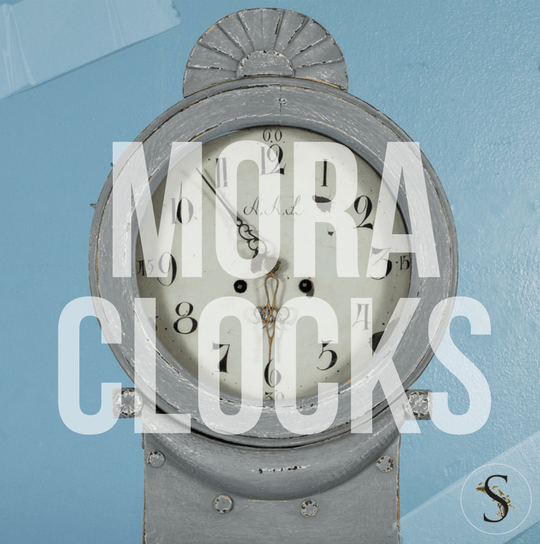
Mora Clocks: Investing In Swedish Heritage
Mora clocks are breathtaking to look at, and have become tremendously popular over the last 10 years. Swedish tall clocks are commonly called “Mora clocks” however, it is known that only clocks and cases produced in the Mora municipality can accurately bear the name of Mora. The mora clock began in around the Mora municipality in Dalara provence in a small town called Ostnor during the late eighteenth century. According to Wikipedia, Mora clock faces are often marked with the inscription “A A S Mora”—the initials of Krång Anders Andersson (1727-1799) of Östnor, traditionally known as the first clockmaker in the district of Mora.
The clock works were crafted by farmers, the first being Krang Anders Anderson (1729-99) , who needed to find additional income during the winter months. The iron mines of nearby Sala made iron affordable for the farmers to work with, which allowed the clock industry to grow. It started with a few farmers who needed extra money, but by the end of the nineteenth century the clock making business in Sweden thrived. More than 50,000 clockwork motors were produced during this time.
Each family around the region would specialize in producing one or more of the parts required for these clocks. A finished clock would often be sold without a case, in which the buyer would then have to arrange for one to be made locally. As many as 1,000 clocks were being made each year. Clock cases evolved from a straight case in the eighteenth century to a curvier form in the nineteenth century. Within 80 years, the competition from inexpensive German and American clocks put an end to this cottage industry.
Jo from Swedish Interior Design, shares some ideas on what you should look for when you want to buy a Mora Clock.
Many people’s first time with a Mora comes from the movie ‘Somethings Gotta Give’ where there is a mora clock prominently displayed in the living room scene with Jack Nicholson. Original 1800s Mora clocks are very rare now so here’s a few pointers to help you find the right one.
They are most worked in pine but very occasionally built in oak and they measure height wise from 180-250cm and feature a great wealth of decorative carvings and original paint finishes.
Each Mora clock is a unique handmade object dreamed up by the imagination of its maker so every clock has a different the hood, clock face decoration, belly shape, plinth etc .
1800s Swedish Mora clocks generally come in a number of types –
Fryksdall: These clocks have a pinched waist, wider belly, curly scroll decoration on the waist and neck and extravagant hood carvings. They come in a variety of whites & greys and would be owned by wealthier individuals.
Bridal: The most unusual of mora clocks, often from Jamtland, these pieces have the finest levels of decorative carving. They exhibit the finest level of craftsmanship in the Mora clock world.
City: a catch all phrase to describe Mora clocks that have fine levels of decoration or beautiful painted finishes that set them apart from the simpler country clocks.
Country: the country clocks are usually plainer in appearance with less decoration. Often given as wedding presents, they would be a prized possession in poorer families. Normally they have simpler hood crowns and less use of glass. They may have no face glass at all or pendulum viewing port for example. Painted in earthier folk art colors in the Swedish Kurbits folk art tradition, they show with yellows, oranges, deep russets, browns and ochres.
There seem to be 3 schools of thought in terms of paint finishes.
Some people strip the clocks back to the bare wood and repaint but that doesn’t make sense to me. Every clock has lived a history and by over restoring, you strip away its special ‘aura, it becomes just a clock body made of old wood devoid of personality making it not much different from a repro one in reality.
Also many clocks have ‘scraped back’ paint. But this is just a paint effect really. Originally the paint would have been a rich chalk paint in perfect condition, and the scraped paint ‘effect’ is just that – an interior design effect similar to ‘shabby chic’ that you see on lots of restored Swedish furniture. It looks nice but its not real!
At Swedish Interior Design, we prefer to keep the paint whenever we can as it is and only repaint where the original coat is in poor condition or it has been repainted at some later time. When we do it is sensitively done to allow the mora clock to live and breathe so to speak.
Finally you need to think about whether you want to use the original clock mechanism or fit a battery powered electric one. This may seem a strange question but mora clocks have very ‘country’ parts, unlike the precision clock mechanisms of English clocks of the period.
So they can be difficult to set up and can be affected by a change in temperature causing the wood in the clock body to shift slightly or being jolted as you walk past. This affects the swing planes and can cause the clock to stop. Also the mechanisms are open to the air and its very easy to get dust caught in the cogs.
So that’s why most of our clients go for the battery option. It doesn’t need winding and it looks exactly the same as the original from the outside. Its easy to do and there’s no damage to the clock as the original mechanism is only kept in place by small screw and you can put the original mechanism back in place whenever you like (although it will need cleaning and setting up professionally if you do).
Further Reading:
- Martha Stewart Appearance, Mora Clocks, and a Winner! Cove Table
- “Mora Clocks and Tall Case Clocks”. Cupboards and Roses. Retrieved 2006-12-29.
- “Swedish Long Case Mora Clocks”. Ryder Antiques.
- http://www.antikuhr.de The Mora Story
- “Swedish painted furniture”. Julie Foster Decorative Antiques. Retrieved 2005-12-17.

Edgar Reeves Lighting and Antiques sells this terrific late 19th century tall long case clock in Swedish “Mora” style. The clock is elaborately painted with floral details from a period perspective. “Mora” clocks are a type of long case clock which were made in, and derived their name from, the town of Mora in Dalrana provence Sweden. Edgar Reeves has this clock priced at $3,200
Leif Antiques has for sale an early Gustavian clock by Johan Lindquist who was a royal clock maker to King Adolf Frederick 1750-1771. This clock was made towards the end of King Frederick’s reign and is a prime example of Lindquist’s work and the beginning of the Gustavian Period. This clock is in exceptional condition and is priced at $80,000
- A Tyner Antiques
- Judy Frankel Antiques
- A Tyner Antiques,
- Dawn Hill Swedish Antiques
- Lillian August Designs,
- Liza Sherman,
- Jacqueline Adams Antiques
- Talisman,
- Scandinavian Antiques,
- Carl Moore Antiques
- Scandinavian Antiques & Living,
- CUPBOARDS & ROSES Swedish Antiques,
- CUPBOARDS & ROSES Swedish Antiques
- Scandinavian Antiques & Living,
- Lillian August Designs
- Laserow Antiques,
- Stair Galleries ,
- A Tyner Antiques
- A Tyner Antiques
- Scandinavian Antiques Co On Ebay


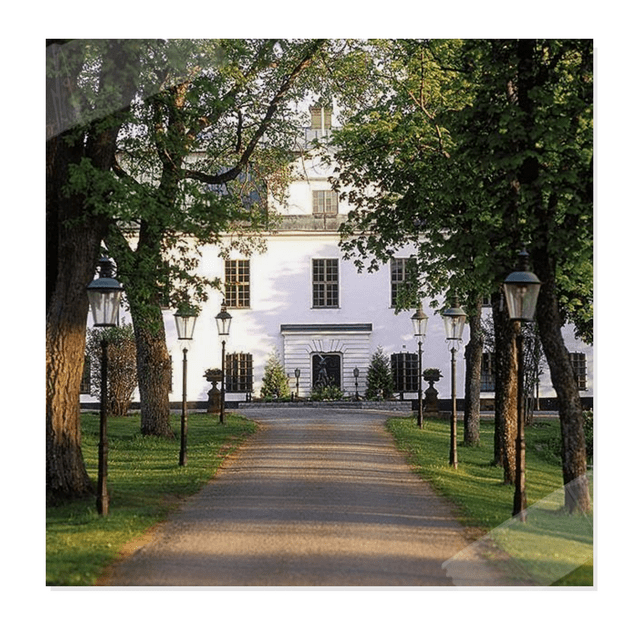
The Lavish Interior Of The Swedish Häringe Castle
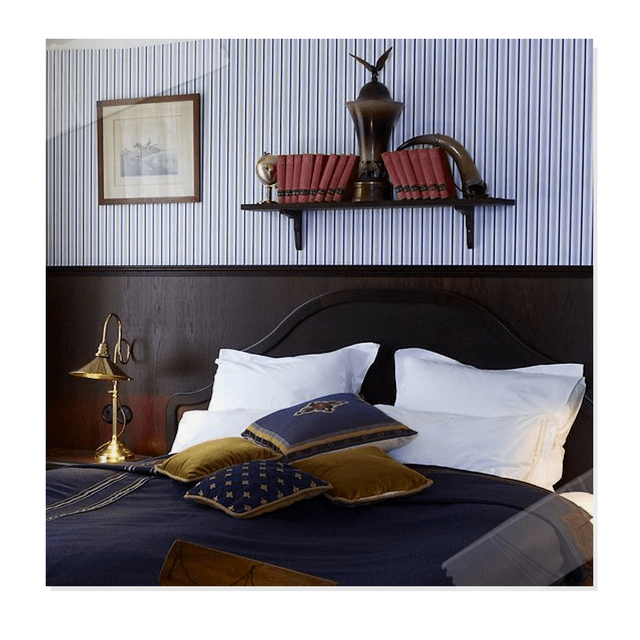
$11M Stockholm Palace is Made for ….Curbed

$11M Stockholm Palace is Made for ….Curbed
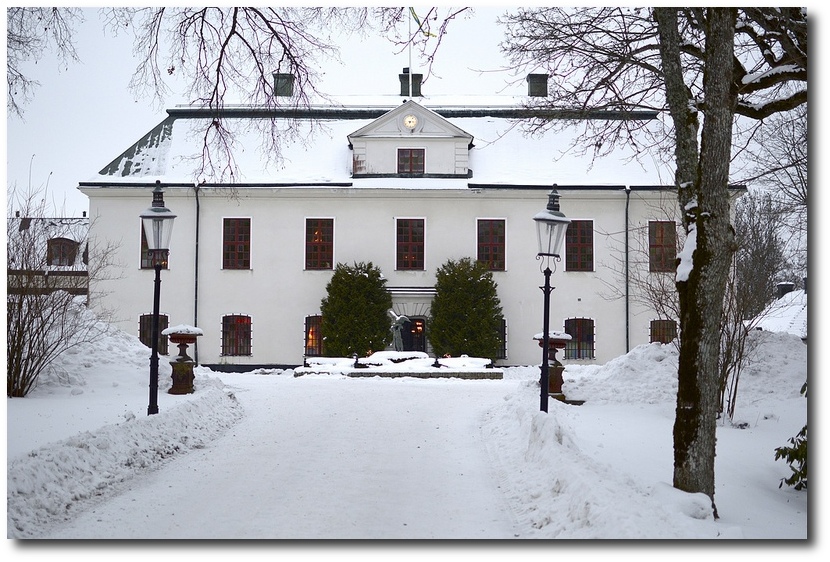
Häringe Castle- mogi.metromode.se
If you want to explore near Stockholm Sweden, consider visiting the Palace-turned-hotel Häringe Castle. This stunning 17th-century baroque castle- hotel just 45 miles outside Stockholm is located near a nature reserve. Historic lore suggests that Vikings first claimed the Häringe Peninsula as property in the 11th century. The estate has belonged to many famous people as King Gustav Vasa, Gustavus Horn, and Axel Wenner-Gren. Häringe was a ship yard during the time of King Gustav Vasa and probably even earlier. Häringe manor consists of the castle garden and park facilities, farm buildings, staff quarters, the farms and active farmland. Häringe is a very important link to the City’s history, and is a national tourist destination.
The main building was originally built in 1657 by Field Marshal Gustav Horn. The south wing was built slightly earlier when the castle was built. The castle got its present appearance at a major refurbishment in 1770. Häringe sat as an estate from about 1770 until 1929, when it was bought by the newspaper man Torsten Kreuger. Kreugar added the landscaping and the swimming pool.
After Kreuger, Häringe was bought in 1934 by business and industrialist Axel Wenner-Gren and founder of Electrolux. He filled the mansion with expensive furniture, and it was said he also built the road leading up to the estate. The Wenner-Gren had Häringe many famous guests like Greta Garbo, Danny Kaye, Karl Gerhard. At one point, all the furnishings were sold by one owner, only to be researched and re-purchased by another one years later. After Wenner-Gren’s death in 1961, the lavish furnishings disappeared. The new owner, crab importer Olle Hartwig, pored over Wenner-Gren’s photo albums, and was able to re-purchase most of the items.
Häringe castle is located in open countryside between Landfjärden and Bobäcken. Häringe estate was in the early 1900s, one of the largest in the county. The manor house, which has its origins in the mid-1600s, is today a whitewashed two-story building with mansard roof. It has separate wings on both the north and south side. On the south side there is a large swimming pool and remnants of very old trees. Beyond the grandeur interior, the property lead the way to feature Sweden’s first outdoor pool with a slide from the second floor bathroom, as well as a bowling alley and underground tunnels.
North and east of the castle are a dozen red-painted farm buildings of different ages, which at one time meet the housing needs of the property. These are dominated by a large barn from 1946. On the castle’s west side are the remains of a garden with statues from the Wenner-Gren at the Castle (1934-1961).
There is also a nature reserve south of the property called the Häringe-Hammersta. The land in the nature reserve owned by the Archipelago Foundation. The land immediately surrounding the castle is privately owned. Today the palace is used for conferences, as hotel accommodation. This castle turned hotel is owned by the Ljungberg family since 1999 and is part of an exclusive hotel chain.
Information gathered from Haninge.se
- Website: Häringe Palace
- E-mail: info@haringeslott.se
Additional Links:
– A Bridal Party At Häringe Castle – 2bridesphotography.com
– Most interesting pictures tagged “häringeslott” on Flick River
– An Enchanted Castle in Sweden –remodelista.com
– An Enchanted Garden in Sweden- www.gardenista.com
– Sweden’s most haunted castle: Häringe – Network Europe
– A night at Haringe Palace –Live Like You
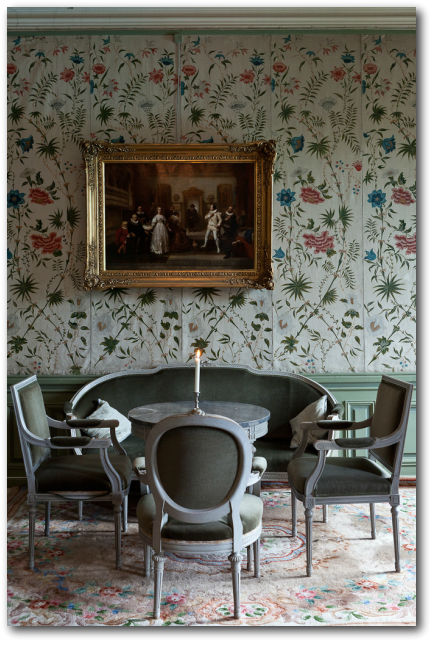
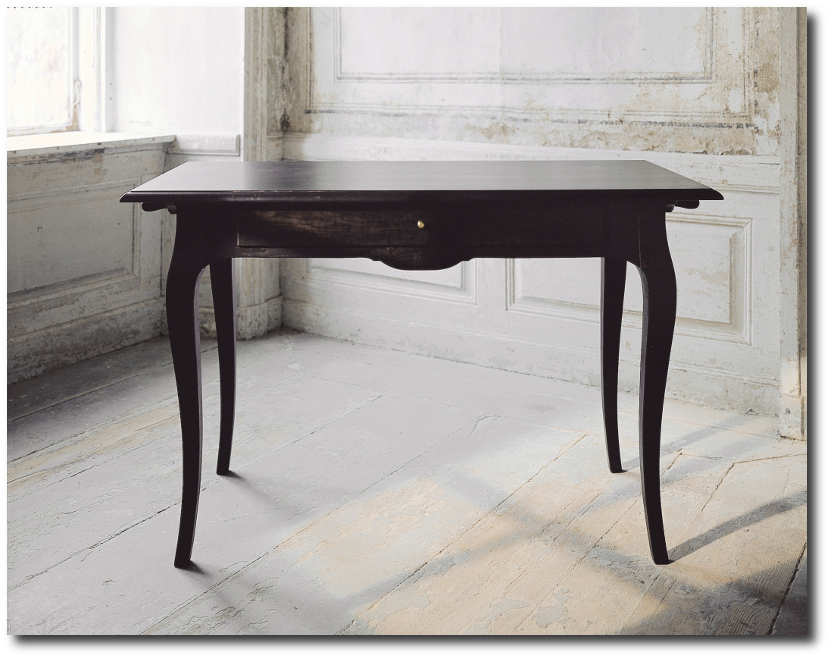
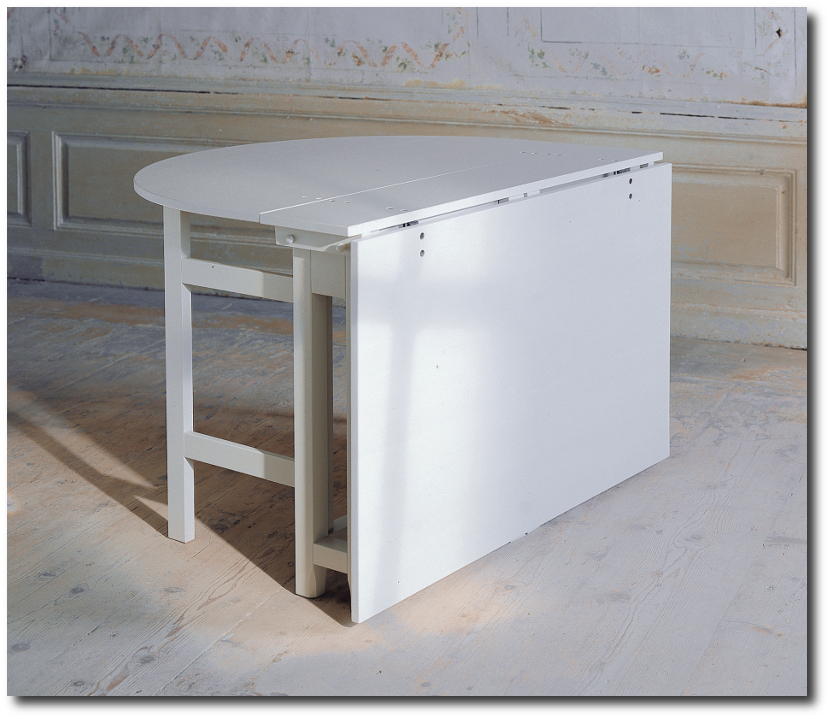
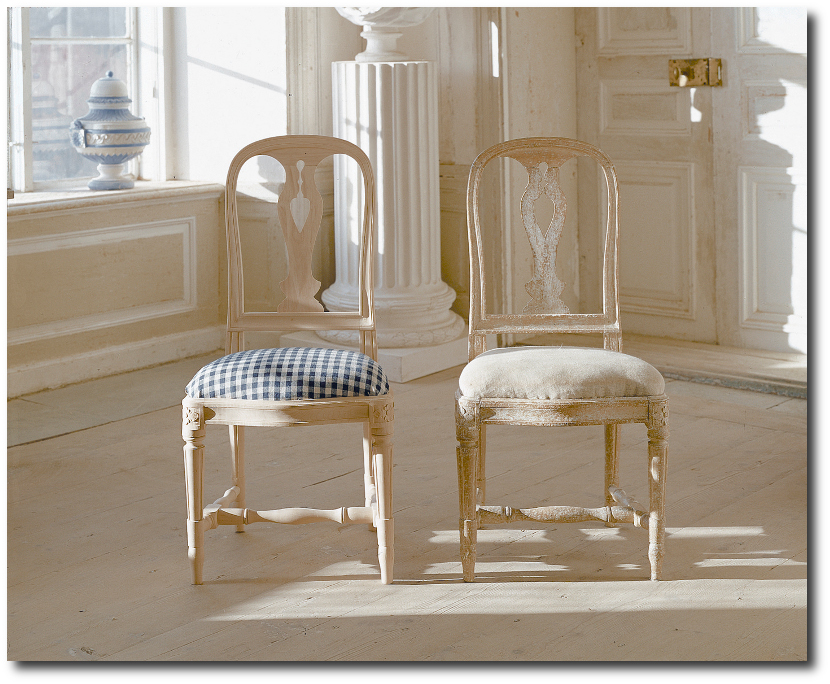
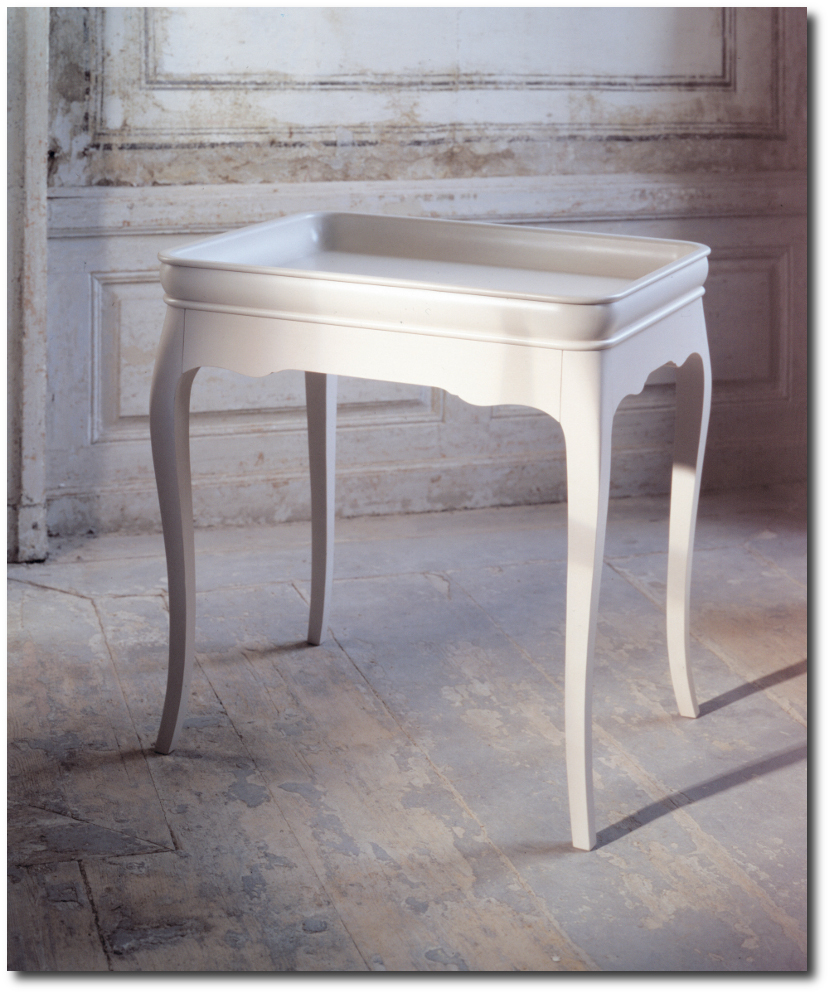
The 1700 Collection Swedish Furniture
The 1700 Collection Swedish Furniture produces furniture that combines the elegant shapes of the furniture found in 18th century Sweden. With the cooperation between the Swedish National Museum of Fine Arts and furniture manufacturer MOVE Möbler & Bohag, they created several authentic replicas of selected pieces of furniture originating from Swedish castles, manors and salons of fashionable health resorts.
The craftsmanship behind each handmade piece remains true to the original. Skilled woodworkers sign each piece next to the seal of the National Museum of Fine Arts. The furniture is made from the woods found in Sweden such as birch, alder and pine.
If you are hoping to purchase a reproduction that is as close to the original antiques, the 1700 collection is deeply rooted in the 18th Century. The collection is a preservation of the Swedish cultural heritage, also giving you an elegant piece of furniture from this era.
Möbler AB
Smyge
Strandv. 71. SE- 231 79 SMYGEHAMN.
Sweden

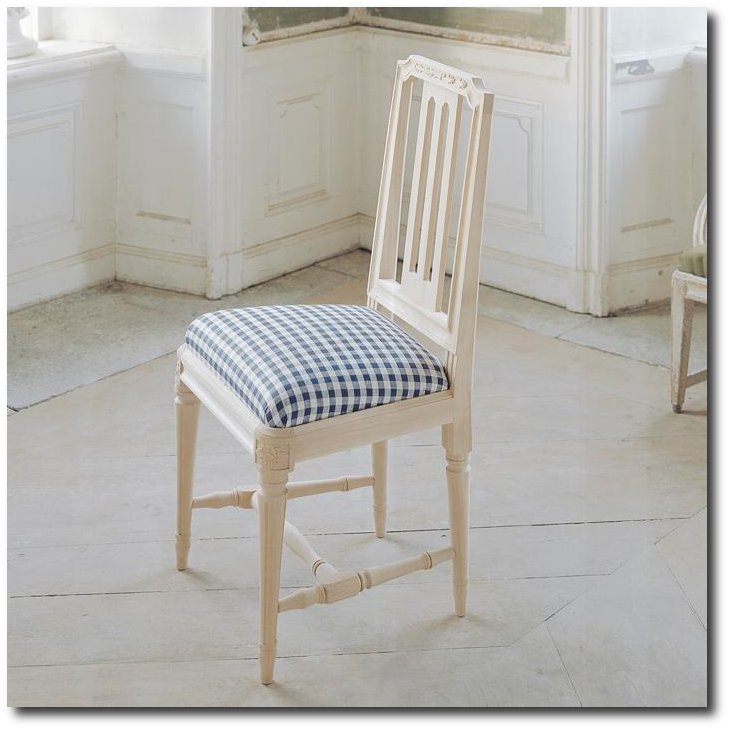
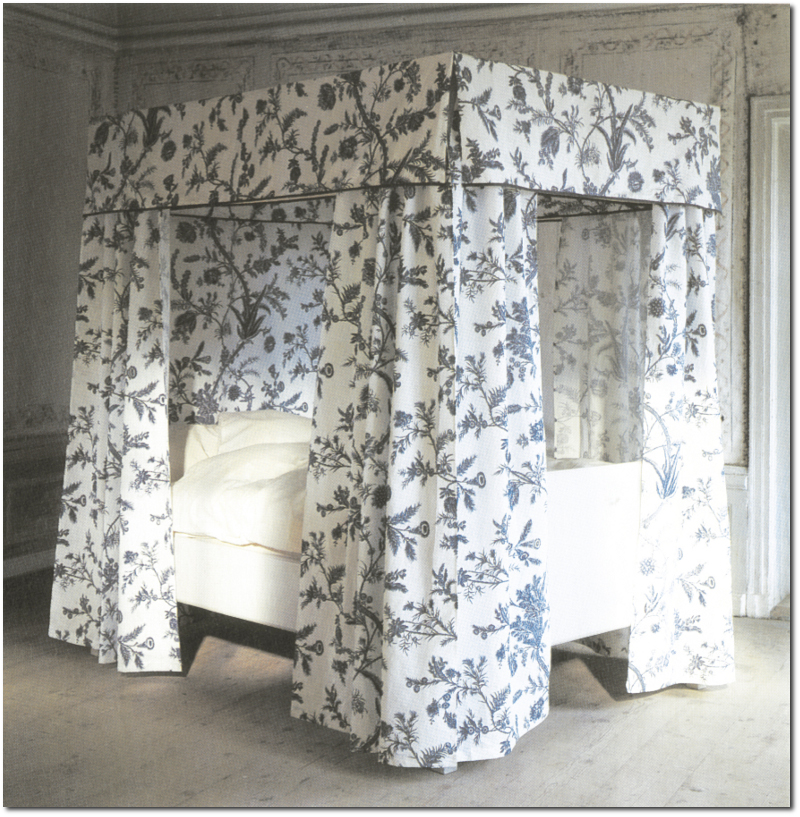
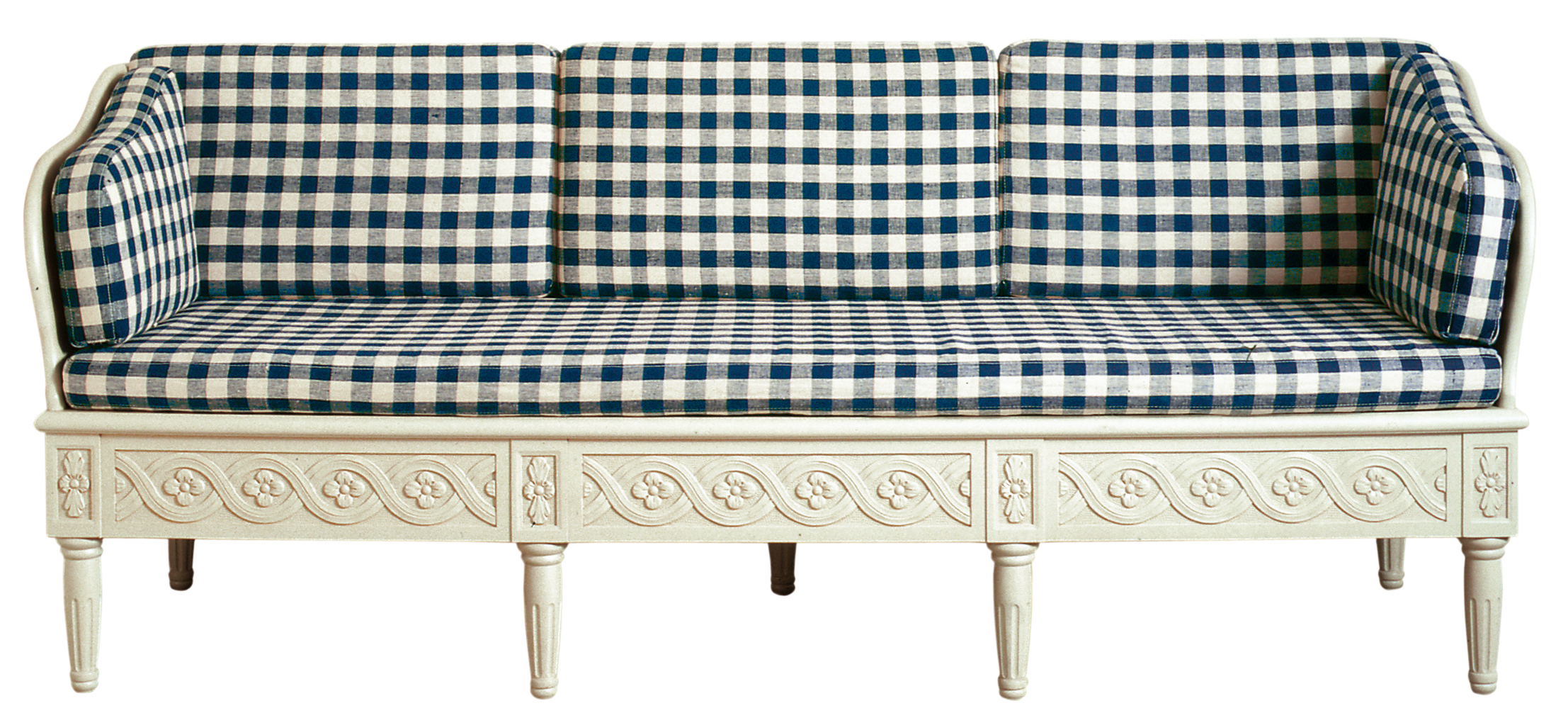
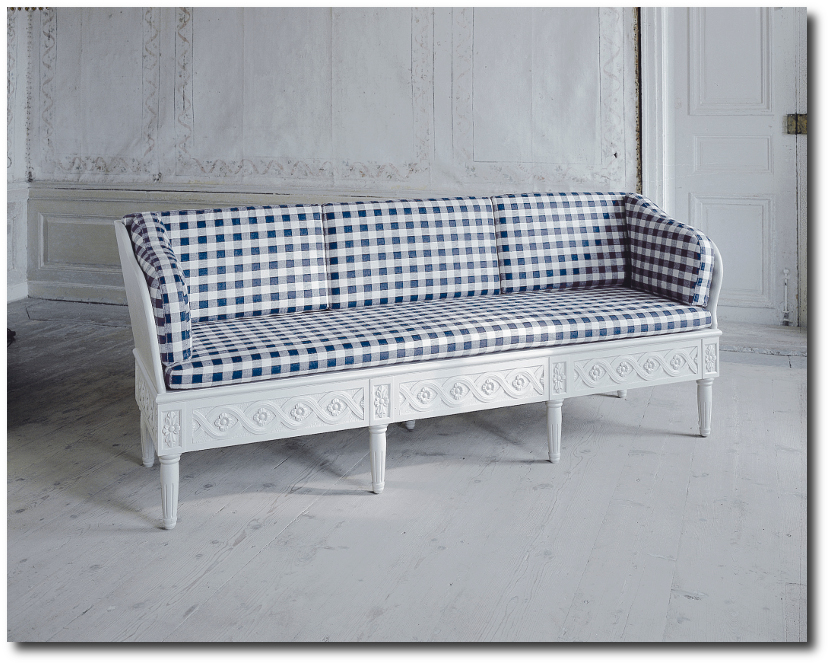

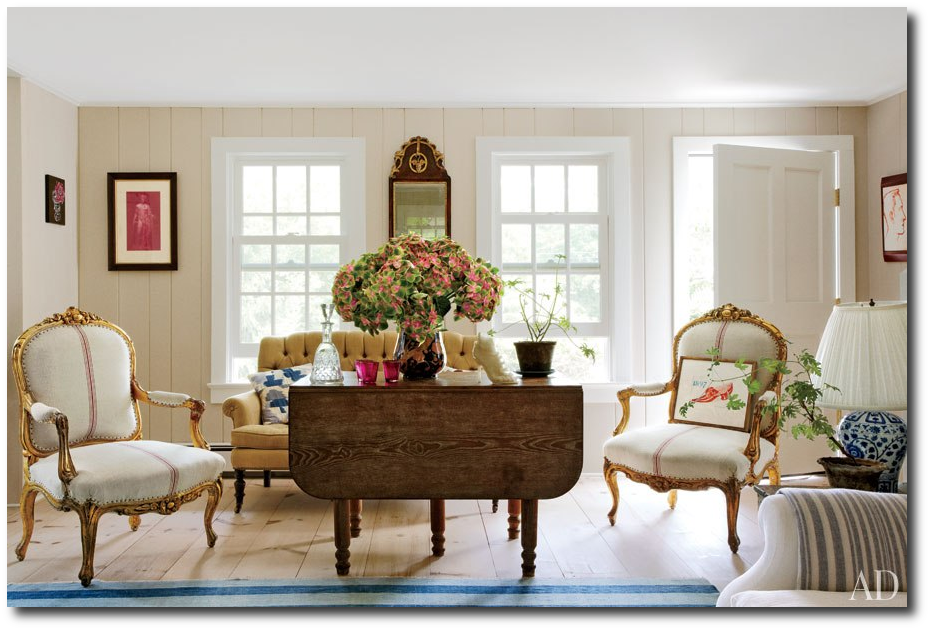
Daniel Romualdez’s Swedish Montauk Home
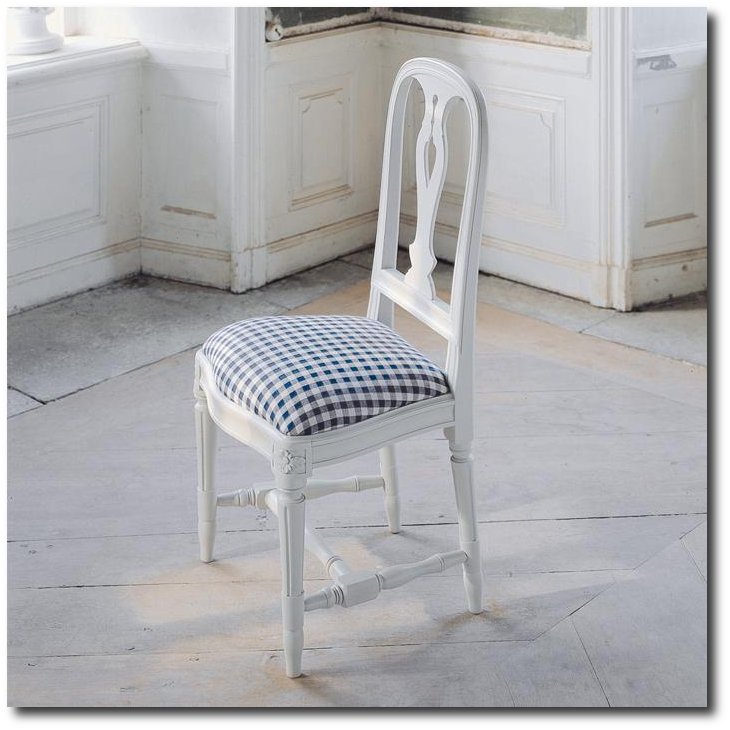
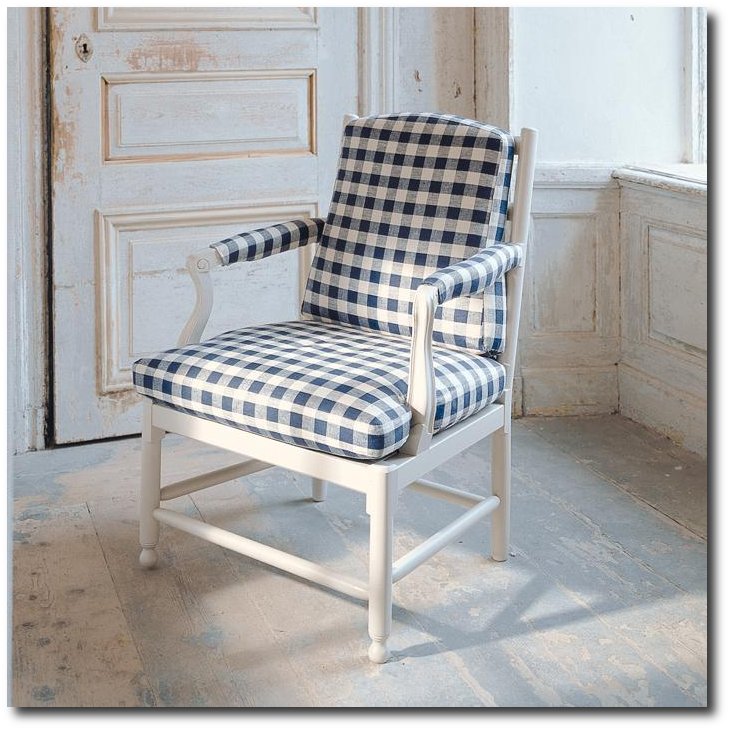
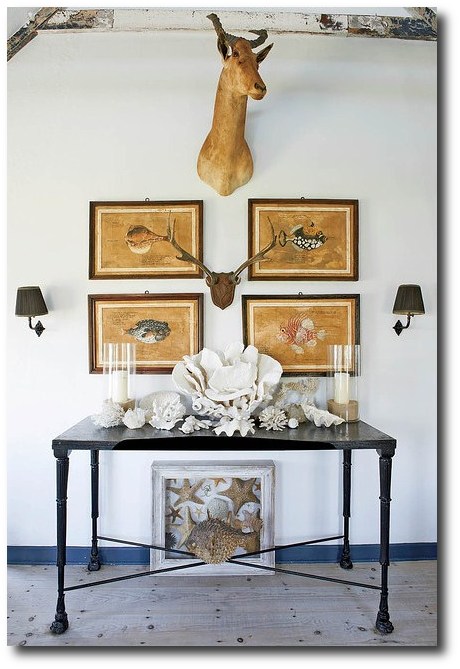
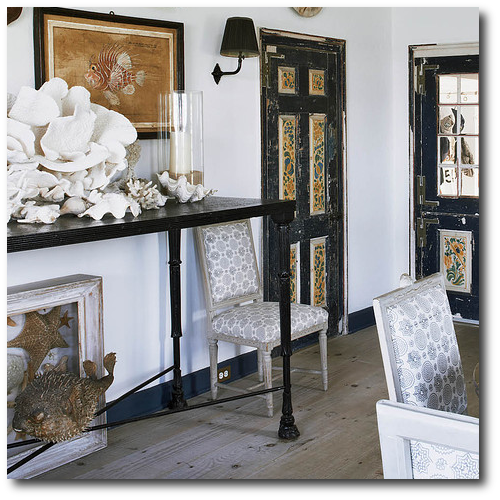
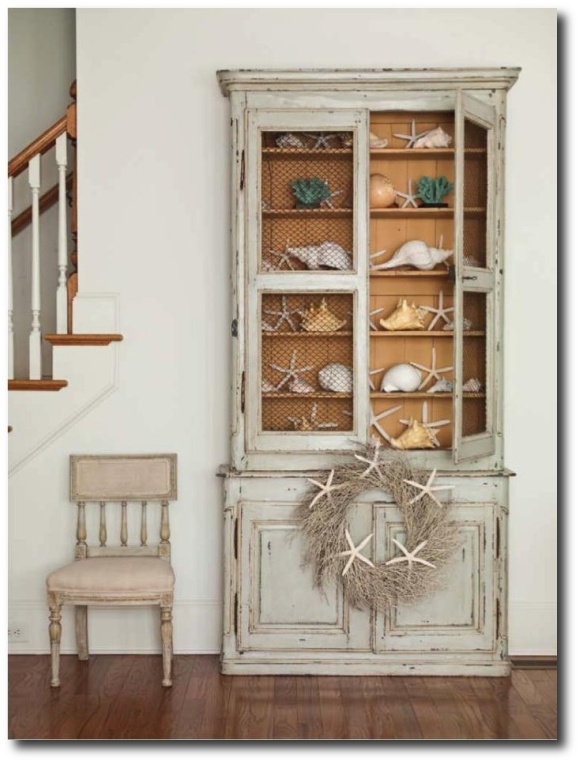
It is no doubt that the hottest designers are using distressed Gustavian furniture in their own homes. Designer Daniel Romualdez is one of those designers. His Montauk, New York home also shows off a captivating white based interior. Romualdez breathed new life into the home using only splashes of blue, white and black. The main dining room shows a beautiful collection of seashells in weathered frames. The room is furnished with 18th century Gustavian furniture with a geometric blue and white upholstery. Most of all the pictures we picture below are credited to the Wallstreet Journal. Here are a few links to this homes interior from Corbis. Here is a picture of the stairway that was installed in limed pine, in line with the Swedish styles found through the house.
Decorating with seashells can add a natural touch to your home. Here are 10 tips to getting a high end look with seashells:
1. Paint your walls in soft pastels. Keeping the wall color light will create a serene feel and allow you to play off the colors found in the lighter natural tones of seashells.
The ocean and the sky are both blue, so blue should be incorporated into the color scheme. Borrow looks from Daniel Romualdez’s home by choosing upholstery in blue and white. White based backgrounds for upholstery choices keep within the classic textile choices found in Sweden.
-Light blue or green walls are also great colors for a room decorated with seashell decor.
-If you do use brighter blues, consider using it in an accessory as Daniel Romualdez’s does with a vibrant floral centerpiece. Add layers of duller blues in your rooms with accents of brighter tones of blue sparingly.
2. Mix in reds, oranges, and golden hues within your home decor to provide a contrast to the white walls, and white shells such as what Daniel Romualdez’s does with the black hand painted doors, and black frames on the walls.
3. Consider installing wall panelling, which can be stained in a soft cream or white. Wood adds an organic layer that is commonly found in Swedish decorating. Clean, brilliant white walls make a great backdrop for bold color splashes or natural wood accents.
4. Sofa or floor pillows incorporate the feeling of comfort. This Sea Shell Linen Pillow Cover with Jute & Mother Of Pearl Embroidery has both the linen fabrics found in Swedish decorating, as well adds a bit of the pearl shine we find in the sea.
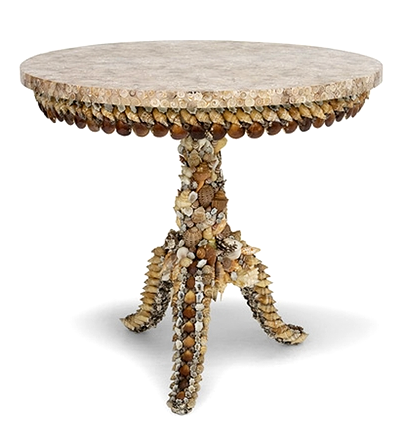
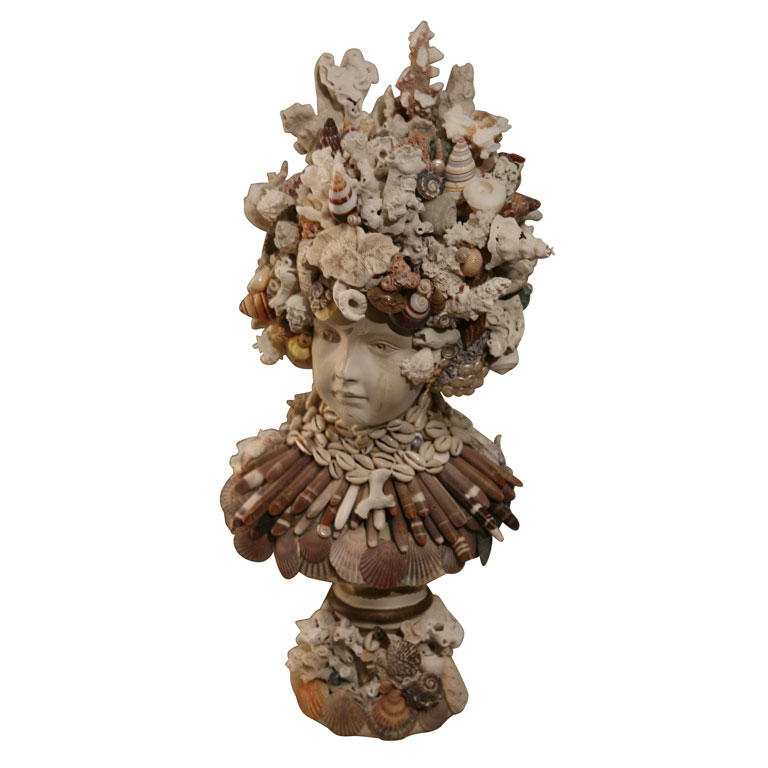
5. Cover furniture or home decor with shells. A neoclassical bust with smaller seashells is a sophisticated approach to using shells in your decor. All you need is a nice looking neoclassical bust, hot glue and a variety of seashells.
-Make a crown for the bust or display it on it’s own.
–Here we see a rustic bust, with a seashell crown.
–Here we see a mirror made with hand collected shells and Ikea mirror frame. All the shells are facing the same direction rather than the sporadic placement that we see with seashell art.
–Here we see a beautiful floral display with an urn decorated in seashells
Plaster Busts on Ebay
7. Consider presenting your collection of shells as a display on your wall with corbels. Instead of displaying the smaller shells, collect the larger seashells, which can make more of an impact. Swedish decorating is known for clean, uncluttered looks, so bigger shells are better in a Swedish scheme. Corbels can be rather expensive, but there are ways of getting corbels that match without spending $300 on each corbel. Make your own shelves for pennies with concrete molds such as this one from Mold Creations. Concrete Success has the perfect mold shelf featuring a sea shell in the design, selling for $34 dollars. This allows you to make endless shelves for your collections, without spending any more than for the mold itself, and the plaster or concrete.
Interesting Finds on Ebay And Amazon
– This square sea shell mold would be a rather interesting texture to cover an entire accent wall in a bathroom with. It has a rather primitive fossil quality to it.
-Silver Tone Decorative Spiny Jewel Nautical Sea Shell Home Decor $27
-Luxury Lane Hand Blown Art Glass Seashell Centerpiece 7.5″ tall by 12.5″ long $25
-White Pearlized Chambered Nautilus Sea Shell Decor 5″ – 6″ $25
-100% Real Sea Shell-4.5″ Original From Haiwaii,$9
-Small Brass Compass Rose Nautical Wall Plaque $50
-Bathroom Decor- Set of 3 Decorative Clear Glass Bottles with Nautical Sea Shell $71
-Luxury Lane Hand Blown Art Glass Seashell Centerpiece 4.5″ tall by 9″ long $25
-Aluminum Sea Shell Decor 4″H, 10″W $36
-Round Rustic Wooden Nautical Porthole Mirror– $70
-Set of 2 Seafoam Green and Cream Sea Shell Pattern Rustic Aged Decorative Bowls $110
-Gorgeous Set of 4 Mini Sea Shell Covered Spheres $48
-Decorative Wooden Paddle $19
-Wooden Nautical Sailboat Yacht Model w/ Shell Sail $24
See our other post Daniel Romualdez’s Breathtaking Late-Eighteenth Century Farmhouse
- Display cabinet with Shell Collection- vine.wisteria.com
- Dark Blue, Striped Scotchgarded Outdoor And Indoor Fabric By The Yard – $23
- Reversible Floral Upholstery Grade Fabric By The Yard – $29
- Fabric for Upholstery Suzani Blue & Beige 54″ $19
- Daniel Romualdez’s Montauk Home- An Outdoor Pergola –Wallstreet Journal
- Daniel Romualdez- –Wallstreet Journal
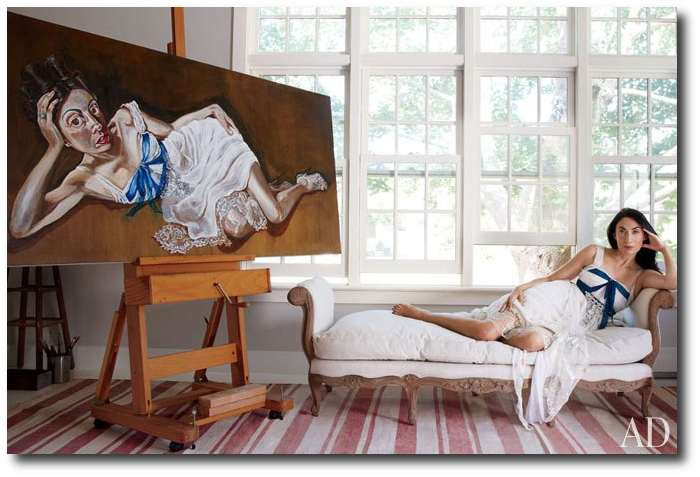
- Anh Duong Renovates Her Cliff-Top House In Montauk With the help of Daniel Romualdez
- Read More at GQ Magazine
Daniel Romualdez’s Montauk Home-www.williamwaldron.com
Another View Of This Room From www.corbisimages.com
You can see the trim was painted blue, and the floors limed. In addition, the doors were touched up.
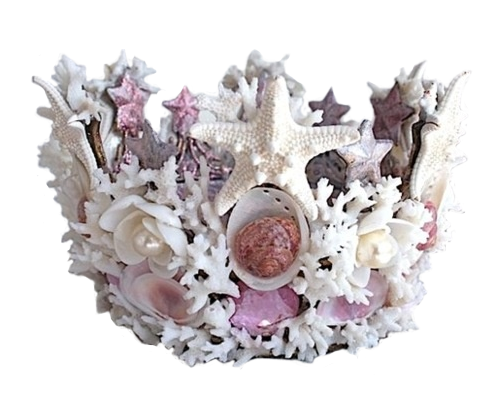
Consider Topping A Bust With A Seashell Crown
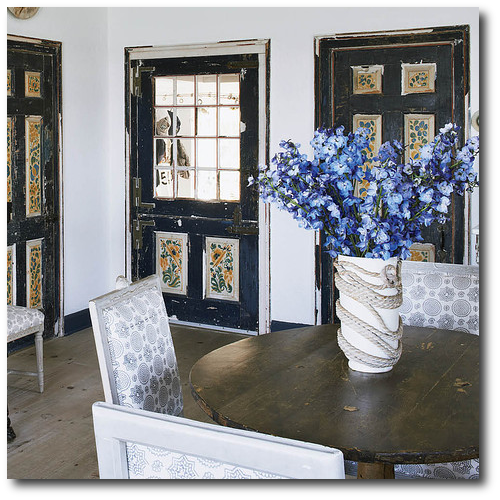
Swedish Furniture UPCLOSE Wallstreet Journal
Fanciful Sea Shell Bust- www.berkshireantiques.com
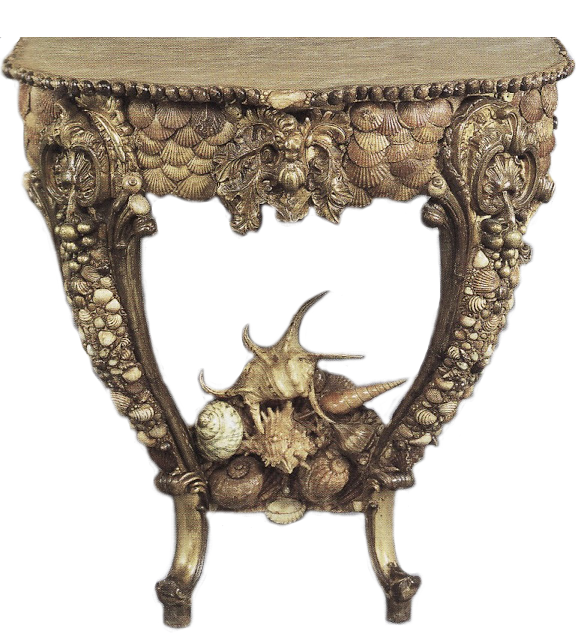
Louis XV Console Table Covered in Seashells-chintz-of-darkness.blogspot.com
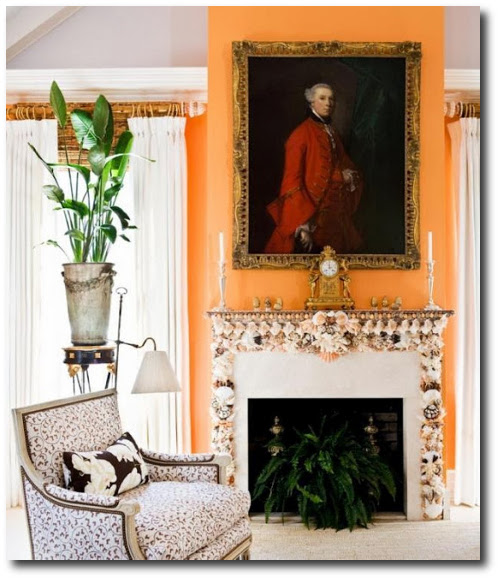 Mimi McMakin, founder of Kemble Interiors.
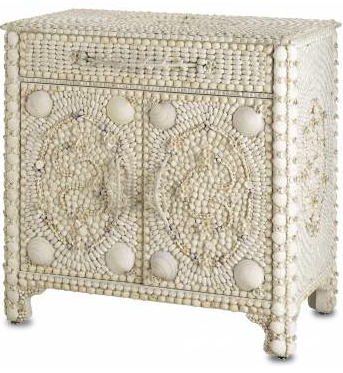
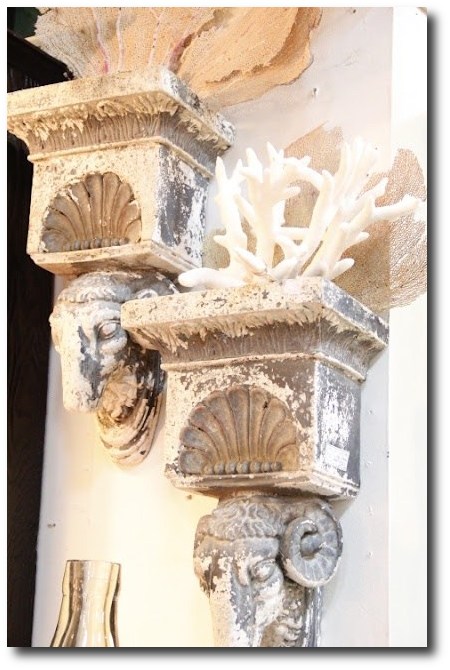
Corbels holding a collection of seashells-debrahalllifestyle.blogspot.com
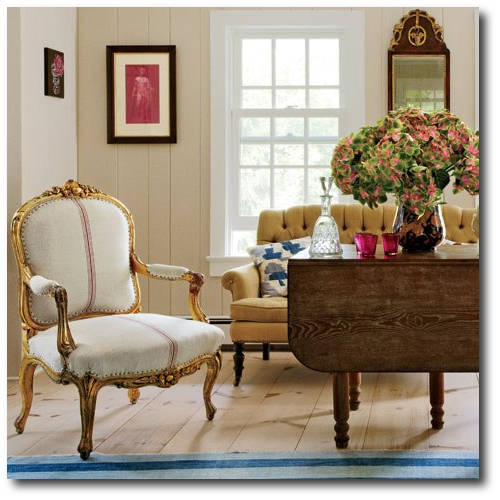
Anh Duong Renovates Her Cliff-Top House In Montauk With the help of Daniel Romualdez
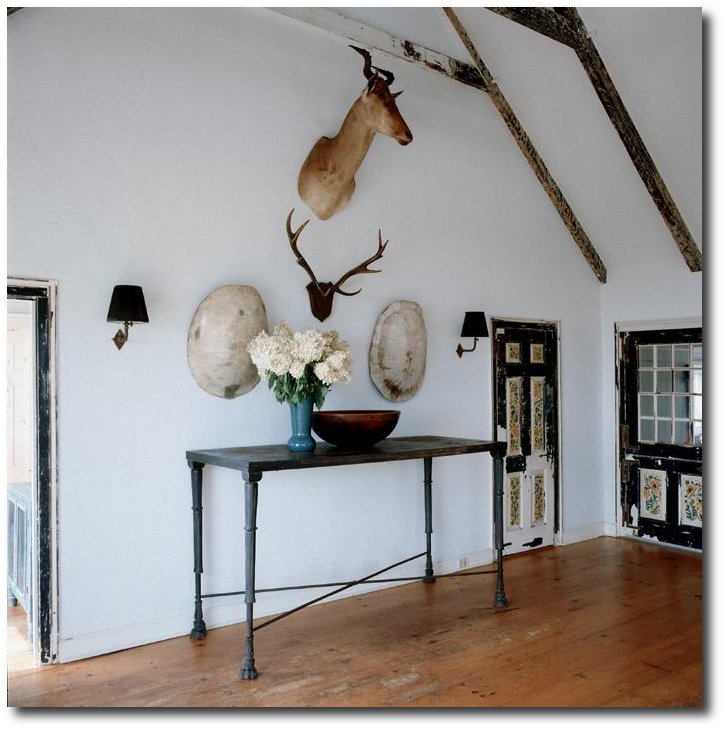
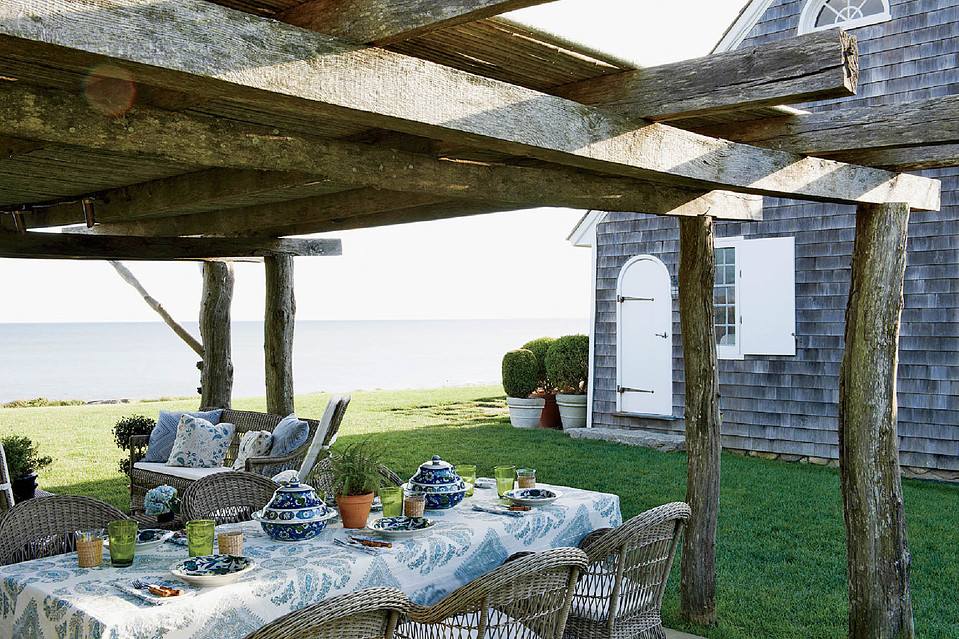


Ruby Beets Swedish Rustic Home
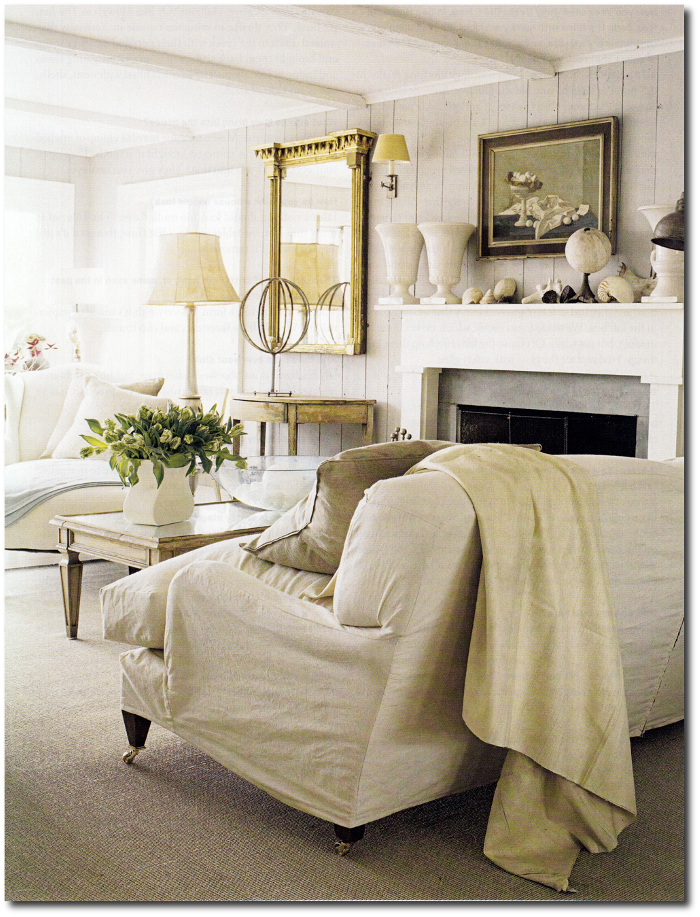
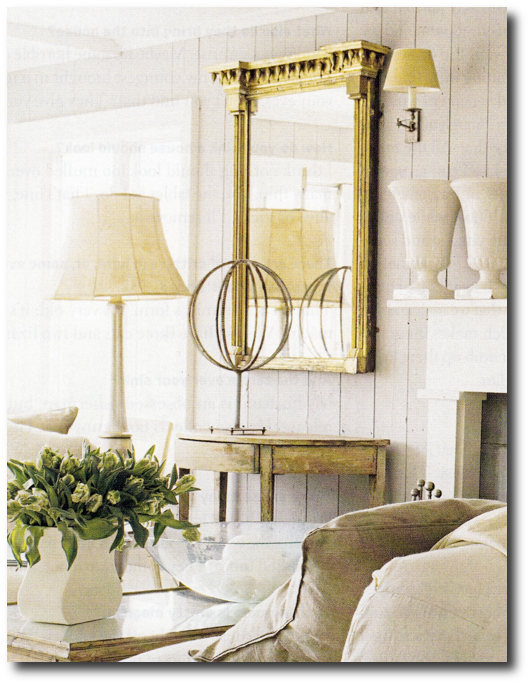
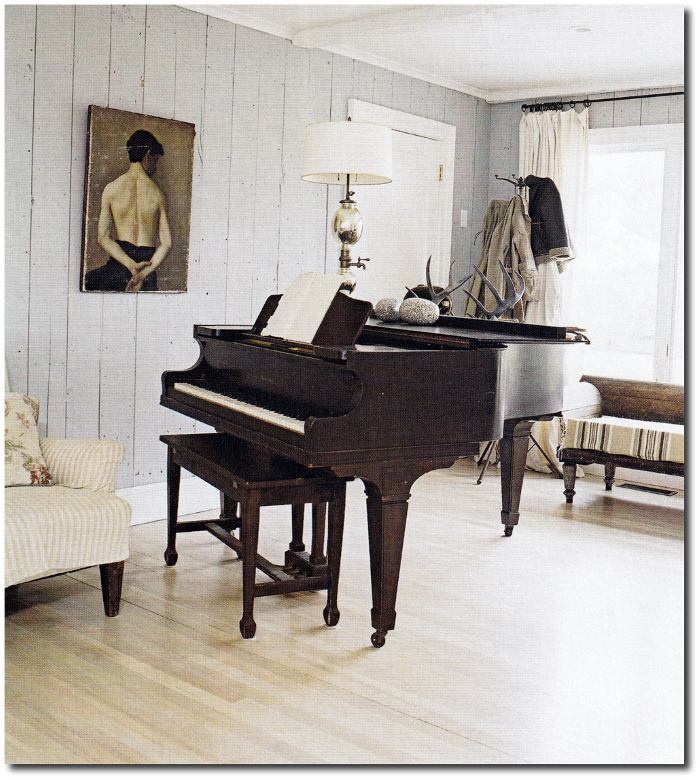
In a corner of the living room, a 1940s mercury glass lamp stands on a rough, round Empire-style table next to two 1920s Scandinavian painted chairs. The graceful wing-backed chaise dates from the 1930s and is upholstered in simple white canvas duck, with natural linen pillows from Ruby Beets.- House Beautiful Magazine
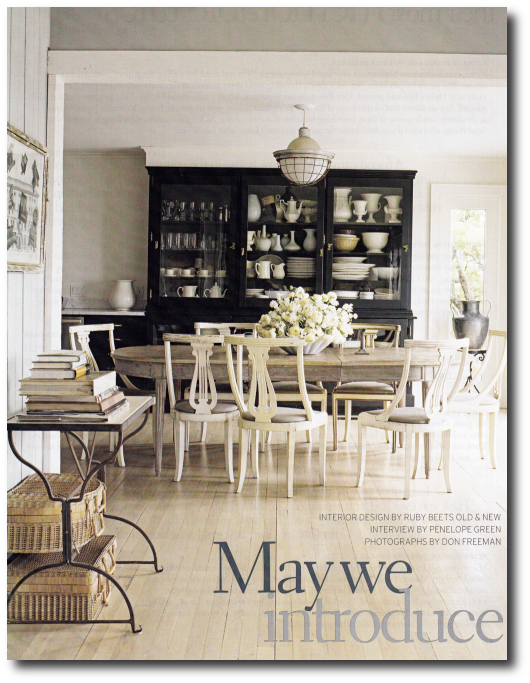
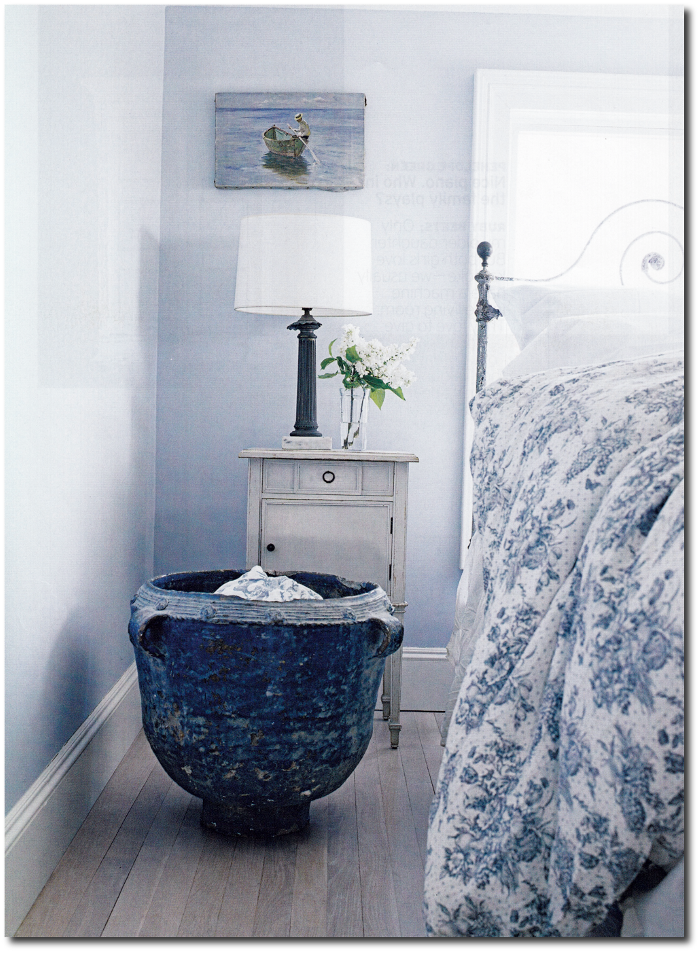
If you haven’t ever seen Ruby Beets home, you are in for a treat. Featured in House Beautiful Magazine back in July of ’06 , this house has the perfect mix of old world charm,and rustic surprises that make it very interesting to the eye. The raw painted furniture, iron decorative items, wood panels and paint color choices are particular elements of the interior styles found in Sweden.
If you enjoy the country cottage looks, but want something more upscale, borrow ideas from this home. Here are a couple suggestions from this interior.
1. Have Slipcovers Made- Spend the extra money and have tailored slipcovers made that will give you the comfortable feel like this home. Swedish textiles were mostly made from organic materials. Consider materials like muslin, duck, or canvas. Many people are taking drop cloths sold in hardware stores and bleaching them. Today you can buy pure white duck or canvas cloth in off white, and various shades of cream, and blue amongst other colors.
2. Invest in Great Antiques– I am not one of those people who are afraid of touching antiques. My best advice, is if you find a sensational chair, improve it and make it your own. Buy the upholstery fabric that makes you happy. Buy the hardware that you will enjoy looking at day after day. Make it YOU!
It is amazing what a strip job will do for your wood furniture. Taking off the varnish will allow the paint to sink into the wood, that when you do to distress the wood, the overall finish looks so much better than painting it alone. For years I have used a chemical stripper until I bought a heat gun, and I never knew that stripping furniture was soooooo easy and fast! If you want to get a rustic look for your furniture, working with the bare wood is the ticket to high quality Swedish looks.
3. Use Black Somewhere- Swedish interiors are usually based around light colors such as blue, light greens, gray and so forth. You would be amazed how nice black stands out against a lightly colored wall. I used to love black painted furniture, that everything was painted black until I fell in love with lighter painted furniture, and all of our furniture was repainted in white or gray. Our walls in our house are painted a light blue, and after debating what color to paint a hallway floor clock, I decided to plunge for black, and was it ever a great decision! Everyone comments on it, because it sure stands out against the lighter colored walls. Contrast can be a surprise! Black colored furniture looks exceptionally well in lighter interiors. Even if you have just one piece in black, it can look sensational!
Here are some of the comments from Ruby Beets featured in Home Beautiful that were particularly interesting
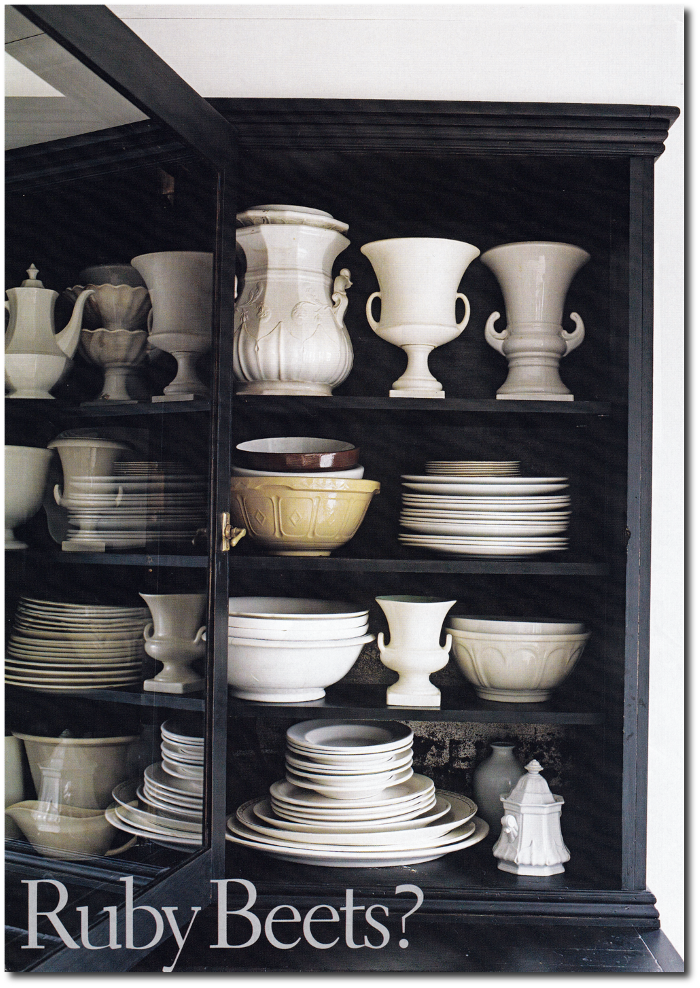
“I was a vintage clothing dealer in the’70s. I’ve been buying old stuff forever. Ruby Beets used to be about the found object school of antiques. My partner and I would buy a dresser and it would have peeling paint and we thought that was romantic. But now we want the drawers to work—enough with the drawer bottoms falling out! The new store is a cleaner, more modern and edited version of what we used to do. My house is too. Life is irritating enough at a certain age. Anyway, I like a lot of white, you can see that. All the furniture is slip-covered in muslin or cotton duck so I can remove it and wash it, which I do every six weeks. I guess, unless something horrible happens. I like big graphic shapes. Those white dishes and things in the kitchen cabinets, some are vintage and some are new ironstone, which we carry in the store. That cabinet we
bought from the local hardware store here. It went out of business, and they had 52 feet of glass cabinetry that we took and put in the kitchen. ”
“When you walk in, you don’t know what age the house is, but it feels like something old. I love it because it feels transparent inside. Hie boards are painted gray like the sea in winter, and because we have no near neighbors we have nothing on the windows—you can see from the front door all the way through to the water at the back. You can see a lighthouse in the distance. The girls used to say they lived in a lighthouse.”
“My husband is an obsessed fisherman, but he’s catch-and-release. He also collects taxidermy fish. He probably has 50 or 40 in his office.”
What is the significance of the name, Ruby Beets?-“Oh. I don’t know. I made it up years ago. But it’s catchy, right?”

4 Resources For Swedish Decorating
Swedish furniture has been sensationally popular the last 10 years as a style that is fresh for decorating the upscale home. Gustavian style has appeared in some of the more prominent decorating magazines in the US such as Veranda, Architectural Digest, World of Interiors and even more frequent in European magazines such as Campagne Decoration.
The casual appearance of lighter colored painted furniture has been popular for centuries. France was credited with the influence of the Swedish furniture in the 17th and 18th century. Many of the formal pieces found in the palace of Versailles were made over in the same shape and form, but painted instead of stained wood. The decadence of the French furniture couldn’t be copied because it was too costly for Sweden at the time, as well as Sweden has their own taste in mind.
In France, side tables were constructed from the most costliest woods, with decoration that took hours if not weeks to complete. French cabinet makers through the 17th century used techniques such as inlay, (pictures cut from ivory or wood, and set into wood), or marquetry, ( veneer composed of numerous woods, and stained which produced a pictorial mosaic), lacquering and japanning, (the application of numerous layers of varnish) were all costly, and time consuming.
While France had the best of the best, some say Sweden did a better job of re-interpreting the design elements seen in France such as the furniture by scaling down the formality. Linen was used instead of silk, paint was used instead of the stained wood, and faux painting replaced marble walls.
Borrow Interior Design Elements From Sweden For Your Own Home
Marks Of The Swedish Style
1. The Use of Paneled Walls (But In A Different Way)
The French were known for their paneled walls. Paneled walls are well known to be the most expensive and rich form of all wall treatments. Originally they were hand carved out of wood, as labor was inexpensive in the 1700′s. Today much of the decorative baroque looking ornaments are made from plaster. Wood panels once served to insulate a room from the cold stone frame of a building. It is also quite apparent that paneling was installed for decorative purposes as well.
Boiserie is the term used to define ornate and intricately carved wood panelling seen in some of the well-to-do French estates. The earliest known examples of boiseries were unpainted, but later the raised mouldings were often painted or gilded. For a great example of painted paneled walls, look at Charles Spada’s Country Home, which gives some great examples of 18th century color combinations. Martha Stewart shows a wonderful example in a green palette. A very formal dining room is done up in blue, and arches painted in oranges and pastel blush tones.
Boiseries were popular in seventeenth and eighteenth century French interior design and the Palace of Versailles. The panels not only appeared on the walls, but were also used to decorate doors, frames, cupboards and armoires as well. Often pictures would be set into the boiseries, the carving framing the picture rather like a conventional frame.
Decorating With Paint -Get This Look For Less….
Many of the wealthier Swedish people borrowed this look for their estate homes. Costly wood paneled walls were a far stretch for many of the Swedish people in that day, as it is for many people today. Paneled walls can cost thousands, and be tremendously time consuming.
Why not fake it with paint?
The Belvedere in the park of the Petit Trianon shows a fine example of what a person could do with paint to simulate the heavy ornamented look of the French style.
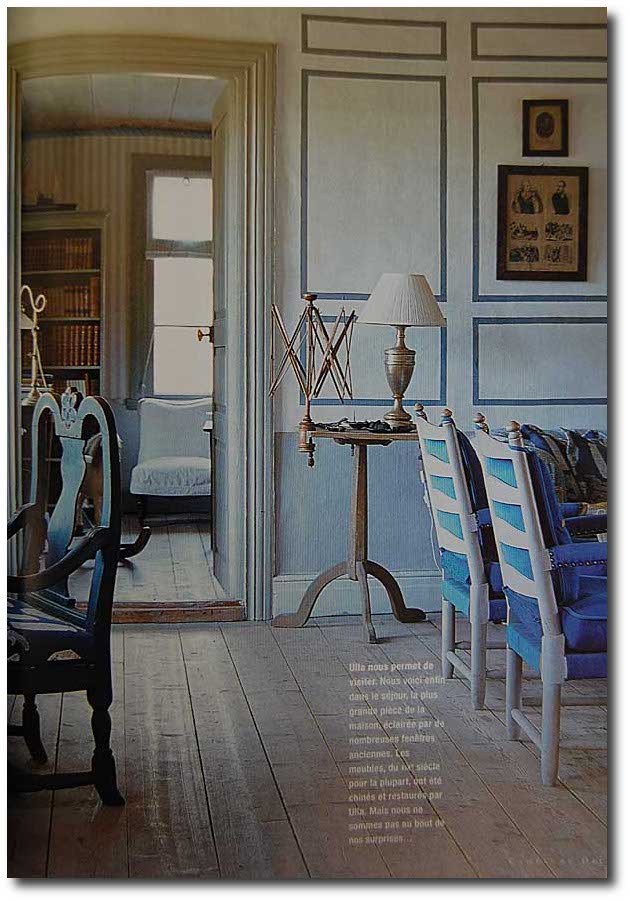
In Lars Sjoberg’s house featured in Country Style by Judith and Martin Miller featured walls with blue frames around them. Using two painted frames simulates the look of framed walls. Further in the post, you can see many more frames painted on the wall which do a beautiful job of showcasing furniture placed in front of it.
Picture Featured in Campagne Décoration
In the USA we have a chain of stores called Habitat For Humanity – Re-stores which carry all sorts of architectural elements from wood screens, to paint, sinks, and so forth, which are heavily discounted.
Here we see the paneled wall idea made from doors which are positioned side buy side. Consider purchasing similar styled doors in sets of 3, 5, or 7 which can be linked together using door hinges. As you can see here, it works!
Picture Credits– A Special Thanks to Aged And Gilded Blog, TweedlandThe Gentlemans Club, And
Lars Sjoberg’s Book- Classic Swedish Interiors
Here are some companies to keep in mind:
1. Decorators Supply– They have over 13,000 designs in their carving library. For over 100 years they have specialized in creating finely detailed composite replicas of the hand carved wood ornaments found in the most extravagant homes.
2. Bailey Interiors.com – Decorative Plaster Ornaments and Claws
3. Beaux-Artes offer decorative wall panels which can be used on walls and ceilings. Their products are cast from historic ornamentation and are available in over 20 different Finishes.
4. Victoria Larsen offers a number of ornamental frame molds which allow you to make dozens of your own molds in the privacy of your home. She also offers raised plaster stencils for the wall in a variety of patterns.
Consider a yearly subscription to Veranda, Architectural Digest, World of Interiors and Campagne Decoration.
We will be discussing accent furniture in Part 2, and Swedish painting techniques in Part 3
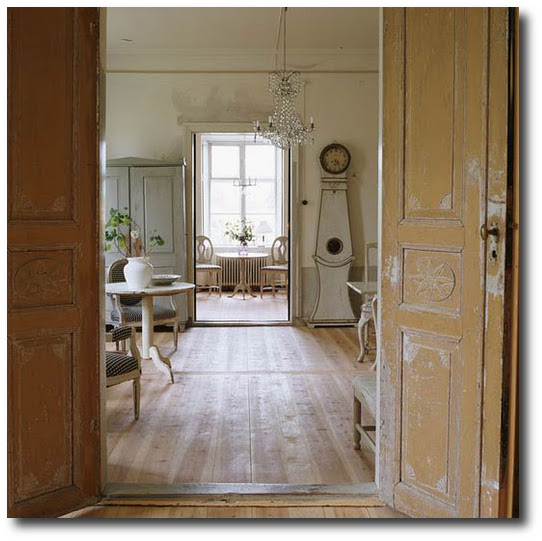
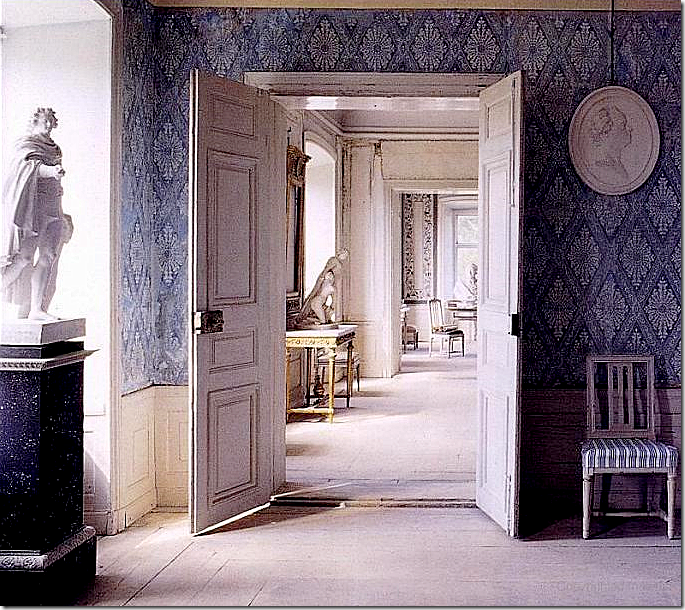
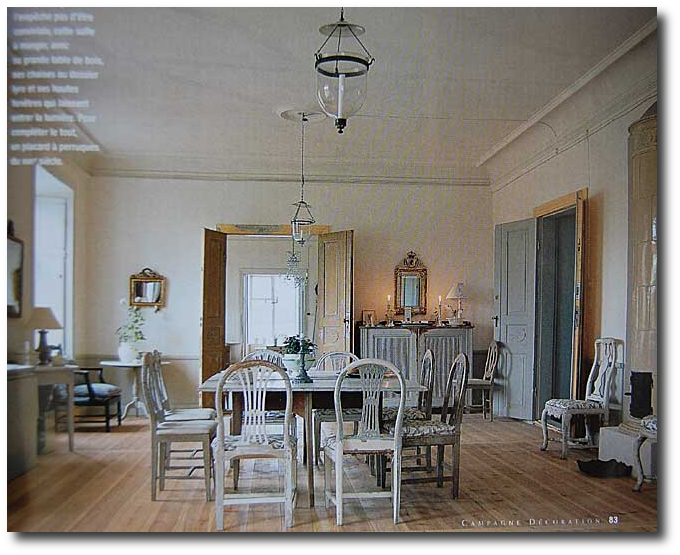
Check out Classic Swedish Interiors for more photos to get a better view of the far room
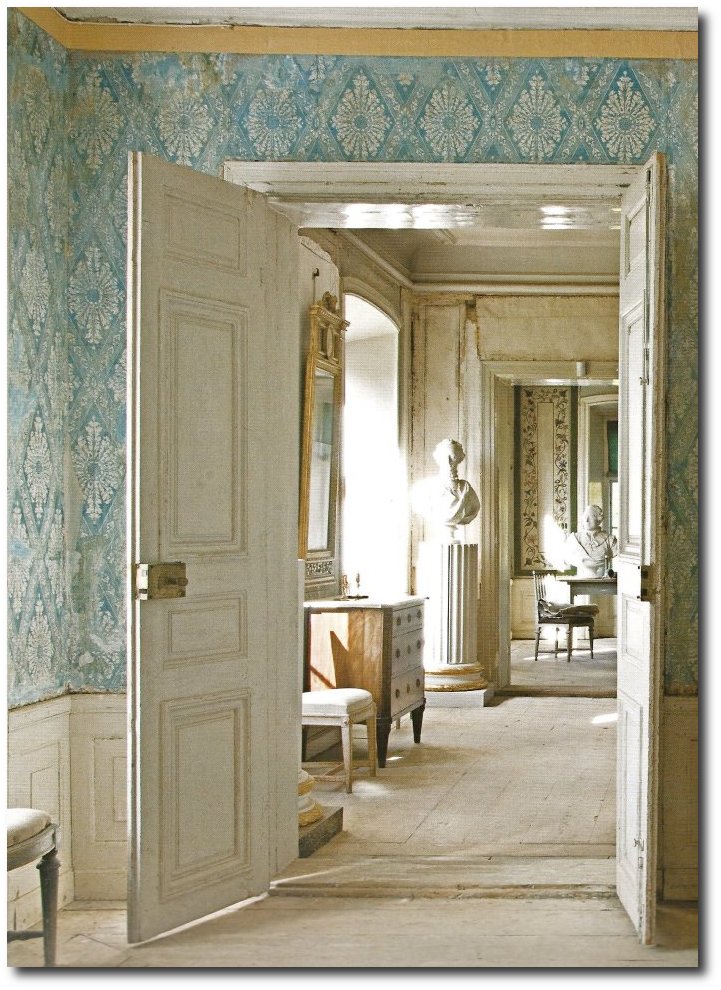
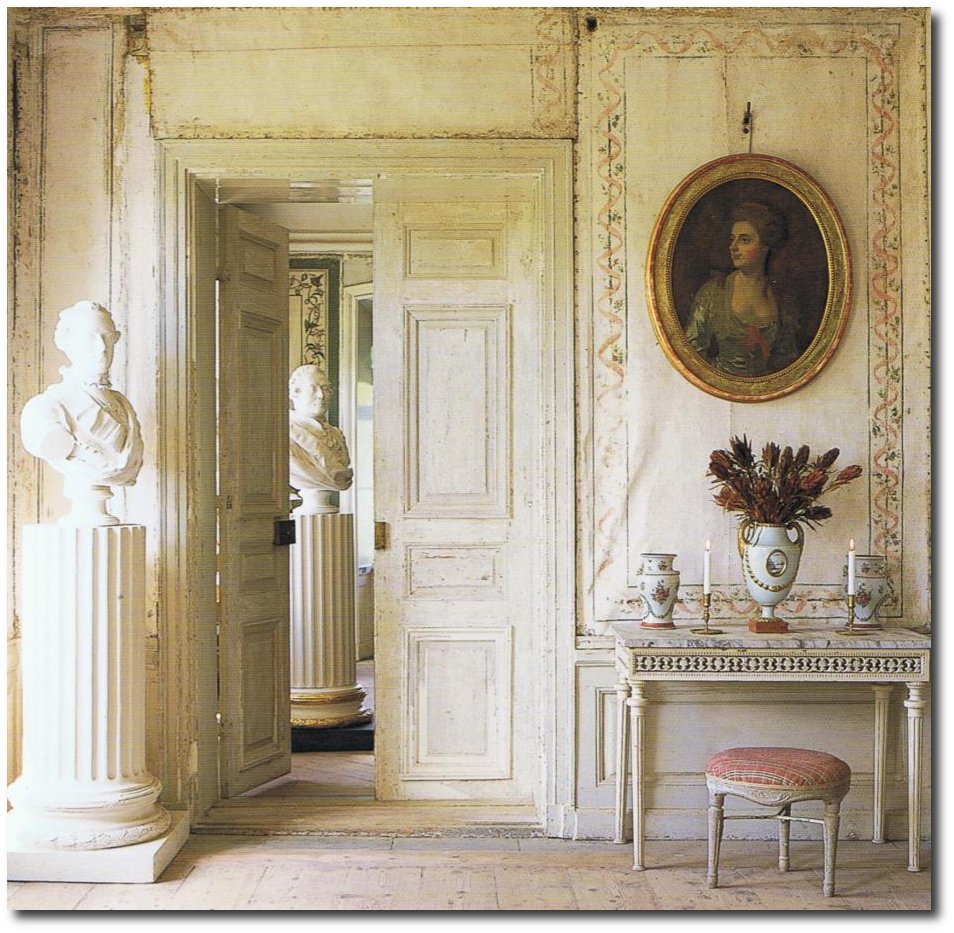

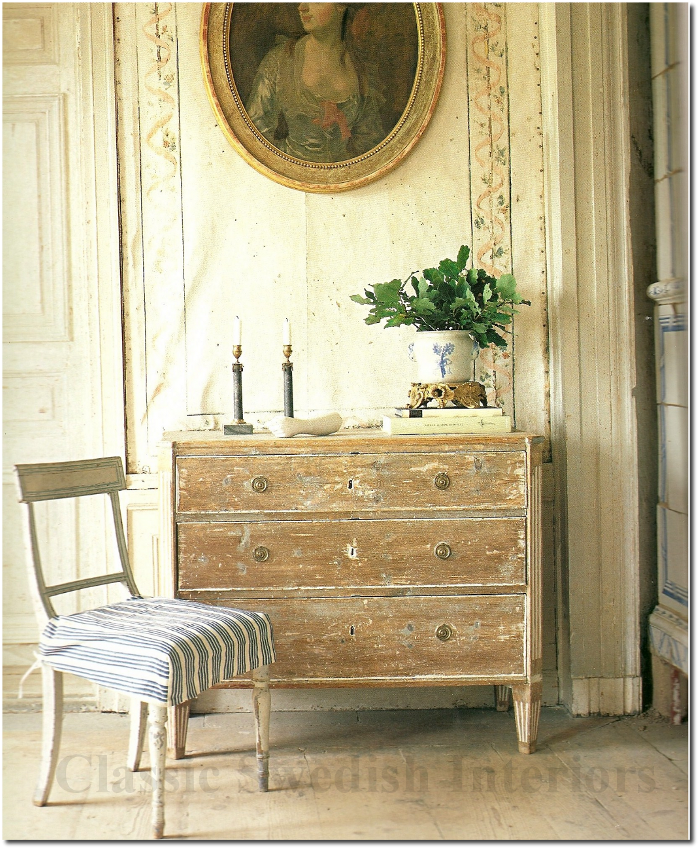
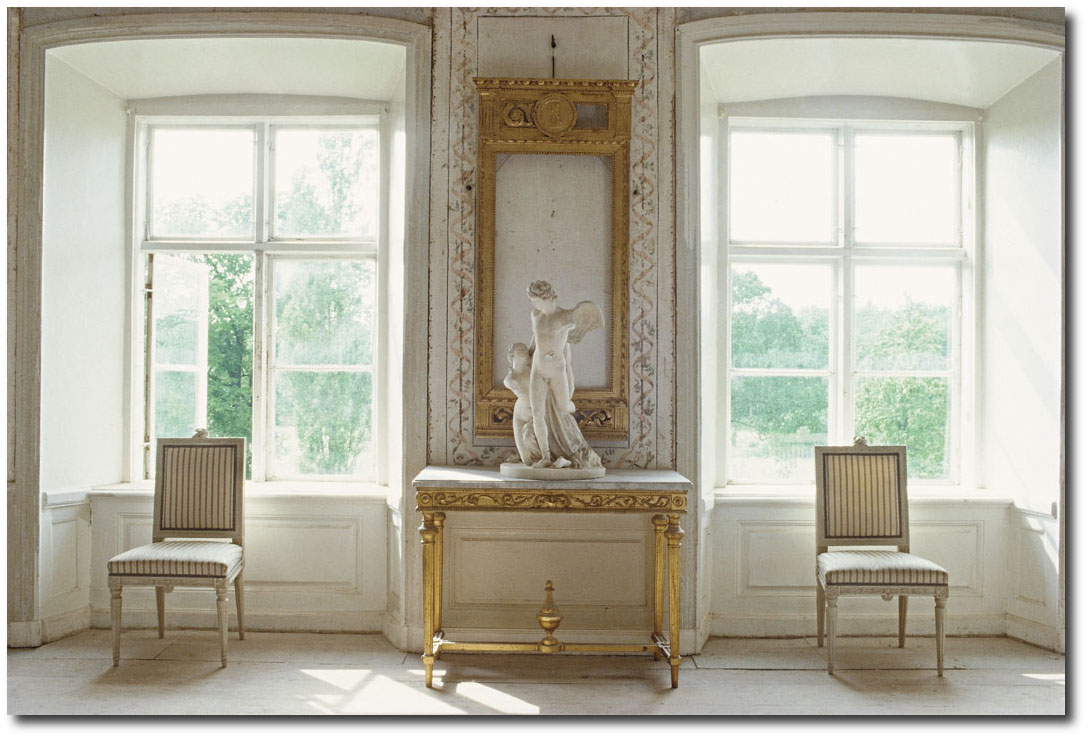
How Important Are Accent Pieces In A Swedish Home?
As we discussed in Part 1, Paneled walls can bring the Swedish flavor into your home and give you the Gustavian appeal you are after.
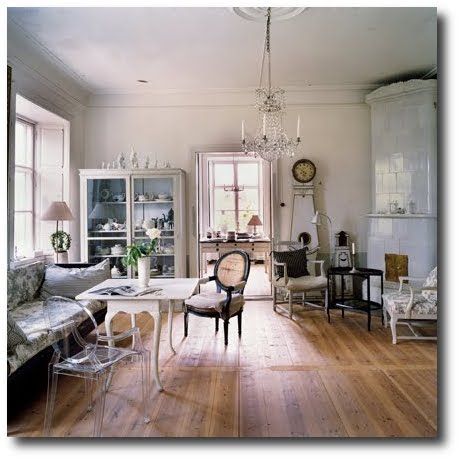
Another element that we see in Swedish historical homes are sitting areas using what we call today as “accent furniture”. It was common to find a number of sitting areas around the home using accent chairs, and tea tables.
2. Accent Furniture
Today accent furniture has become more popular again. We have been used to over-sized sofas, and forgotten what side chairs and tables can do for a room.
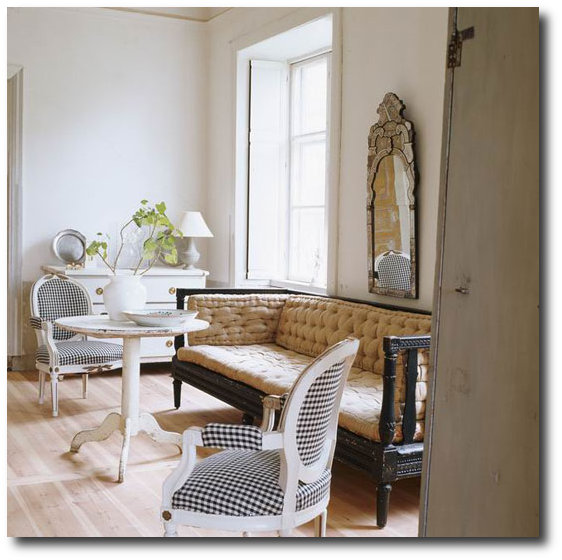
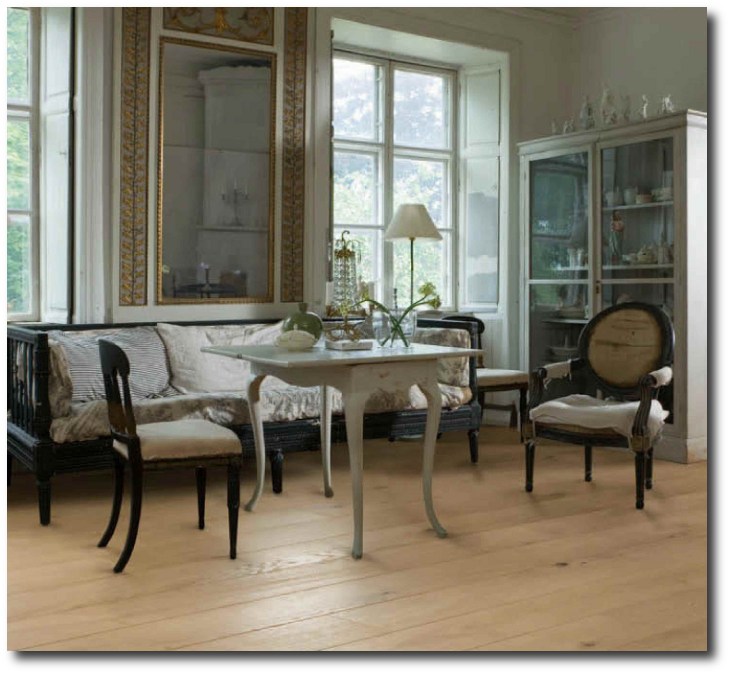
Swedish design is based around symmetrical looks. In the living room above, we see two white painted chairs in a Gustavian buffalo check paired with a black painted Swedish bench. In other photos of this room the black bench is paired with a Rococo table and the furniture seen in the rest of the home is moved around. Here we see a round white painted tripod tea table. Using accent furniture allows you to move the furniture around the house like they have done with Barbro’s home.
Smaller accent furniture became popular in France in the 17th & 18th centuries, and caught on in Sweden. The Accordion Side Table is one example of smaller scale furniture that existed in France. The accordion table itself wasn’t something seen in Sweden, but the idea of smaller tables became popular, or functional at the time.
Tables didn’t just look pretty, they served a purpose in the home. Side tables were practical for playing cards, having tea, and doing fine needlework. Writing tables were one of the most common uses for tables in this time. Tables with folding leaves were extremely popular in Sweden. Tables were pushed against the wall, and were then brought out for dinners, crafts, and schooling.
Sofa tables were designed to appear before sofas. These tables were long and narrow, and often had folding leaves which enabled the person to sit at the sofa and use the surface of the table without having to move the table closer to them. Consider adding a table paired with a sofa instead of a modern day lower “coffee table” that is seen in most homes. Or add a set of upholstered benches in front of your sofa to tie in matching upholstery.
Picture Credits– A Special Thanks to Campagne Decoration Magazine, Photos featured on Aged And Gilded Blog & Master Henry Blog


Painting Swedish Looking Furniture – 3 Tips / Part 3
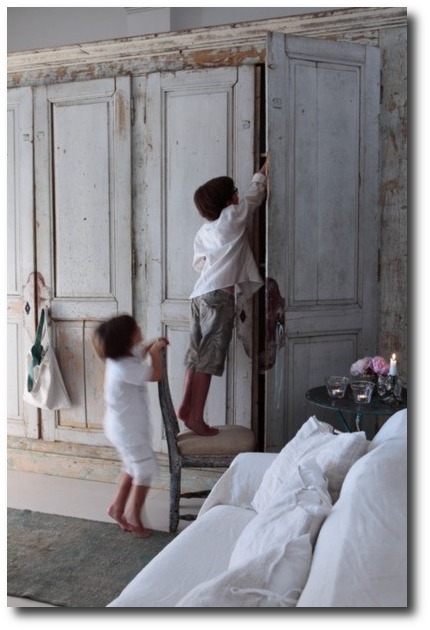 Picture Credit Habitania Work Rooms
As we discussed in Part 2, Accent furniture, such as Gustavian chairs, smaller tables, drop leaf tables, stools, and benches can be brought into the home, and used instead of the larger scaled furniture that we are used to today to achieve that Swedish Gustavian look.
Another element that draws people to the historical Swedish look is the painted furniture. There is an art to getting the rich patina that is seen on true antique furniture found in Sweden. Almost anyone can find vintage French furniture in their area which can be distressed using a number of techniques to give it a historical appeal.
In this early post I wrote, I describe some of the paint techniques I have used to achieve great white painted furniture.
Here are some of my best tips to getting realistic Swedish painted finishes……
1. Work with colors that are muted. If you have ever mixed paint before, think about the colors that are produced when black or white paint has been added to a color. In the 17th and 18th century, there was a limited color palette available, so black and white paint was added to an existing color to produce a shade that was darker or lighter. On one of my pinterest boards, I compile some colors that will give you ideas of ranges of hues that are very appropriate. Annie Sloan has a wonderful range of colors which all are muted, yet vibrant paint shades which I suspect were based off the French style that she is so attracted to. She has put together a fabulous palette of colors which would work in any French or Swedish styled home.
Don’t ever work with colors with really bright pigments. I cannot blame anyone for being confused as there are thousands of shades of paint to pick from. The furniture should look aged, and color appropriate for the century you are after. I guarantee you, getting a really nice finish on a piece of furniture doesn’t have to be complicated.
2. Strip Or Sand To Get Down To Bare Wood.
A raw wood piece of furniture is always the best to work with. Although finding a piece of furniture that is untouched with paint rarely happens. Starting off with a piece of furniture that is not painted is ideal, but if it does have paint, consider comparing the the color you have picked out to the color the furniture is painted in currently.
Would you mind having the original color showing through?
If not, consider spending the time stripping off the paint. A perfect strip job isn’t necessarily if you plan on re-painting it, but enough of the paint removed will give you a new wood surface to work off of.
I have seen black painted furniture with distressing showing white beneath, and it doesn’t look great. A base color of red looks terrific with black painted furniture, or just plain wood. If you don’t want to strip the furniture, (as it is a lot of work) consider giving a good deep sanding to the furniture, especially to the areas you plan on distressing.
Often times if stripping the furniture is something I don’t wish to do, I sand the furniture quite well as a first step, paint it in the color I plan on working with, and then sanding it again as a third step. This allows me to touch up the original paint color that shows through, while leaving some of the distressed areas that show off the wood. It is a lazy way of getting the finish, but the results are quite nice.
If you plan on doing multiple shades such as the chest below, consider colors that work really nicely together. White works nicely as a top color.
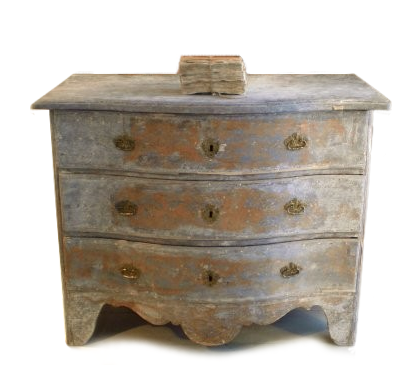
Swedish Distressed Chest From Atelier September
Distressing gives your piece of furniture a depth, which is often seen in Swedish antiques. I am not afraid of roughing up my furniture, and I am not afraid of altering an antique. Many antique dealers caution people from painting furniture, because it does loose the natural patina, and because of that, it often looses the value. This is a wise piece of advice to those people who are looking to “invest” in heirlooms for the value.
If you always wanted a white distressed cabinet, paint it, and don’t be afraid to do so. My motto is that you have to first love the piece, because after all, it is in YOUR home. Your children may have a totally different style in mind for their own home, so do what makes you happy, rather than looking at furniture as items to pass down to family.
I used to sell used furniture for a hobby, and always ran into the problems with paint sticking properly. Either you tore off your arm by sanding the heck out of every piece, or you ran the risk of the paint peeling later on, which lead me to use oil paint. Not every oil paint brand is the same. Some brands are so hard to work with, that they will make you pull your hair out. It is almost impossible to find oil paint in a finish that is either flat or eggshell. You won’t find glossy Swedish antique furniture, so don’t use it on your furniture. The look should either be eggshell, or satin.
Cover Stain By Zinsser is a fantastic oil primer which I discovered by accident, and almost was beside myself when I discovered how well it performs. You can buy this at Home Depot and almost every Hardware Store, and the best part of this paint is that it is TINTABLE in almost all the lighter shades of paint samples such as Behr, Martha Stewart, and so forth.
High Hide Odorless Oil Primer without Sanding – Odorless Primer

I bought the paint, because I couldn’t send out a piece of furniture which would later peel. I wanted a paint that could stick to anything and not scratch. Oil based paints are not environmentally friendly. The trade off with this paint is that it has a heavy smell which disappears after it has dried. You will need to use a paint respirator, and I emphasize that recommendation.
The most surprising aspect to Zinsser’s Coverstain Primer is that it is not a thick paint. It is rather thin, and goes on like spreadable butter. You rarely need an additional layer of paint, because it is oil after all, and isn’t like water based paints. Oil paints tend to self level as they dry, leaving almost no brush marks. Oil paints do cover well, and hold up wonderful. Unlike other oil paints, which can take up to a week to cure, this Coverstain dries to the touch in 3 hours, and cures over night.
The other reason why I recommend this product, is that it is sand-able. Almost every other oil paint brand I have tried doesn’t sand very well, and often leaves the finish needing an extra coat. Because Zinsser’s Coverstain dries flat (matte) sanding blends in rather nicely. In the past, I often added two coats of the tinted primer, and then sealed it with a Polycrylic
Polycrylic is one of the best finishes to use on white based furniture, because it doesn’t yellow over time, like polyurethane does. With the polycrylic, I would apply it with a brush, and then with a damp white cotton wash rag, I would just wash it off. This would give me a seal to the paint color, while at the same time, maintain the flat, or eggshell finish that I enjoyed.
Another tip I would recommend is to buy a good quality angle paint brush for water based paints. I have used these with my oil paints, and my brush sits in paint thinner for weeks, and it is still not damaged. Regular chip brushes are ok, and inexpensive enough to throw out, but a good quality brush won’t leave paint strokes. Someone suggested to me to invest in an expensive brush, and I pass on those words of wisdom.
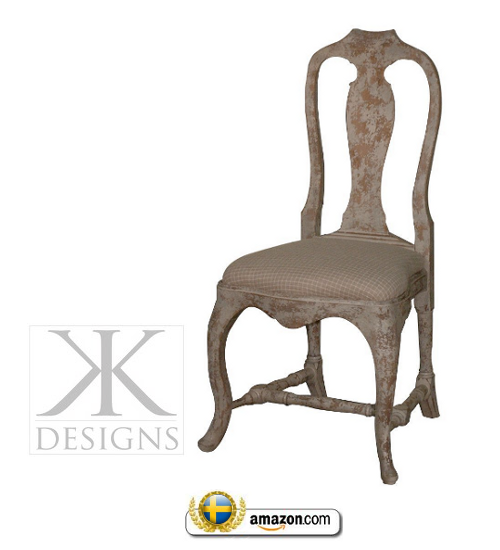
Swedish Accent Chair With A Fabulous Paint Finish $506
18th Century Buffet, circa 1760 Jane Moore Interiors in Houston
Picture Originally Featured on Indulge Decor Blog
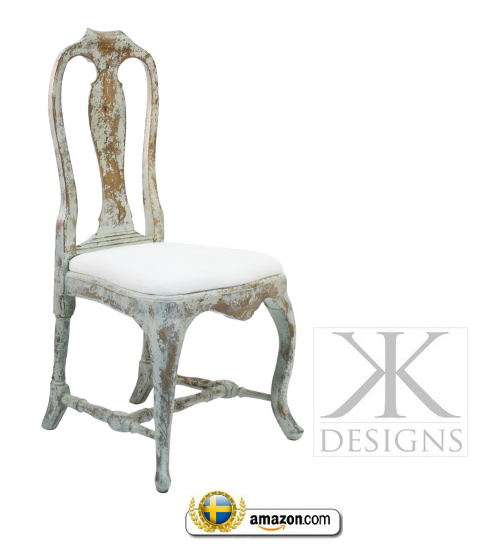
Stunning Swedish Styled White Painted Accent Chair
Neoclassical Swedish Styled Accent Chairs Sold In Pairs $983
3. Glaze Your Furniture With Brown Glaze…..
Glazing is so easy, it takes minutes. If you can wipe your table after dinner, you have the skills to glaze! It is that easy. A glaze is a translucent binder which paint pigment is added to the mixture to produce a translucent color. You can buy glaze mixed together at your local hardware much like ordering paint, or you can buy glaze alone and mix in paint yourself.
Buying brown glaze already mixed will go a far way if you paint furniture for a living. I used it on all my painted pieces, including my white furniture.
Blend & Glaze Decorative Painting Liquid

Ralph Lauren Faux Technique Glaze

I have discovered that glaze can be applied in two ways. You can apply it with a paint brush, let it stand for 3 minutes, and take it off with a slightly damp rag. With white furniture, even though you may feel you removed a lot of the glaze, the little bit that is left gives your furniture that slight change in color.
With flat finished white furniture, I give some wise words of wisdom. Add a coat of polycrlic before you glaze. You could even dilute the polycrylic with a slight bit of water, OR, just brush on a very small amount on to your furniture, such as dry brushing techniques. The reason for this, is that your furniture can turn a shade of brown, which is not what you are after. White furniture will have a hue of brown, but you don’t want the glaze to STAIN the paint.
Another trick is to work with a creamy white, not a bright modern white. Your whites should always have undertones of brown or green in them. When glazing white furniture, if the finish is flat or eggshell, you will need to work fast in pulling off that glaze. If the finish is satin, you will have a bit more time.
For painted furniture such as blue, or darker paint colors, glaze can be added, and it makes a world of difference. Often times I just paint on the glaze, such as you would just dry brushing the furniture. I use the term “dry brushing” as your paint brush isn’t loaded with paint. A small amount is necessary to make a dramatic difference. A brighter colored blue, will be muted when brown glaze is added, so experiment with brighter paint shades with brown glaze, you might be surprised what beautiful finishes can be achieved.
These Swedish chairs were likely scraped down to the original paint
Look how nice white upholstery looks with gray paint.
Originally featured on Romantiskahem.blog
This beautiful console table featured on The Paper Mulberry Blog, originally from Appley Hoare Antiques
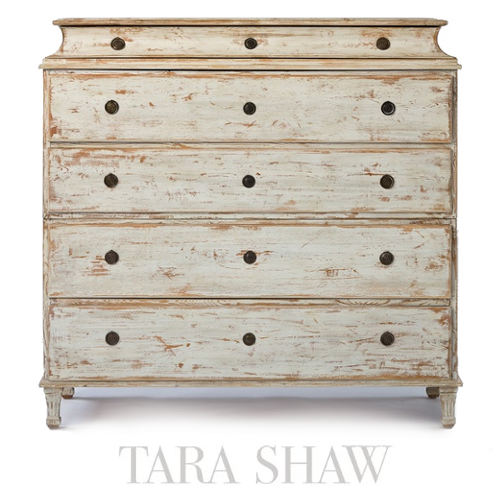
Tara Shaw Swedish Chest- Coach Barn Now Sells Tara Shaw’s Collection
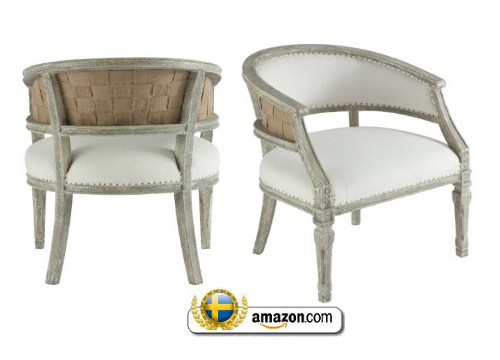
Reproduction Swedish Tub Chairs From Amazon $775
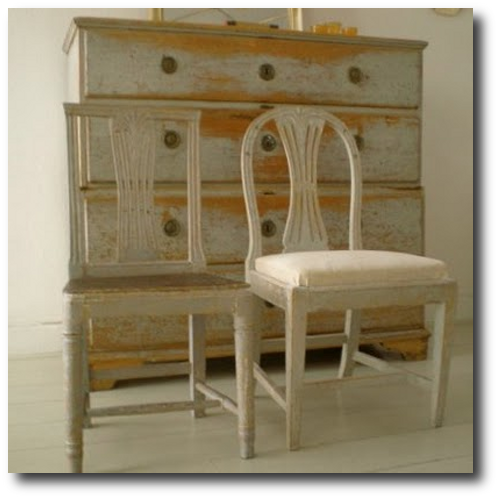
Swedish Distressed Chest From Atelier September
A Stunning Trumeau Mirror From Tone on Tone Antiques,
Featured on Henhurst Interior Blog
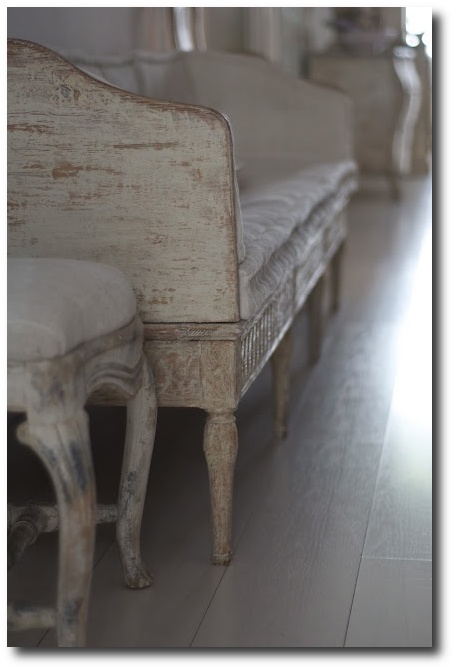
Swedish Aged Paint Finishes From Antiqbr Blog
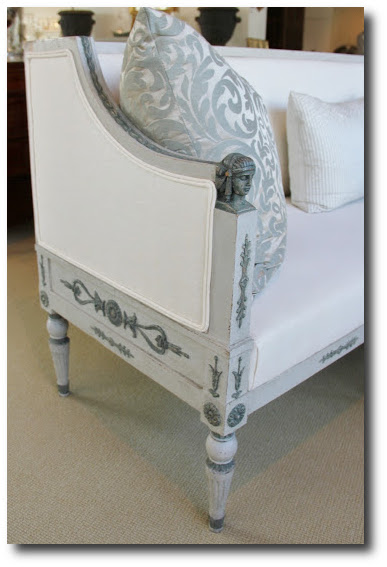
An extravagant painted sofa in terrific blue gray paint with painted ormolu
From Tone on Tone Antiques Featured on Featured on Henhurst Interior Blog
Swedish Aged Paint Finishes From Antiqbr Blog
A Few Previous Articles Of Interest
- – White Painted French Furniture– The French Provincial Furniture
- –25 Ideas Of How To Incorporate Orange, Pink and Coral Into Your Home- The French Provincial Furniture
- – Ideas For Embellishing Painted Furniture– The French Provincial Furniture
- –French Provence Red Check Textiles– The French Provincial Furniture
- –Distressing Painted French Provincial Furniture
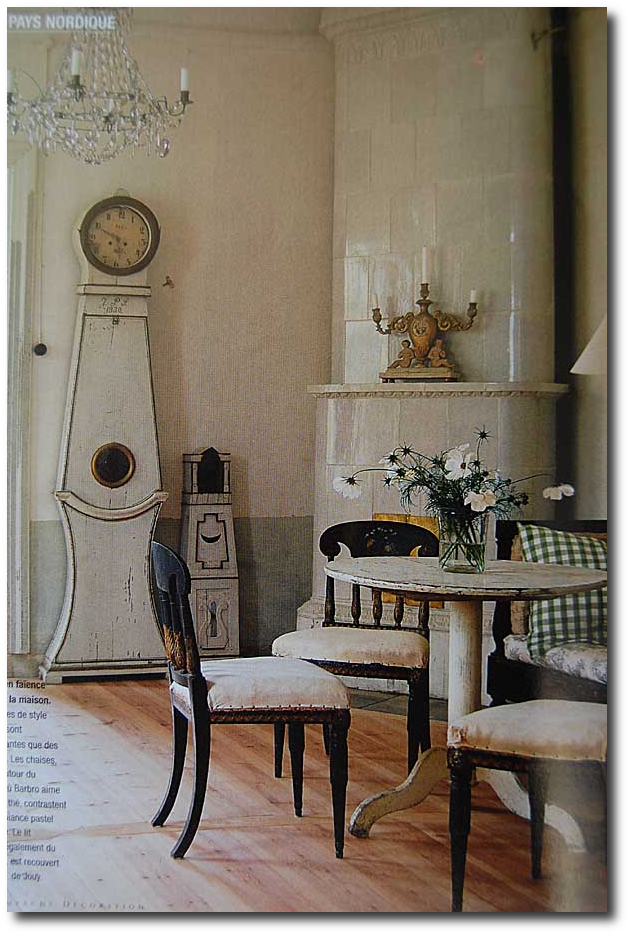
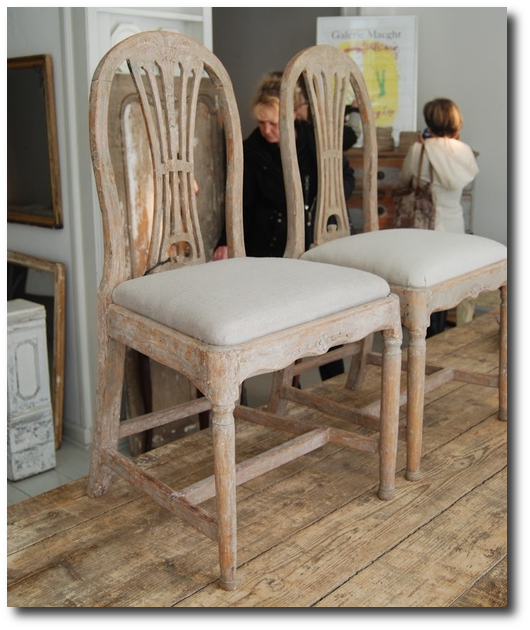
Swedish Mora Floor Clocks
Mora Clock in Salmon Paint Sweden, Circa 1820, Tall case clock signed “Matts Jonson/Mora”, Sweden circa 1820. Wonderful salmon paint with gilded detail, all having an exceptional patina. Original clockworks have been newly cleaned and adjusted
Swedish Mora Clock Painted In A Soft Blue With Cream Painted Carved Accents From A Tyner Antiques
Sweden Circa 1790 Early Mora clock, Sweden circa 1790, in original pale salmon paint. The bonnet features beaded detail around the face and the crown, as well as oval glass panels on either side for viewing the clockworks. Both the bonnet and case retain their early, rounded glass. All original with newly cleaned and regulated clockworks Cupboards and Roses
Below:
1. Swedish Painted Pine Tall Case Clock, C. 1780, of the Rococo Style with carved and polychromed case detail. Mora movement and original paint decoration – Lillian August Designs
2. A Swedish tall clock in a rare pillar design with and original faux painting resembling marble. The face is an unusual combination of metal exterior with a gilded center echoing the gilt paint on the feet. The clock is in working order with the added feature of a calendar. Sweden, circa 1800. Dawn Hill Antiques
3. Swedish tall case clock, c.1780-1800, of the Gustavian period, the rococo case carved with neoclassic gilded motifs and retaining traces or its original paint. Mora movement. Lillian August Designs
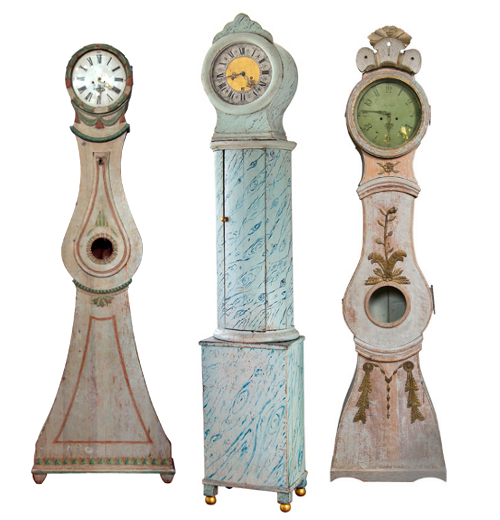
Below:
1. Mora clock, Sweden circa 1820, with dial signed “P. Svensson / Rageröd.” Scandinavian pine case with reeded panels and dentil molding under the bonnet. The original clockworks have been newly cleaned and regulated. Sold By Cupboards & Roses
2.Sweden Circa 1848 “Mora” clock, Sweden dated 1848, with a beautifully carved case retaining its original painted decoration including the two sets of initials commemorating a marriage. Inside the case is a record of the clock’s provenance which reads,”Carl Nilsson, 1786-1850. Worked as a clockmaker in Northern Slätthult, Jönköping County. Buried in the cemetery of Villstad. This clock was purchased June 13, 1964 by Emil Johansson.” Sold By Cupboards & Roses
3.Antique Black Swedish Mora Grandfather Clock, circa 1850, Antique Swedish Black Painted Grandfather Clock. The lovely curves of this clock are typical of the Mora grandfather clocks, famous from Sweden. Sold by Scandinavian Antiques
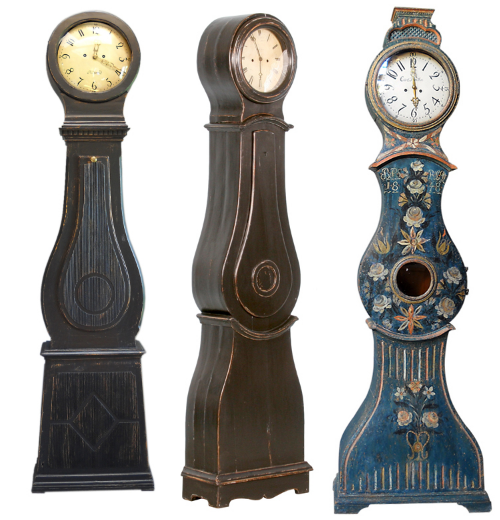
Swedish Mora Clock From swedishinteriordesign.co.uk
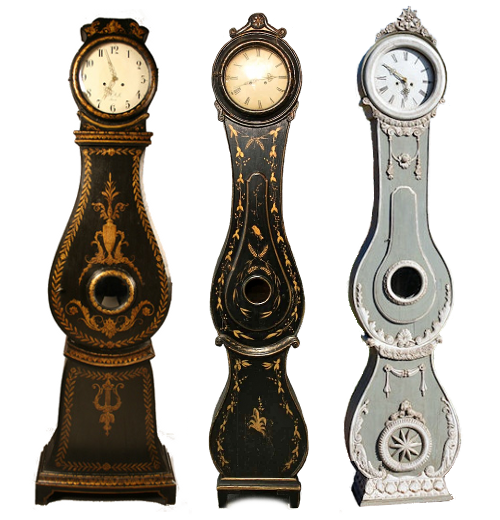
Swedish Mora Clocks From swedish-clocks.com, rlgoins.com, Swedish Interior Design
Shannon Bowers Home, Swedish Design- Painted Blue Mora Clock
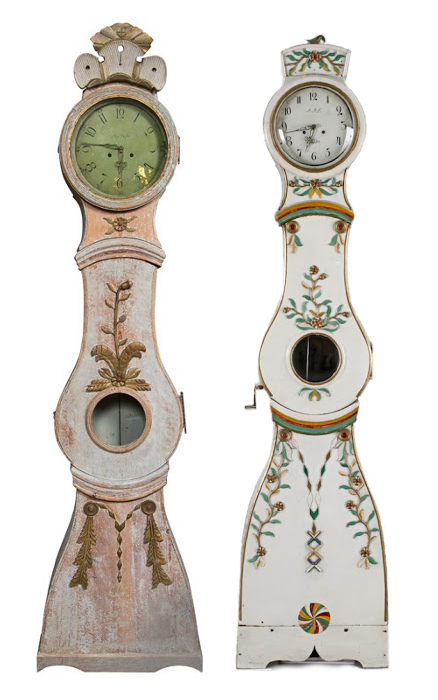
Swedish Painted Pine Tall Case Clock, C. 1780 Lillian August Designs, Swedish Interior Design