Q&A With Swedish Designers Edie Van Breems and Rhonda Eleish
Q: Clearly, you are scholars on Scandinavian style. For you, what is the essence of it?
A: Recognition of the importance of nature and the impact it has on interiors and overall lifestyles. Light, colors, and the functionality of daily living also play a huge role. In Sweden there is a wordbruskonst, which loosely translates to “useful art.” This respect for economy and intimacy with nature is an integral part of Scandinavia’s design psyche.
Q: Scandinavian antiques are usually made of humble materials, but painted to look like marbles, gilt, and fine woods. How do you make them work in modern spaces?
A: Antique pieces, by virtue of their patina and imperfections, add a depth and soulfulness to rooms that could otherwise be one-note and cold. A rough-hewn, rustic, painted farm table, for example, is going to look amazing with contemporary metal chairs or formal, tailored, upholstered dining chairs by sheer virtue of the contrast. An 18th-century Gustavian chandelier in a barn room or a rustic, painted farm chair in a severe, all-glass or marble contemporary bathroom becomes almost sculptural.
Read more at deringhall.com
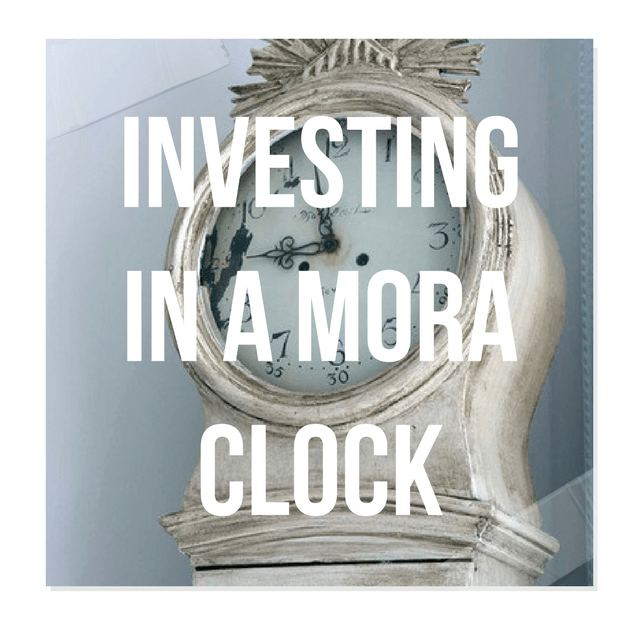
Investing In Mora Clocks – Expert Advice From Jo From Swedish Interior Design
Swedishinteriordesign.co.uk specializes in Swedish Antique Gustavian, Biedermeier, Rococo and Country Painted, Veneer and Natural Wood Furniture.
In the Homes and Antiques April 2014 Issue, Swedish Interior Design was asked to spill about Mora Clocks. Here is what they had to say:
A grandfather clock by another name?
A Mora clock is specifically a longcase clock made in the town of Mora in central Sweden during the l8th and 19th centuries.
Why there and and why then?
Bad harvests in the 1700s meant that the farmers of Mora, which was a largely rural community,
had to come up with a way to supplement their income. The pendulum clock had been invented by Dutch scientist Christian Muygens in 1656 using the sketches of Galileo so there was already something of a tradition for making clocks of this sort in Scandinavia and the cottage industry quickly developed. Each family in Mora look responsibility for making a certain part: the pendulums, the faces, the brass mechanics and so on.
Tell us about the clock’s defining features…
They are known (or their curvaceous hourglass shapes and are more often than not painted in pale greys, whites or blues as these colours reflected candlelight better on long dark evenings. Sometimes they will have ‘kurbits’ folk art designs – a form of bold, painterly decoration most
recognizable from wooden Dala horses that originate from Dalarnia, the same region that
Mora clocks come from.
How easy are they to come by?
Oddly the largest collection of Mora clocks is here in the UK. It is owned by Jo and Madeleine
Lee who run Swedish Intorior Design and have just moved their business to an old granary near Shoreham where you can find over 50 of the clocks in stock. Look out for ones marked ‘AAS’. They may well be made by the first Mora clockmaker Krang Anders Andersson whose oldest known clock dates to 1792. Be wary though, the moniker has been copied onto later clocks so check for documentary evidence of his craftsmanship.
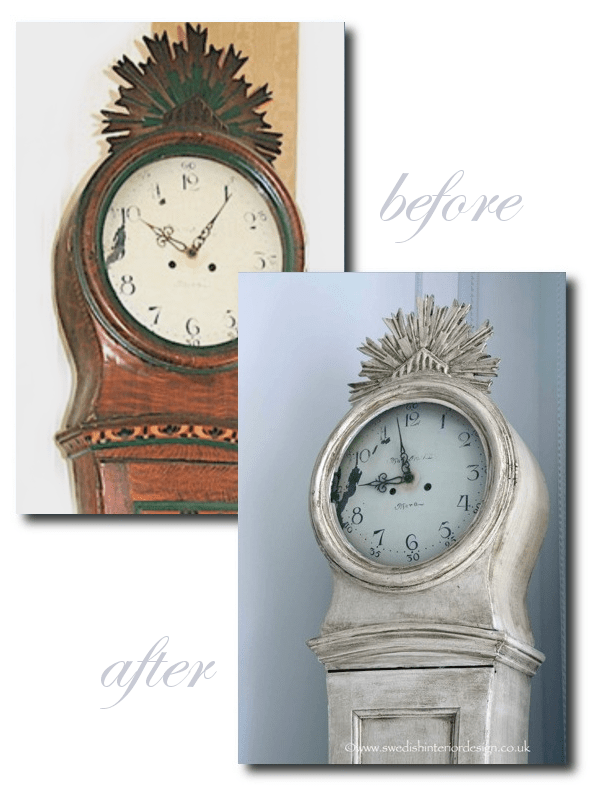
Jo spills some of his secrets of how he goes about refreshing Swedish antiques that need a facelift.
He discovered this Mora clock about many years ago, and it was one of the first pieces he found in Sweden. He loved the clock but wanted the overall look to fit into their 1886 apartment which was decorated around whites and greys.
The clock was found painted in a “Kirbits Folk Art Style…..
“It was statuesque, superbly proportioned, elegant and painted in reproduction Kurbits Folk Art style. The repaint was probably done in the early 1900s and the colours they had used and the painting style were rather garish. The original Kurbits Folk Art Style was prominent in Sweden in the early part of the 1800s and was a freehand style using feather shapes, swirls and subtle earth tome colors (reds, ochres, yellows, oranges) to create a visually sumptuous but definitely country style. You can see examples of the kurbits painting from the early 1800s by looking at the 360 degree view of the Swedish Interior Design Kitchen where we have freestanding cabinets from 1799, 1803 and so on with the original Kurbits paint.”
Jo tells us how he made this clock look antique with paint:
Step 1 – “Key the entire clock with medium sandpaper (180 grit) to allow the paint to grip and look it over to decide whether there were any bits that needed gluing or fixing. Generally I prefer to leave pieces ‘as is’ if possible rather than fix them up to much as the life they have undergone is part of their character and makes them real”
Step 2 – “Prepare The Tools In this case a variety of brushes of different sizes to allow me to get a fine coat on to the clock without filling up the wonderful crenulations and shapes on the body with excess paint. You can get very carried away with special brushes but actually we generally use pretty standard ones – my brush heads don’t have to include virgin yak tails from Mongolia! In this case I used a Craig and Rose acrylic paint (I used Regency White in the Chalky Emulsion finish), which dries nice and quick and that goes on very smoothly with a nice chalky texture. I didn’t use a primer in this case but you can if you want. Alternatively, any chalk-like paint such as Farrow and Ball’s Estate Emulsion, Chalk or Milk Paint could be used. With Chalk and Milk Paint, you would have to wax the piece and not glaze it as I did, which I will talk about a bit later.”
Step 3 – Base Coat “A nice smooth stroke with a larger headed brush to keep an even spread and smaller headed brushes or ones where I’ve cut them to an angle for getting in and under things! Always be careful not to let the paint pool or drip and consider it from several angles to make sure the coverage is good. Once I’d built up the base coat, I added 2 further coats at a slightly watered down consistency until I liked the visual texture“
Step 4 Sand “Light sand to matte the paint down a bit with 320 sandpaper and then some judicious distressing either in the right places where you would naturally get a lot of use (like the handle in the pendulum door) or for effect (to highlight a special feature). I also use a razor blade too sometimes for a different look”
Step 5 Antiquing. “Now that I like the basic color and the level of distress, I decide how and if I should antique it. When well done, antiquing really adds to the feel of a piece and can highlight its decorative mouldings, giving them a 3D effect. But if overdone or clumsily applied..awful! Many people like to use wax but I prefer to make up my own antiquing fluid using an acrylic glaze as a base. I mix the acrylic glaze with a dark brown, grey, red or yellow paint so I can create an antiquing color that matches the color tones I want to effect and it still looks like the real ‘dirt of ages’. So sometimes it’s greyer, browner, more yellow, ochre or red – whatever you need for a special job. The key is “think” where naturally dirt would accumulate and build it up in layers and once that’s done to see if you want to use it as a special effect to highlight any feature. Another light dusting with 320 sandpaper in places and then stand back and admire the handiwork”
You can see their unique collection of antique mora clocks, and other Swedish furniture by viewing by private appointment 7 days a week.
Call +44 1273734371 or visit the website at www.swedishinteriordesign.co.uk
Also, look up at Swedish Interior Design blog for more tips of how to decorate with Swedish furniture.
Follow Jo on Facebook, follow his wife’s blog Madeleine Lee.com
- Madeleine In their Swedish Home
- Picture Credit- Swedish Interior Design
- Beautiful creamy whites and golds seen in their home
- Pictures taken in their home for a fashion editorial in Coco Indie Magazine, see more at bellakotakphotography.com
- Swedish Interior Design
- Clock 1: Unique Early 1800s antique Swedish mora clock with an incredible original trompe l’oieil wreath motif and a very unusual larger head with stunning roman numeral clock face
- Clock 2: Early 1800s antique Swedish mora clock in original white paint.The mora clock is in good condition and features the makers name ‘Roth of Norkoping’ and elaborate beautiful handpanted gold curlicue designs.
- Clock 3: Very early 1800s Swedish mora clock in original paint. Incredible ribbed crown motif on the hood and very distressed but structurally sound.
- Mora Clocks From Swedish Interior Design


Swedish Reproduction Furniture At Solgarden

House Beautiful Magazine, 2002, Picture Credit solgarden.se

If you are looking for beautiful reproduction Swedish furniture, consider Solgarden. Solgarden has two lines of furniture, one named “classic”, and the other named “vintage”.
Solgarden Classic- This line is manufactured by a Swedish furniture maker and the timber is locally grown in Sweden. This line is inspired after authentic 1700s furniture found in Sweden. Within this line, you will find furniture inspired after gustavian, rococo and baroque styles. All of their furniture is hand painted adjacent to their store.
The pricing of the furniture includes a choice of color within their “Solgård Colours”. Their signature painting is a process that involves nine different applications. While you have the option to paint the furniture, you can also have it finished to a “worn” appearance that also gives the look and feel of antique furniture.
Solgarden Vintage- Here you’ll find beautiful pieces found around Sweden which have been restored and refreshed with paint or new fabric. Often times these pieces are one of a kind, very unique and special. If you are looking for something specific, which you cannot locate yourself, contact them, and they can do their best to locate that item. Solgarden also offers furniture painting, furniture upholstery and sewing services.
About Solgarden
The operation was named Solgarden, and was originally founded out of a yellow house. After a few years, the business grew and moved to Karlavagen 58 in Stockholm. It was in 1998 when the company changed owners, and over the years the business developed a passion for concentrating their efforts in Gustavian styled furniture, and it was there that special pieces were copied and reproduced. The level of painting evolved over the years, and the quality of the furniture just got better over time.
In 2012, Anki and Mary took over, and Solgarden opened the current store on Surbrunnsgatan 28 in Stockholm. Skilled painters and artists continue to paint furniture next to their shop, and they have expanded to also offer add one-of-a-kind older refurbished furniture along side their 1700s reproduction furniture. A customer can also take advantage of their upholstery and sewing services. If you need slipcovers made, upholstery for a chair, or settee, or bedding and drapery to be made, they can do that too.
Contact Solgarden:
- Surbrunnsgatan 28, 113 48 Stockholm
- +46 (0)8-663 93 60
- info@solgarden.se
- www.solgarden.se
This stunning feature was featured in House Beautiful back in 2002. Read all about Marianne von Kantzow’s apartment located on Strandvagen:
“Welcome to my latest love affair,” said the invitation to the launching of Solgarden’s new management four years ago; Marianne von Kantzow just abandoned her post as as a construction executive” to take the helm at one of Sweden’s premier makers of reproduction Gustavian furniture and objects. The daughter of Swedish aristocrats, she was raised in an 18th-century manor in the countryside north of Stockholm where “you could find not just Gustavian furniture but details of the style everywhere—walls decorated with painted canvas in colors such as pearl gray and decorated with swags of flowers in lovely pastels.” she remembers.
At Solgarden she offers furnishings that hark back to the years between 1770 and 1790, a golden age in Sweden during which King Ciustav III had his own love affair—with the fashions of the French court. Solgarden continues to discover antique pieces to reproduce, often with the help of the distinguished decorative arts scholar Lars Sjoberg. The company makes tables and chairs finished in the traditional 18th-century gray paint, but von Kantzow has also modernized the look of her furniture by using what she calls “Solgarden white.” This color, her trademark, is a soft “broken white” la European term for off-white) antiqued in her store’s workshop with eight layers of paint and one of wax.
Von Kantzow also tinkers with tradition in her nine-room apartment on Strandvagen, Stock-
holm’s Fifth Avenue. Divorced after a long marriage that produced five now grown children,
she left a picturesque weekend house on an island in the Stockholm archipelago and now lives
in town full time with her companion, a lawyer. “He and I have the same taste.” she reports,
although her decor is so “un-Swedish” that when she hosted her daughter’s engagement patty,
the young woman’s future mother -in-law expressed fears that her son might have to live with
Marianne von Kantzow’s aesthetic. “Swedes are generally afraid of strong colors on themselves and in their homes,” says von Kantzow. “They walk into my house and stare with their mouths open, and I can see they wish they could be as daring.”
The late 19th-century apartment overlooking the National Museum and the waterfront is decorated with the same colors that von Kantzow has used in all her houses. “I love while with other colors, preferably strong pastel tones of blue and pink.” she says, “They give love and happiness to a room.” Her color palette is both pleasing and practical. “I believe in color schemes that allow a person to move furniture from room to room without having to reupholster everything.
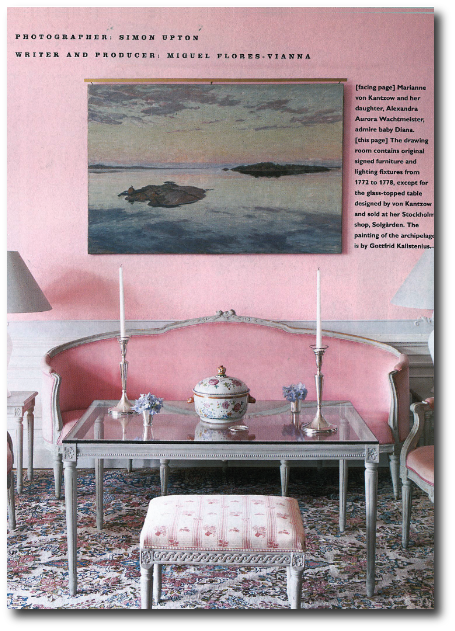
The apartment’s 15-foot ceilings and ample natural light are dramatic and accommodating. The piece de resistance is the drawing room, where against rosy pink walls von Kantzow has arranged two conversation groups, using her collection of signed late-18th-century furniture upholstered in pink velvet and blue period documentary fabrics. Anchoring two opposite walls, she has hung paintings close to her heart, one of her great aunt, the other showing a view of her beloved archipelago.
For the formal dining room she painted a forthright Wedgwood blue on her walls, along with Solgarden white for the panels. Two pieces immediately attract attention: a 19tg century cut-glass chandelier—a copy of one made for the Austrian empress Maria Teresa—and an 13th-century Dutch cabinet housing pan: of von Kamzow’s china and silver collections. Most of the dining chairs are 18th-century originals.
Von Kantzow- shows her playful side in the kitchen and study. The former took its surprising lime and pink accent colors from the heating stove installed at the time of the buildings construction. In the latter, von Kantzow uses a shack of sorts, complete with roof and trompe l’oeil scenery, as a walk in closet.
If only von Kantzow could enjoy her urban oasis more often. Like any good enterprising Swede, she works long hours—sometimes seven-day weeks. Fortunately her soothing yet stimulating shop makes up for it. Customers, she says, “come in and say things like ‘All this whiteness makes me calm,'” and they tend to stay a while, conversing deeply with strangers.
House Beautiful Magazine, 2002, Picture Credit solgarden.se
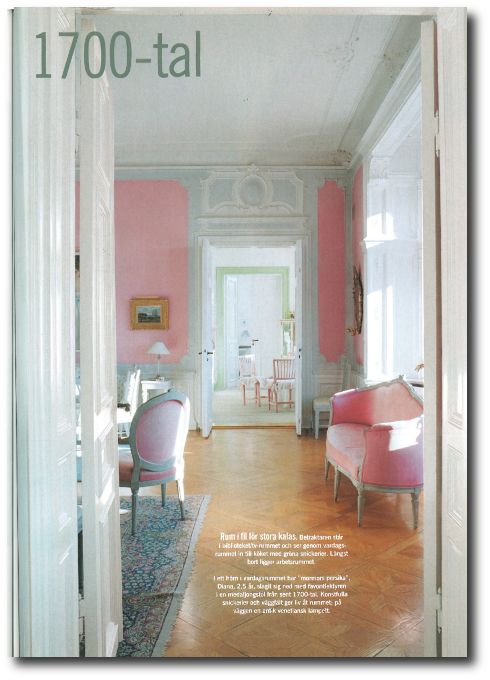
Pink Gustavian Interior -SKONAHEM
2004 Picture Credit solgarden.se
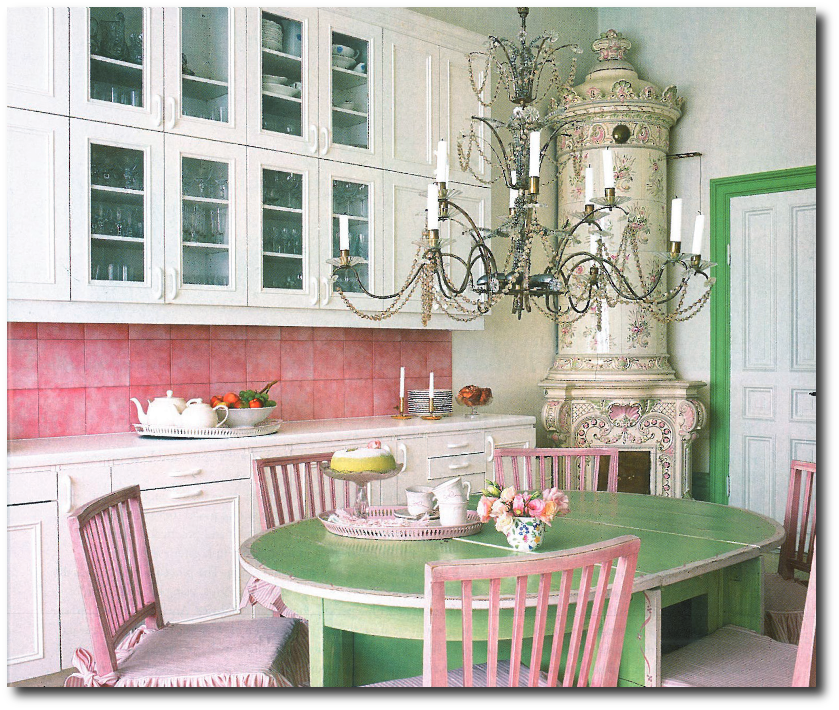
House Beautiful Magazine, 2002, Picture Credit solgarden.se
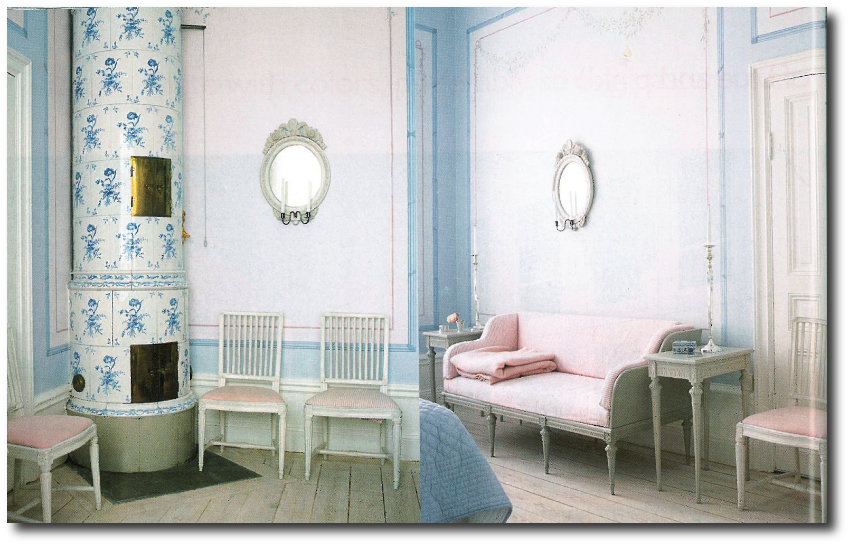
House Beautiful Magazine, 2002, Picture Credit solgarden.se
Pink Gustavian Interior -SKONAHEM
2004 Picture Credit solgarden.se
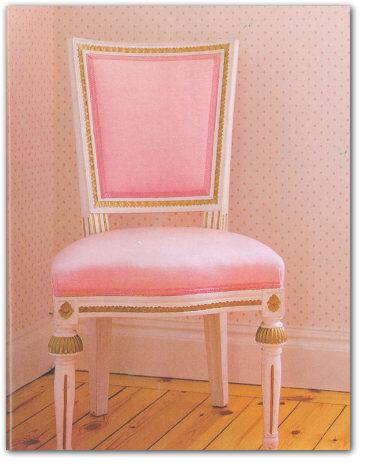
Pink Upholstered Gustavian Chair- GODS & GARDAR
2004 Picture Credit solgarden.se
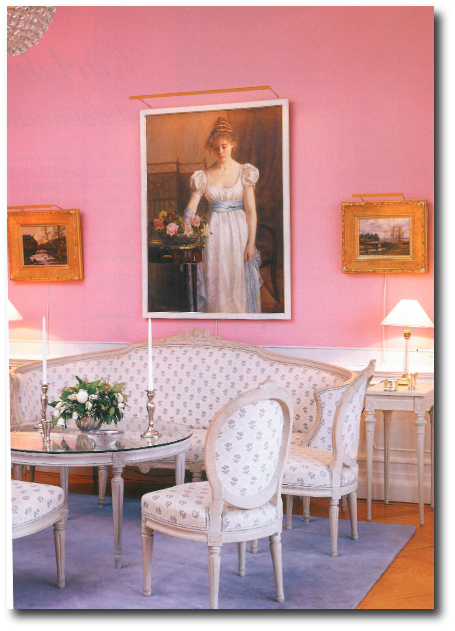
Gustavian Room – BAZAAR
2002 Picture Credit solgarden.se
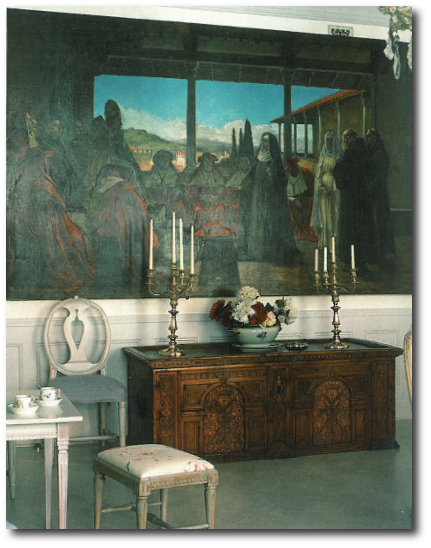
Swedish Interior, Designer Marianne von Kantzow Seen In Hem & Gardar Magazine, Featured At solgarden.se
More Picture Credits :
- Baby Swedish Toys In A Nordic Styled Interior – Picture Credit solgarden.se
- Swedish Interior, Designer Marianne von Kantzow Seen In Hem & Gardar Magazine, Featured At solgarden.se



An Interview With Daniel Larsson- The Go-To Guy For Swedish Antiques
D.Larsson Interiör & Antikhandel
I recently was able to interview Daniel Larsson, owner of D.Larsson Interiör & Antikhandel, one of Sweden’s top sources for authentic antique furniture and decor. Daniel opened his store in July 2012 and has quickly become recognized in the industry as the go-to guy for Swedish Antiques – He not only locates the goods you’re looking for but also educates you when buying your first slice of Swedish history or adding to your ever growing collection of rare Scandinavian finds.
Unlike other dealers who wouldn’t dream of sharing their sources, Daniel is a guide with The Antiques Diva® & Co European Tours which means he takes clients hand in hand to wholesale warehouses and secret sources.
Daniel has traveled around the world, and has lived in the USA, England, India, Norway, Spain and Holland, but has returned back to his roots in Helsingborg, Sweden where his main antique store is located.
He and his better half, life partner and wife- Cristina, work together to run D.Larsson Interiör & Antikhandel, a busy antique store, which offers Swedish furniture ranging from 18th to late 19th century. They specialize in presenting Gustavian painted furniture and Swedish country styled pieces. They supply directly to private or trade customers worldwide, and network with easy and reliable shipping companies. Daniel is one of six dealers in Decorative Collectives; a new Antiques Center in Petworth, Uk, where he currently features the majority of his stock.
Here are my questions for Daniel:
Q- What had you interested in antiques? Where did that passion come from?
A: I have always been interested in Interior Design and it came rather naturally to me. In my early 20s I got hooked on the modern retro Scandinavian style when I decorated my first apartment. After taking several years to tour the world I settled down with my wife in Helsingborg, Sweden and together we began to make my house a home. A friend recognizing my talent in design approached me and asked if I wanted to start a business selling antiques together. After a couple of years together we eventually decided to each go our own way – but I was hooked! I had been bitten by the antiques bug and I was committed to staying in the trade. I began to concentrate on higher quality Swedish pieces and expand my repertoire in to Baroque, Empire, Rococo and Gustavian pieces.
Q: Was there one antique that you let go, and wish you hadn’t?
A: Sigh… the one that got away. I’m dreaming of a stunning Rococo mirror (see attached pic) that I wished I would have kept for myself. I try not to get too attached to the pieces in my store – but must confess sometimes I sell items to quickly and find I don’t have enough time to enjoy them properly.
Q:Tell us a few keys to look for when determining if a piece of furniture is an authentic antique?
A: The authenticity of antiques is a complex matter, there are great books about the subject but for an untrained eye it can be very hard to spot a fake. A good way to start is by looking at the wood to check if it’s old and has a nice patina. The best thing you can do is to buy from a trustworthy dealer which will be able to give you all the information about the piece so you are sure of what you have bought. And you can always ask for a certificate of authenticity. Another tip is to always check the price, if it is to good to be true… it probably is!
Q:What are the most sought after styles right now? What are people asking you for?
A: The Gustavian style with it’s pale colors is always popular and people are also asking for good Swedish country pieces because they fit perfectly in a modern setting as well. People are looking to mix things up nowadays, it gives more caracter to a home.
Q:Like many of us who are fond of one thing over another when shopping for furniture and decor, is there a particular style or antique that your wife Cristina buys over and over? Tell us her secret antique fetish?
A: Cabinets, She always need to have at least one big cabinet in the showroom. She likes big and impressive things 🙂
Q: For New Buyers, ….what would you suggest to invest in first?
A: Always buy something that you love, follow your heart. If you want something really Swedish go for a tall case painted clock or a Gustavian sofa. Both are very decorative. Another great choice is a Rococo or Gustavian mirror as they are easy to place making a fabulous statement peace.
Q: Many Swedish dealers shun the thought of re-painting antiques. I find many dealers re-painting furniture in the most popular colors such as gray, or white, and others cringe at the thought of disturbing a finish. What are your thoughts on this?
A: The majority of Swedish painted furniture has been painted several times thru the centuries and to find one in original color is extremely difficult nowadays and when you do find them they sell for extraordinary sums. What happens sometimes is that the latest layers of paint are dry scraped to reveal traces of the original color but the majority of times this is not possible because the paint has suffered to much damage thru the years and needs to be repainted. This way the tradition continues. Don’t be mistaken; repainted pieces, if done properly are still highly valued.
Q:From a Small Business point of view, here are some pooled questions that have been asked from small furniture collectors who represent smaller markets:
How would you suggest going about determining the price for an item? Do you recommend reproduction pieces and if so what determines a good piece? How do you go about restoring pieces that are not in tip-top condition?
A: When I determine the price I look at the originality, rarity and quality of a piece. It’s also important to know the market value.
I certainly do recommend reproduction pieces especially when clients are looking for more than one-of-a-kind pieces. What often happens in the hospitality market is that they need many arm chairs of the same model and that is an impossible to find in the antique market.
I always use a specialized furniture carpenter to restore my pieces if they are not in tip – top condition. It’s important that the restoration work is done the traditional way sympathetic to the past.
Q: Finally, what should clients who wish to participate on the hardcore antiquing tours be prepared for?
A: At The Antiques Diva® & Co we’re known for giving clients access to the best little black book of antiquing address on the continent – in Sweden as well as all over Europe. On my tours I really try to educate my clients. All our tours are private and customized – and thus, when a client books a tour we inquire what they’re looking for and then we plan a route that gets them to down the back roads to the places they need to know about. On tour we translate, negotiate and then we liaise with a shipper to help get the goods home sweet home across the pond. While you can book at 1 day tour – real dealers want to delve deep into the countryside – and our trade tours can run 3 or 4 days of hard core antiquing.
Visit Daniel and Cristina’s website dlarssoninterior.com
Follow Daniel on Twitter- here
D.Larsson Interiör & Antikhandel
Wrangelsgatan 13 254 39 Helsingborg, Sweden
+46 73 438 18 43 info@dlarssoninterior.com
