The History Behind Jean Bernadotte Otherwise Known As Karl Johan
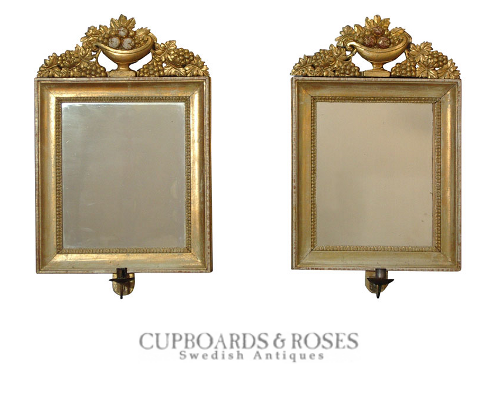 Pair of carved and gilded wood mirrors from the Karl Johan, or empire, period, Sweden circa 1830. Original brass candle holders on each. Original gilding, mirror glass, and backs. $8,500
He was born by the name Jean Bernadotte in France, and later in life became the ruler of Sweden. Here is how the history unfolded…..
Napoleon I – On The French Front
In May of 1804, the French people voted to change the consulate to an empire and to make Napoléon the Emperor of France.
In 1805, Austria, England, Russia and Sweden became united in a new Third Coalition to move against France. It was in September of 1805, when Austria attacked the French controlled Bavaria. Napoléon moved his army into Germany in September, and by October, Napoleon captured the Austrians at Ulm and occupied Vienna. It didn’t stop there, in December, Napoléon won his most brilliant victory which decimated the Austro-Russo armies at Austerlitz.
In June of the following year, Napoléon named his brother Louis as King of Holland, and within each following each victory, Napoléon enlarged the French Empire.
On the other front, Prussia and Russia joined together to mount a new campaign against France. In October, of 1806, Napoléon’s army decimated the Prussian army at Jena and at nearby Auerstadt. Napoléon was interested in preventing his enemies, especially the British, from trading with continental Europe. In November, he declared a new administrative law, which banned English ships from all ports under French control.
Napoléon was on a roll, in June of 1807, Napoléon eliminated the Russian armies at Friedland, which resulted in the signing of the Treaty of Tilsit, by Napoléon and Tsar Alexander. Under the treaty, King Frederick William III, of Prussia, became a vassal to France and lost half of his territories. Russia was forced to recognize the yet-to-be-created Grand Duchy of Warsaw which was to be carved out of Prussian Poland. Russia was also forced to make other territorial changes. Napoléon then turned to defeating Sweden, which he did with the help of Russia, in 1808.
The Start Of Things Falling Apart For Napoleon
The Peninsular War began in 1808 when Spanish and Portuguese forces rebelled against French rule. Tens of thousands of French soldiers died in the war, and the loss of Spain and Portugal greatly damaged Napoléon’s prestige.
Napoléon divorces Josephine, aged 46 years old in 1809, because she had not produced an heir. Worried about the continuity of the empire, he had the senate pronounce his divorce from Josephine in December of 1809. It was because of this that Pope Pius VII excommunicated Napoléon. Retaliating, Napoléon had the Pope arrested on July 6. On February 17, 1810, the Papal States were annexed to France. The pope was then forced to sign an additional concordat and to annul Napoléon’s marriage to Josephine. It wasn’t too long after that that Napoléon married Marie Louise, in April, 1810, the 18 year old daughter of Emperor Francis I of Austria.
On July 9, 1810, Napoléon again increased the size of the Empire by annexing Holland and much of Germany to the Empire.
Jean Bernadotte – On The Swedish Front….
Bernadotte joined the French army and after the French Revolution, he advanced quickly and was in 1804 appointed as a Marshal of France by Napoleon I, even though the pair had a tumultuous relationship. When his service to France ended in 1810, he was voted the heir to the Swedish throne.
In August of 1810 Swedish Parliament had their eye on him for the Swedish throne. In October the same year, Bernadotte arrived in Sweden, and quickly took over as the real head of state, as the reigning King Karl XIII was in poor health. The Swedish royal family was dying out with King Charles XIII, so Baron Carl Otto Mörner (a Swedish courtier), advocated for his position for leadership.
Karl Johan had good relations with France however, Swedish foreign policy led Sweden into alliance with Russia and Britain against France. Sweden was then promised to Norway, which meant going against Napoleon. In 1813 led Karl Johan Swedish troops in the sixth coalition war , which was successful against France. After the victory against French, he forced Denmark to cede Norway by the Treaty of Kiel . Norway declared its independence after having hosted a national assembly at Eidsvoll, but after a short war in late summer 1814 the Norwegians surrendered, and entered into a union with Sweden.
A few facts about Karl Johan:
- He was originally named Jean Bernadotte, but was also named Jean Baptiste after John the Baptist
- He converted the royal court from Roman Catholicism to the Lutheranism, and never learned to speak Swedish or Norwegian. French was widely spoken by the Swedish aristocracy.
- He married in 1798 with Désirée Clary , who had previously been engaged to Napoleon Bonaparte .
- Rosersberg Carl’s Country Retreat – Featured in Neoclassicism In The North On Amazon
- “Rosersberg Palace – Found on abebooks.com
- Niall Smith See MORE Pictures on New York Social Diary.com
- Small Bouillotte Lamp, Empire Style – Found on en.expertissim.com
- Johann Jacob de Lose 1763-1844 1805 www.1st-art-gallery.com
- Spegel by Josef Frank and Estrid Ericson
- First Class Staterooms Empire Rooms. Pinterest
- Late Gustavian Early Biedermeier BJORK STUDIO
- Swedish Empire Chairs- D.LARSSON
- Swedish Empire Stools dlarssoninterior.tumblr.com
- Pair of side chairs Found on cupboardsandroses.com
- Pair of Swedish armchairscupboardsandroses.com
- Pair of Swedish armchairs cupboardsandroses.com
- Pair of Carved Armchairs cupboardsandroses.com
- Pair of armchairs, Sweden circa 1860, cupboardsandroses.com
- Don Freeman Photography
- Lundgrens Antikhandel
- The Neo Lifestyle: Laura Montalban
- Laura Montalban | New York Social Diary
- House of Blass Came Unraveled – NYTimes.com
- Biedermeier pieces are found throughout this house- featured on traditionalhome.com
- An antique Biedermeier cabinet (c. 1850) topped with antique marble Found on traditionalhome.com
- A Palette of Mississippi Blues – House Beautiful
- Biedermeier Found on roys-antiques.com.au
- Biedermeier – Tim Wood Furniture Limited
- Chateau de Malmaison Found on google.fr
- Dallas Interior Design Found on courtneyprice.com
- 1920’s Empire Style Daybed – Castle Antiques
- 19th Century Swedish Empire Mirror- D.LARSSON
- Hinkley 3200AN – Lighting Import Service
- Beautiful Gustavian Stool. Originally Seen On 1stdibs
- Also Seen At www.fangkuang.co

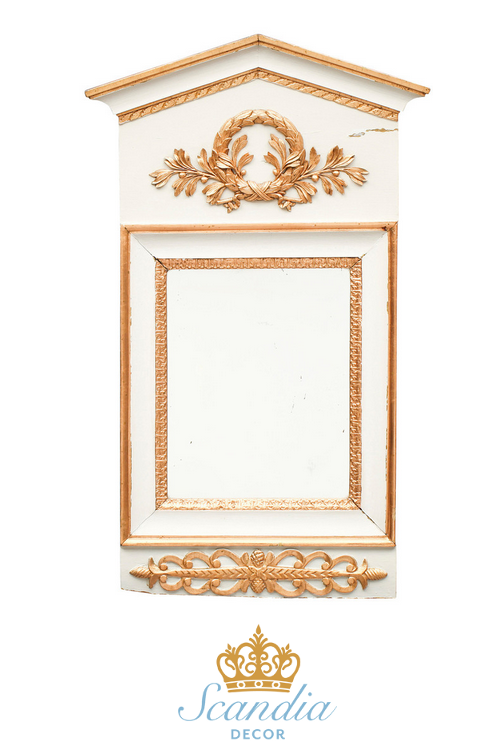 Small Gustavian Empire Swedish Mirror Scandiadecor.com
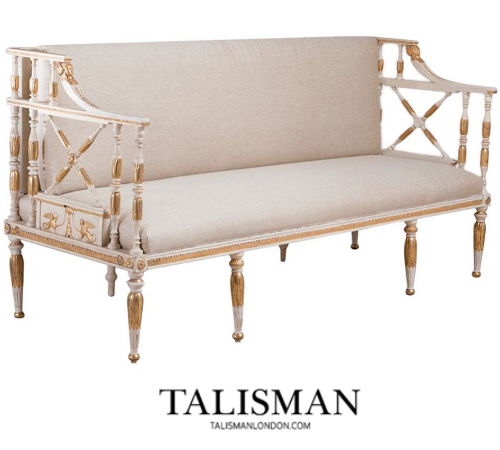 A Swedish Empire Sofa with Classical Gilt Detailing Upholstered by Talisman circa 1790
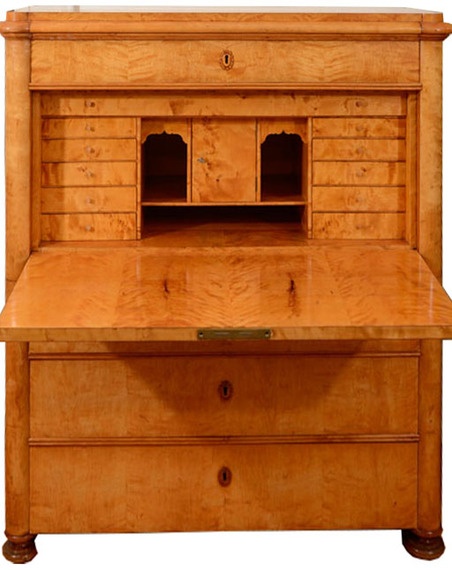
Biedermeier Secretaire Found on deringhall.com


The History Behind Empire Furniture From The Karl Johan Period -Liza Laserow
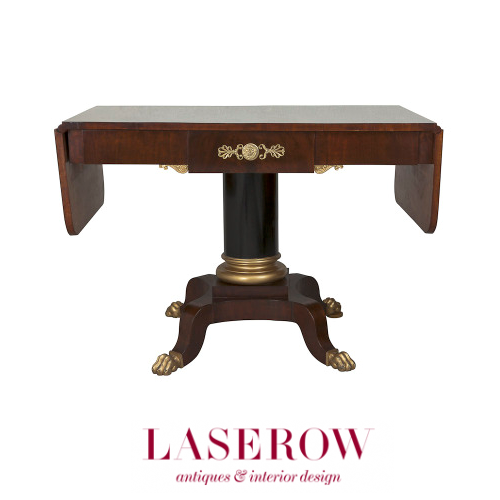 Drop leaf table made in Stockholm, Sweden. Details according to the periods highest fashion such as lion feet and lions head. The drawers keyhole is elegantly hidden behind the gilded lions head.
Authored By Liza Laserow
1810 the french officer Jean Babtiste Bernadotte came to southern Sweden accompanied by one of Napoleons marshals Monsieur Bernadotte , the man who was going to become King Karl XIV Johan. It was at this time the French Empire style came to Sweden. Napoleons architects: Charles Percier and Pierre Fontaine developed the style in France during the late 1790. They took Neoclassicism and gave it heavier look. Inspired by the roman empires strong lined art and architecture warlike attributes such as eagles, shields, helmets and spears became important symbols of the period. The glory years for this period was between 1804-1814 when Napoleon I was the emperor which also gave the period its name; Empire. During 1830 the style got softer and late Empire and in southern part of Sweden it got blonder – Biedermeier.
Mahognay with gilded details dominated the periods materials for furniture and mirrors and it was during this period the wallpaper was introduced in the form of panoramic views with classical ruins. Silk upholstery with matching window treatments in strong colors such as green, lemon yellow, red or gold was the highest fashion. Sweden also got its first silk weaving mill thanks to a Swede who smuggled a weaving chair to Sweden from France.
Read more about Swedish porphyry during the Karl Johan period.
About The Author
Liza Laserow, the daughter of the mother-daughter-owned company Laserow Antiques. Born and raised in Sweden, Liza moved to New York City, where, though she had trained to be a lawyer. Her mother, Karin, founded a showroom in Sweden 30 years ago and, in 2009, Liza helped launch a Laserow Antiques outpost in the New York Design Center in Manhattan. The exquisite gallery features furniture curated from Sweden’s most significant periods—Baroque, Rococo, Gustavian, and Empire—spanning from 1650 to 1820.
Follow Liza’s Blog, Old Is New,
Laserow Antiques Website
Laserow Antiques On 1st Dibs
Britahill
Brandstadvägen 612,
SE 275 67 Vollsjö
Sweden
Phone: +46 (0) 416 352 52
Cell: +46 708 13 52 30
1st Dibs @NYDC
200 Lexington Avenue, 10th Floor #63
New York New York 10016
USA
+1 212 988 9194
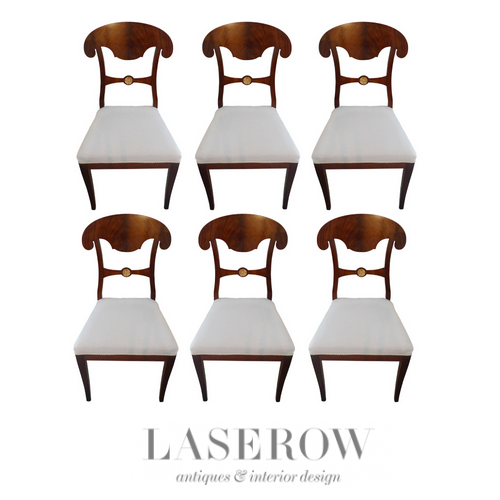
A set of 6 Empire dining chairs made in Sweden during the Karl Johan
Period. Frame in mahogany with gilded flower detail on black splat.
Newly upholstered.
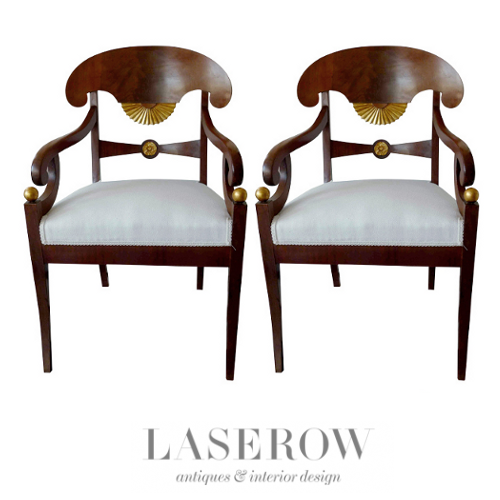
A pair of empire desk chairs in mahogany with gilded details in shapes of balls, flowers and fan
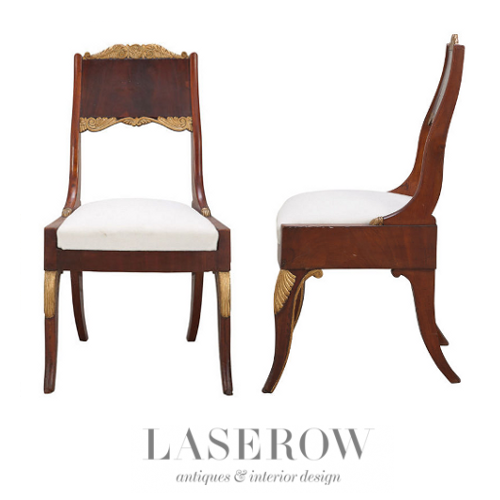
Pair of Russian Empire Mahogany Side Chairs
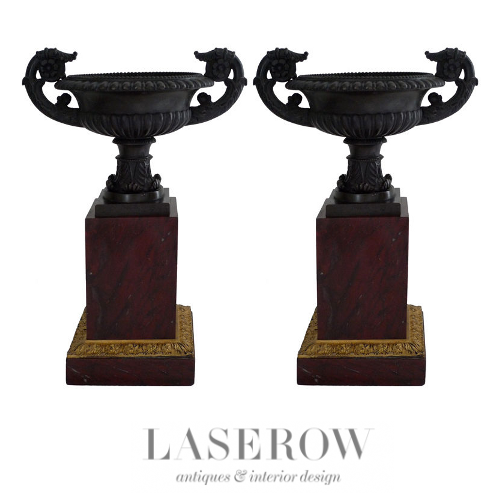
A pair of Tazzas from the late part of the Empire period. Made in Red French Marble, patinated bronze with decor of gilt bronze.
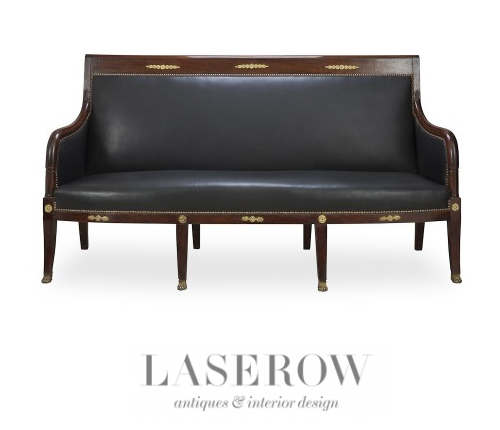
Sofa from the Empire period made in France. Frame of dark polished mahogany with gilt bronze decorations. 4 front legs ending with lion feet in gilt bronze.
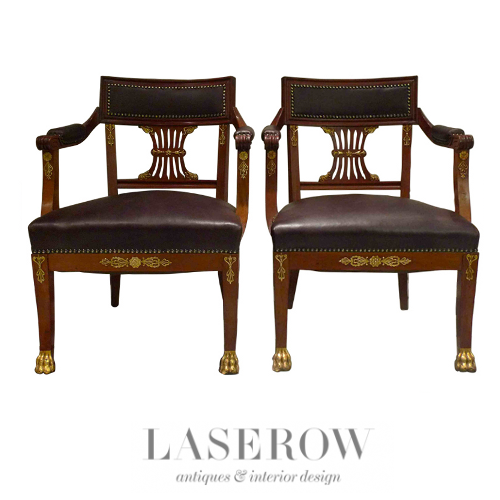
A pair of French desk chairs (can be sold separately as well) made in
Mahogany and decorated with polished bronze details. Legs ending with
lions feet. Upholstered in dark brown vintage leather.
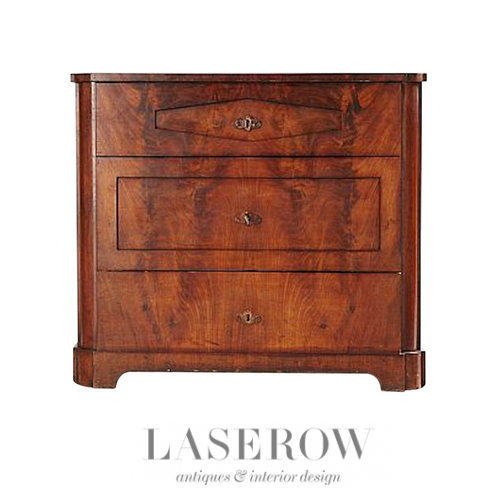
Swedish mahogany chest of drawers amde during the Karl Johan period
1820-1830. Simple carvings on drawers front and rounded corners.
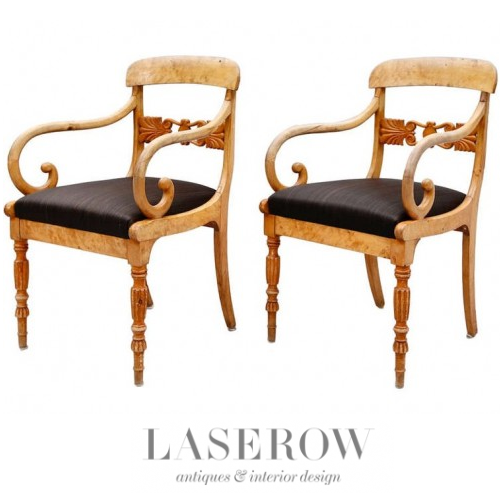
A pair of Swedish Biedermeier armchairs in light birch made during the mid 19th Century ca 1840.
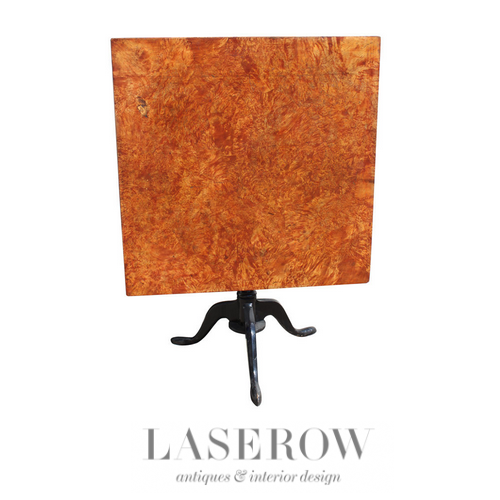
A Swedish Karl Johan Alder Root Tablein a very good quality. Top made by inlayed alder root standing on a blackened tripod base.
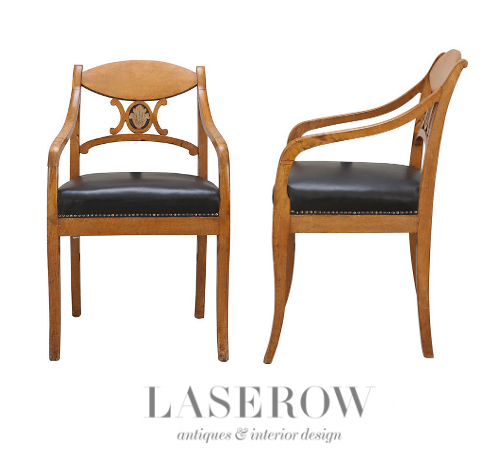
A Pair of Swedish Karl Johan Armchairs
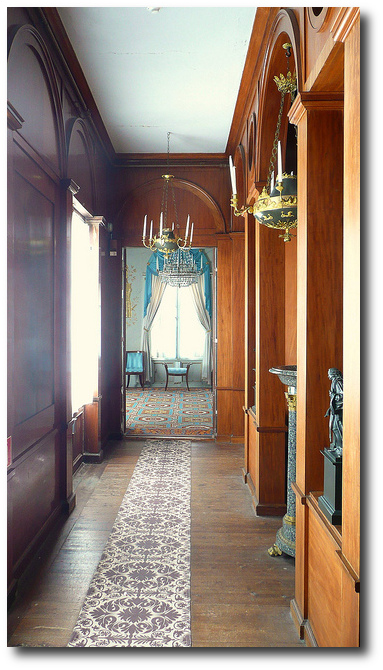
Rosendal Palace- Picture Credits- Faun070 On Flicker
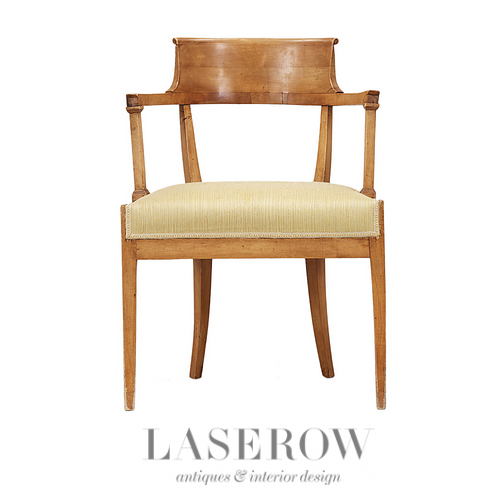
A single Empire desk chair made during the Empire period early 1800’s in Sweden.
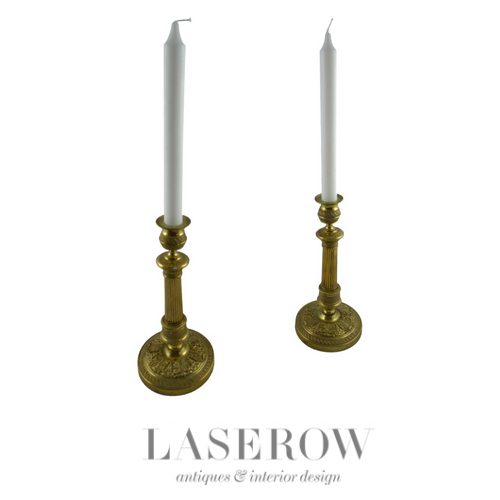
A pair of candlesticks made during the empire period 1810-1830 in
France. Urn shaped candleholders and a rounded channeled body standing
on a round foot decorated with flowers.
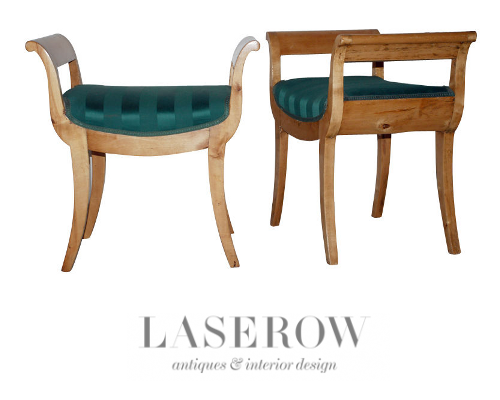
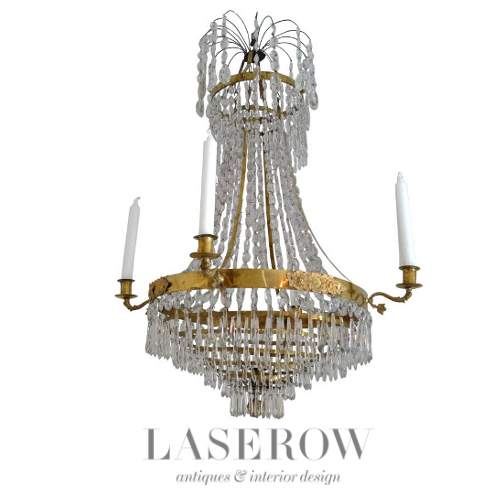
A exquisite crystal chandelier from the early part of 19th Century and
Karl Johan period. Frame made on brass with gilt bronze details. Diamond
shaped crystals. Four arms for candles and one in the middle of lower
basket Calles “welcoming candle”. All original.
An exquisite tall gilt wood mirror made during the Karl Johan period
with a demi lune shaped molding. A rectangular ending decorated with
leaves.
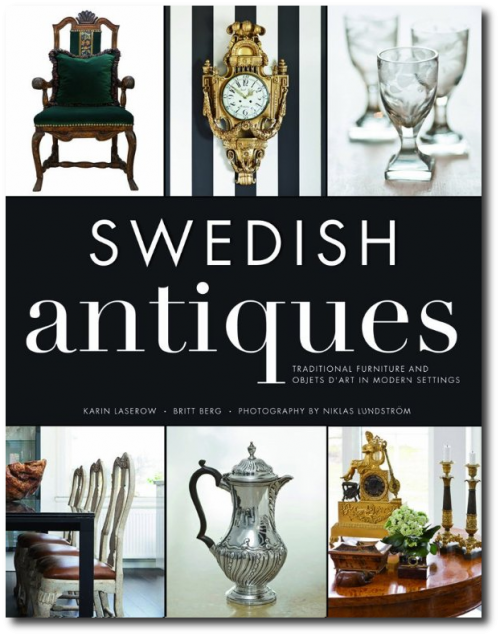
Antiques In A Modern Settings By Karin Laserow
A comprehensive guide to blending beautiful antiques into a modern home.
Incorporating antique furniture and art into a modern home may seem like a contradiction, but Karin Laserow and Britt Berg show just how easy it is and how stunning the results can be. Highlighting the rich traditions of Swedish furniture and other décor, this full-color guide begins by explaining the basics of antique furniture, from style histories to the nuanced differences of Baroque, Rococo, Empire, Gustavian, Art Nouveau, and more, with striking photographs throughout. Readers are taught how to tell the difference between old and new, how to evaluate antiques, and how to determine whether repairing, repainting, and refinishing are worthwhile decisions for protecting antique investments.